If you want to know how to read more when you have no time for books, start with the 5-minute rule. You read at least five minutes every day. That’s the floor, not the ceiling: if you want to keep going, keep going. Tie reading to something you already do every day, keep a book within reach, and track days, not pages. Five minutes a day adds up to more than 30 hours of reading a year.
- 5 minutes is a minimum you can hit even on your worst day.
- Tie reading to an anchor: coffee, your commute, waiting, bed.
- Always have a book within reach: on your phone and in one physical spot.
- Track days, not pages. The goal is not missing days, not “read 50 books.”
- Missed a day? Just read today. One miss doesn’t break a habit.
Table of contents
- My experience: the 5-minute rule
- Why 5 minutes, not an hour
- How to read more books every day: 6 steps
- Reading tracker
- Paper, e-reader, or audio
- Can you learn to read faster?
- Where it breaks
- The minimum version
- If you fell off
- Benefits of reading every day: what we actually know
- FAQ
- Your action for today
- Sources
My experience: the 5-minute rule
As a kid, I read in my free time. Now I have a separate rule about reading. On my list of personal rules, it goes like this:
I read more than 5 minutes a day, no matter what.
The word “more” matters here. Five minutes isn’t the goal. It’s the floor. There’s a second rule too, an indirect one: fill waiting time with calm, useful things — reading, meditation, planning. A line, a meeting running late, a commute — those are minutes for a book too.
I read on my phone. And most often exactly when I’m waiting for something.
Why 5 minutes, not an hour
An hour of reading a day is a great goal for someone who has an hour. Most people don’t. The “I’ll read an hour a day” plan lasts until the first busy week, and then the book sits on the nightstand for weeks.
Five minutes works for three reasons.
You can’t fail to find them. Even the busiest day has five minutes: while the kettle boils, while you ride the elevator, while you wait for someone to pick up.
Repetition builds a habit, not volume. In Phillippa Lally’s study, people repeated a new behavior every day in the same context. It took about 66 days (the median) to become automatic, with a range of 18 to 2541. Five minutes every day gives you seven times as many repetitions as one long evening with a book each week.
A tiny action is easier to start. That’s the idea behind BJ Fogg’s Tiny Habits method: you make a new behavior so small it doesn’t need motivation, and tie it to something already in your day2. Five minutes of reading is exactly that kind of behavior.
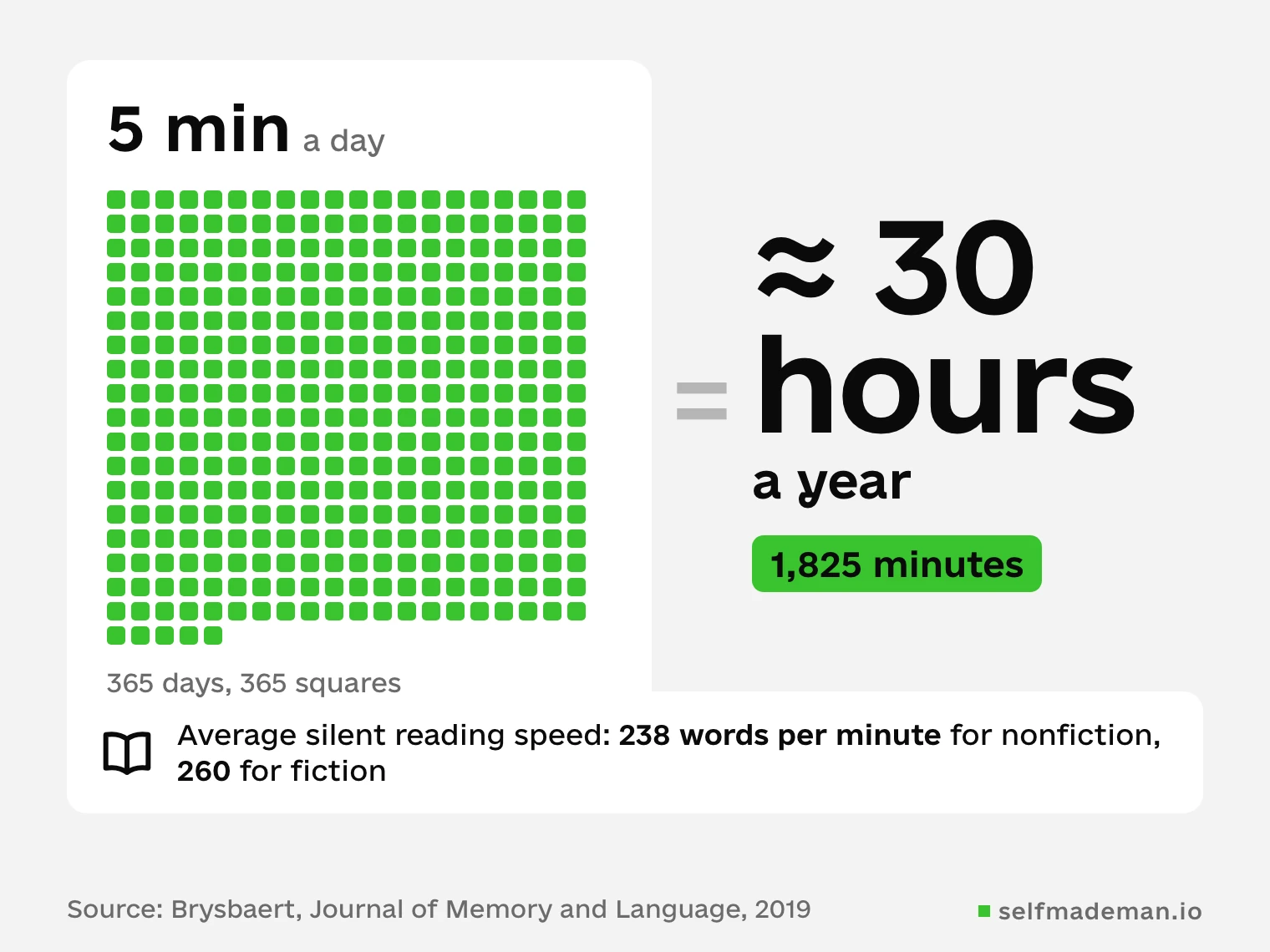
And a bit of math. Five minutes a day is 1,825 minutes, or about 30 hours a year. The average adult reads silently at about 238 words per minute for nonfiction and 260 for fiction3. So in five minutes you read over a thousand words, and in a year, hundreds of thousands. That’s several full books. Out of what you used to call “no time.”
Not an hour when you can — five minutes every day.
How to read more books every day: 6 steps
- Pick an anchor. Something you do every day, no exceptions: morning coffee, your commute, lunch, bed. The formula: “After [anchor], I read for 5 minutes.”
- Keep a book within reach. One book in an app on your phone, so you can read during any wait. A second one sits where your anchor happens: by the coffee maker, in your backpack, on your pillow.
- Set a timer for 5 minutes. When it goes off, you can close the book with a clear conscience. Want to keep going? Keep reading. The timer is there to make starting easy.
- Track days, not pages. In the evening, a check mark: did you read or not. Five minutes and two hours count the same. That way the rule doesn’t turn into a competition.
- Read what you actually want to read. That’s how to enjoy reading again. Book not working? Drop it, no guilt. The rule is about reading, not about a specific book. A boring “useful” book kills the habit faster than a lack of time.
- Once a week, write down one idea. One line: what from your reading you want to put to use. Otherwise reading becomes a collection of ideas instead of change.
Reading tracker
One page or one minute. On the worst day the rule is kept if the book is open and you have read at least a paragraph.
When the signal sounds, the day is marked by itself. The timer keeps going in a background tab and after a page reload.
Tap a day to mark it or remove the mark. A missed day is just an empty square: no streaks to lose.
Read what you want to read. A book isn’t working? Drop it without guilt: a boring “useful” book kills the habit faster than a lack of time.
The printed log is for the month shown in the calendar, with your marks and your rule. Everything stays in this browser.
Paper, e-reader, or audio
Format comes second: the best one is whatever’s within reach at your anchor moment. But we do know a few things about the differences.
A meta-analysis of 54 studies comparing reading on paper and on screens found a small advantage for paper in comprehension. It shows up with informational texts and when reading under time pressure. With fiction, no difference was found4. The practical takeaway: nonfiction you want to remember is better on paper or an e-reader. A novel is fine on your phone.
Audiobooks are great for commutes and the gym. Whether they count toward the 5-minute rule is up to you. Just don’t let the rule turn into “put it on in the background and think about something else.”
Can you learn to read faster?
Short answer: speed reading barely works. A major review of reading research concluded that doubling or tripling your reading speed without losing comprehension is unlikely. Eye movements take up only a small part of reading time; the real limit is how fast your brain recognizes words and links them into meaning5. The best way to read faster is to read more: your vocabulary and background knowledge grow.
That’s why this rule isn’t about speed. Five minutes of slow reading with understanding beats fifteen minutes of skimming.
Where it breaks
- The bar creeps up. Things are going well, and you decide: “From now on, 30 minutes minimum.” The first rough day — and you miss. Keep the minimum at 5 minutes and let 30 be a bonus.
- Reading for the count. A “50 books a year” goal nudges you to pick thin books and finish boring ones. Count days, not books. Same goes for reading challenges.
- Your phone. You’re reading on your phone, a notification pops up, and five minutes later you’re in your feed. Turn on Do Not Disturb while you read, or use an e-reader.
- Falling asleep over the book. If your anchor is bed and you’re out by page two, move reading to another time. Or treat it as a bonus to your evening routine, but hit the rule during the day.
- Reading instead of doing. The tenth book on habits won’t replace one habit you actually start. If you read nonfiction, step 6 is a must.
The minimum version
One page. Or one minute. On your worst day, the rule counts if the book is open and you read at least a paragraph. The chain of days matters more than volume.
If you fell off
Missed a day? Today, just read your five minutes. No need to make up the debt with ten. In Lally’s study, missing one day didn’t throw off habit formation1. What breaks the habit isn’t the miss. It’s the thought “well, I blew it, I’ll start again Monday.”
A break of a week or a month? Check two things. Is the book too boring? Did your anchor disappear (vacation, a new job, a different schedule)? Change the book or the anchor, but keep the bar where it was: 5 minutes.
Benefits of reading every day: what we actually know
There’s a lot of hype about the benefits of reading. There’s also serious data, but you have to read it carefully. In a US study of 3,635 people over 50, those who read books were 20% less likely to die over 12 years of follow-up than those who didn’t, after adjusting for education, wealth, and health6. That’s a correlation, not proof that books make you live longer: maybe people who read just live differently. So the main argument for the five-minute rule is simpler. You like reading, and you don’t have time. Now you do.
If you want to start with a book on how habits are built, here’s a breakdown of James Clear’s “Atomic Habits”.
FAQ
How do I train myself to read more?
Make the daily minimum tiny — 5 minutes — and tie it to something you already do every day, like morning coffee or your commute. Track days, not pages. Volume grows on its own once the habit sticks.
How much should I read a day?
As much as you’ll actually do every day, including bad days. For a start, 5 minutes.
How do I get into reading after years away from books?
Pick a book you want to read, not one you “should” read. Set a timer for 5 minutes and tie reading to your morning coffee or commute. For the first two weeks, just don’t skip.
How many books can I read at 5 minutes a day?
About 30 hours of reading a year. At an average speed of 238–260 words per minute, that’s several books. And in practice, five minutes often stretches.
How can I learn to read faster?
Speed reading without losing comprehension barely works. Your speed grows naturally as you read more and know the subject better.
Do audiobooks count?
Your call. If you’re really listening and not just playing it in the background, it’s a real way to take in a book. Nonfiction you want to remember is better read with your eyes.
Is it better to read in the morning or at night?
Whenever you have a reliable anchor. If you fall asleep on page two at night, read in the morning or on your commute.
Your action for today
Pick a book you’ve been meaning to read and put it where tomorrow’s anchor is: by the coffee maker, in your backpack, or on your pillow. Today, read for five minutes with a timer. Check off the day. That’s it.
Sources
- Lally P., van Jaarsveld C. H. M., Potts H. W. W., Wardle J. How are habits formed: Modelling habit formation in the real world. European Journal of Social Psychology, 2010, 40(6), 998–1009. ↩
- Fogg B. J. Tiny Habits: The Small Changes That Change Everything. Houghton Mifflin Harcourt, 2020 (ISBN 9780358003328). ↩
- Brysbaert M. How many words do we read per minute? A review and meta-analysis of reading rate. Journal of Memory and Language, 2019, 109, 104047. ↩
- Delgado P., Vargas C., Ackerman R., Salmerón L. Don’t throw away your printed books: A meta-analysis on the effects of reading media on reading comprehension. Educational Research Review, 2018, 25, 23–38. ↩
- Rayner K., Schotter E. R., Masson M. E. J., Potter M. C., Treiman R. So much to read, so little time: How do we read, and can speed reading help? Psychological Science in the Public Interest, 2016, 17(1), 4–34. ↩
- Bavishi A., Slade M. D., Levy B. R. A chapter a day: Association of book reading with longevity. Social Science & Medicine, 2016, 164, 44–48. ↩