How to read faster without losing comprehension? Not the way speed reading courses sell it. Research doesn’t back the idea that you can read 3–5 times faster and understand just as much1. Speed and comprehension sit on opposite sides of a scale. Speed up, and something drops. What does work: pick a reading mode that fits the task, preview the text before you read it, cut distractions, and simply read a lot. Vocabulary and knowledge of the topic speed you up more than any eye exercise. And don’t measure just words per minute — measure words per minute times comprehension.
- The average adult reads silently at about 238 words per minute for nonfiction and 260 for fiction2.
- The bottleneck isn’t your eyes. It’s how fast your brain recognizes words and builds meaning.
- “Stop subvocalizing,” “never go back,” “read diagonally” — these tricks hurt comprehension.
- What works: choose a mode (study, read, skim), preview, put the phone away, read a lot.
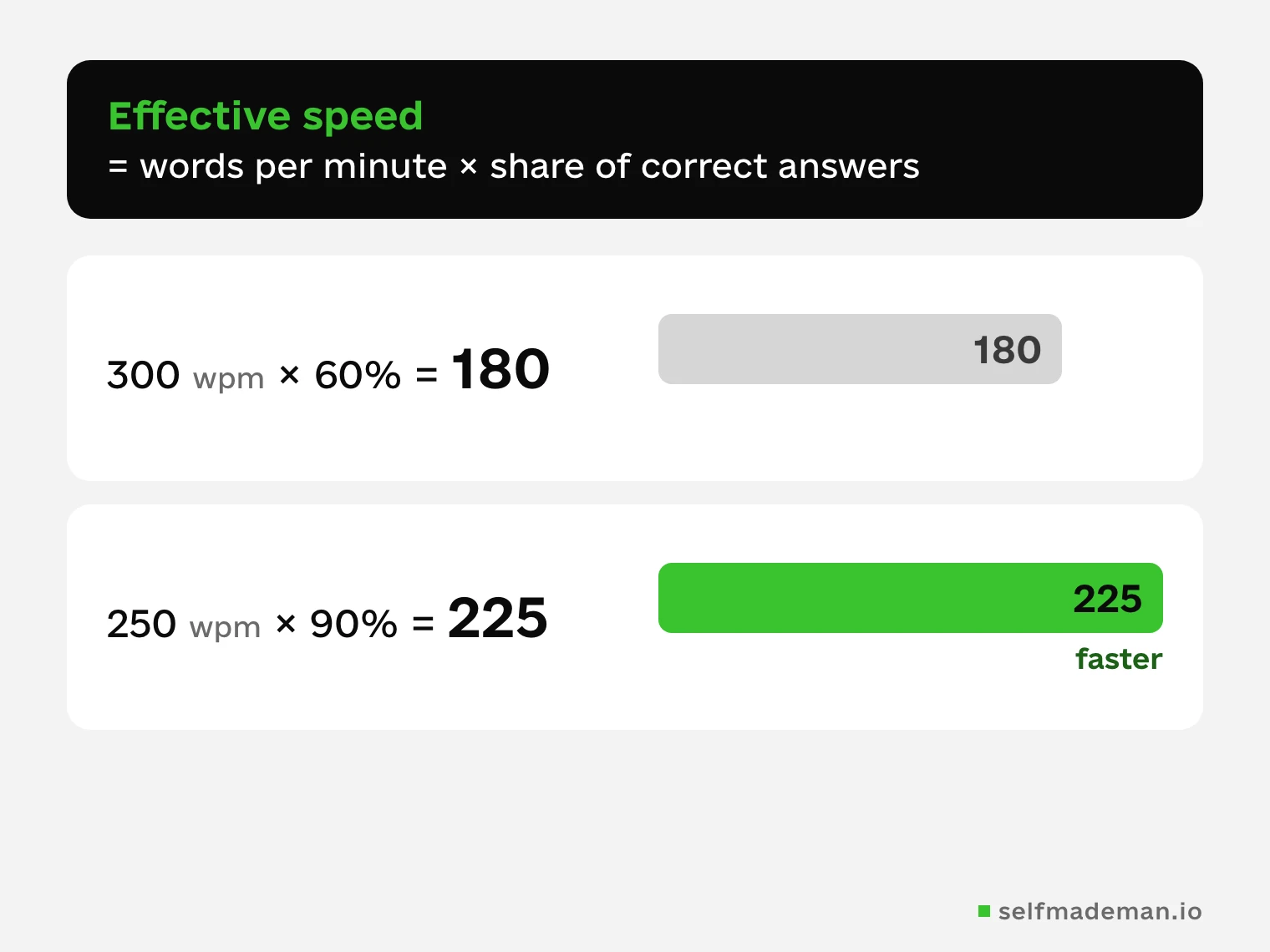
- Track your effective speed: words per minute × share of correct answers.
Table of contents
- My experience
- Does speed reading work? What the research says
- Average reading speed in words per minute
- Four speed reading myths
- How to read faster and understand more: 6 steps that work
- Measure your speed and comprehension
- Reading modes: a cheat sheet
- Where it breaks
- The minimum version
- If you fall off
- FAQ
- Do this today
- Sources
My experience
I’ve never tried speed reading. My reading rule is about consistency, not speed: I read for more than five minutes every day, no exceptions. Five minutes of slow reading with understanding gives you more than half an hour of flipping pages. More on that rule in the article on how to read every day.
But at work, the speed question is a fair one. SEO comes with a lot of documentation, industry articles and reports, and you can’t read all of it carefully. Some of it you need to study, some you just need to get, and some you skim and close the tab.
Does speed reading work? What the research says
The speed reading craze started in 1959, when Evelyn Wood opened her Reading Dynamics courses in Washington, D.C. In 2016, five reading researchers led by Keith Rayner published a major review: how we read, and whether speed reading can help1. The conclusions are inconvenient for the course industry.
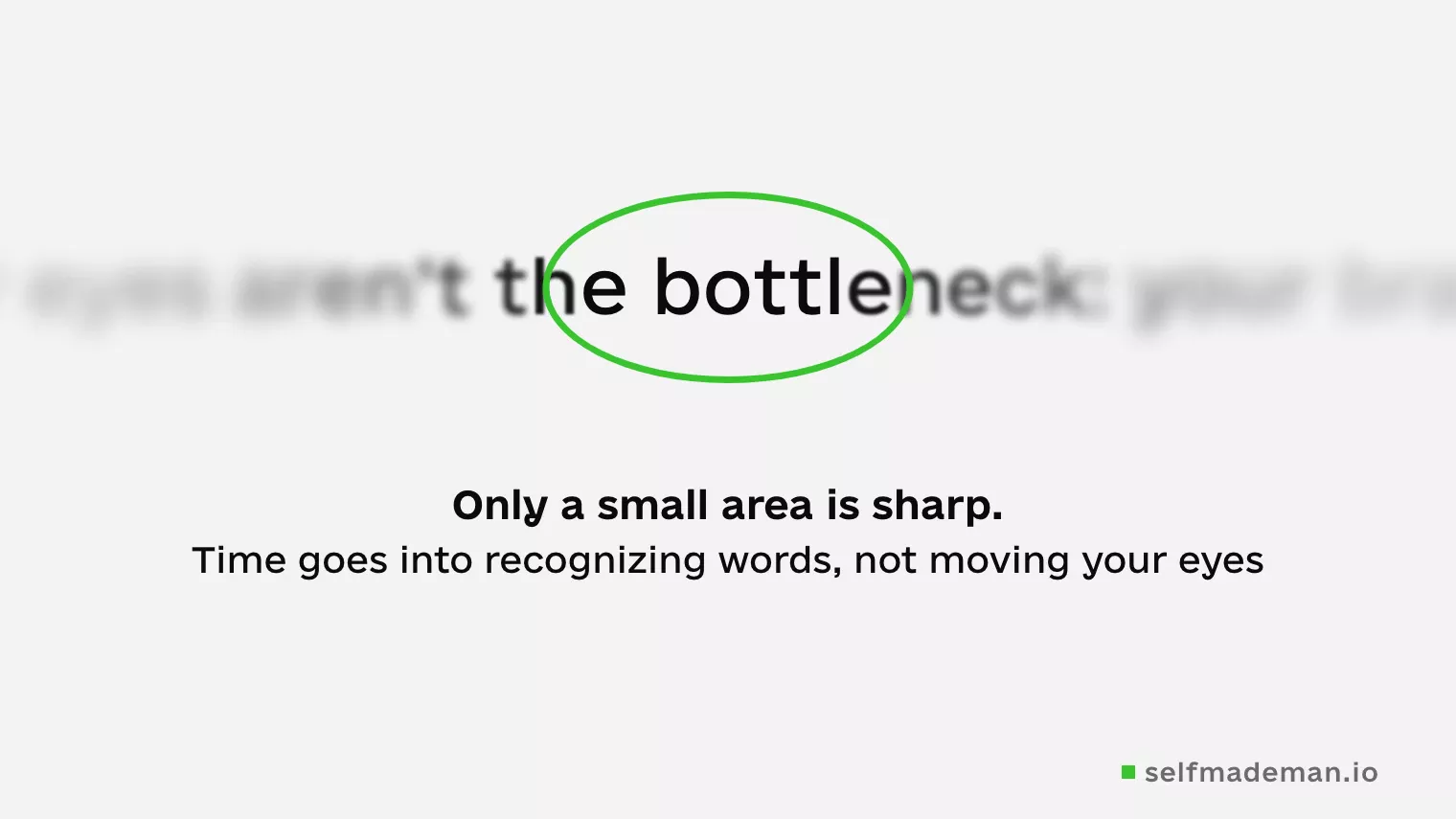
Your eyes aren’t the bottleneck. Courses teach you to “widen your visual span” and take in a whole line at once. But we only see sharply in a small area around the point we’re looking at. Everything else is blurry. And most of the time goes not into moving your eyes but into recognizing a word and fitting it into the meaning. Eye training speeds up the part that wasn’t slowing you down.
Speed and accuracy trade off. According to the review, doubling or tripling your speed (from roughly 250 to 500–750 words per minute) while understanding as much as in normal reading is unlikely1. When someone “reads” several times faster after a course, they’re not reading faster. They’re skimming. You can catch the gist, but you lose the details. That’s a perfectly fine mode for some texts — but it’s not a miracle, and it’s not a new skill.
The best way to read faster is to be a good reader. The more words you know and the better you know the topic, the faster you recognize words and the less you get stuck. That grows with practice, not with drills.
Average reading speed in words per minute
For reference: the average adult reading silently manages about 238 words per minute for nonfiction and 260 for fiction. That comes from a meta-analysis of 190 studies with more than 18,000 participants2. Typical ranges are 175–300 wpm for nonfiction and 200–320 for fiction. These numbers are for English; other languages need a different number of words to say the same thing. So compare yourself with yourself, not with someone else’s chart.
Four speed reading myths
“Stop saying the words in your head”
Inner speech while reading isn’t a bad habit left over from first grade. It helps you hold words in memory while your brain assembles them into a sentence. According to Rayner’s review, trying to suppress it hurts comprehension, especially with difficult texts1. You can’t remove it completely, and you don’t need to.
“Never let your eyes go back”
Going back to what you’ve already read isn’t a defect. It’s comprehension repair. In an experiment by Elizabeth Schotter and colleagues, participants weren’t allowed to look back: words were masked as soon as their eyes moved on. Comprehension dropped — and not only on confusing sentences, but on simple ones too3. Rereading a paragraph because your mind wandered is a different thing. The fix there isn’t a ban. It’s attention.
“An app will flash words at you and you’ll finish a book in an hour”
Apps that show words one at a time in the center of the screen (the RSVP method) promise to cut out “extra” eye movements. Rayner’s review points the other way: you can’t go back and you can’t see the next word in advance, so comprehension suffers1. Fine for short messages. Not for a book.
“Read diagonally, in a zigzag”
That’s just skimming, renamed as a “technique.” Skimming is useful when you know what you’re looking for or you’re deciding whether a text deserves your attention. In a study by Geoffrey Duggan and Stephen Payne, people had only enough time to read half a text. Those who skimmed the whole thing remembered the main ideas better than those who read the first half straight through. But they didn’t remember details or the text’s conclusions any better4. Skimming gets you the gist and loses the rest. Passing it off as full reading is fooling yourself.
Speed reading doesn’t make you read faster — it swaps reading for skimming.
How to read faster and understand more: 6 steps that work
- Before you start, ask: why am I reading this? To study and apply it, to get the general idea, or to find something specific. Your speed depends on the answer. Slowly reading a newsletter is as odd as skimming a contract.
- Pick a mode. Study: slow, with notes and pauses. Read: your normal pace. Skim: headings, first sentences of paragraphs, conclusions, numbers. Switch modes on purpose, not because you’re tired.
- Preview in 1–2 minutes. Table of contents, headings, intro, conclusion, tables. You know the frame in advance and spend less effort figuring out where the text is going. A good book breakdown before reading, like the summary of Atomic Habits, works the same way: the frame is already in your head.
- Cut distractions. Phone in another room, notifications off, one tab. The most expensive seconds in reading aren’t slow words — they’re rereading the paragraph you missed while your eyes were in a messaging app.
- Read more, and more widely. Vocabulary and knowledge of the topic are the main accelerator1. Your first book on a new subject reads slowly. The fifth goes noticeably faster, because half the concepts are already familiar.
- Measure speed together with comprehension. Once a month: a 5-minute text, a timer, then 5 questions about the content. Calculate your effective speed: words per minute × share of correct answers. Classic reading-speed research used this same measure5. 300 wpm at 60% comprehension is 180. 250 wpm at 90% is 225. The second one is faster.
Measure your speed and comprehension
For a retest, take a text you haven’t read yet: a familiar one reads faster.
- Read at your usual pace. Don’t speed up for the number: the test compares you with yourself.
- Questions after the text: 5. Answer from memory, the text will be hidden.
- If you leave the tab, the timer pauses.
One measurement is not a verdict: fatigue and the type of text change the result. Compare several, taken when you’re fresh.
A self-check, not a diagnosis. The result depends on the text, the language and how tired you are, so compare only with yourself. Results stay in this browser.
Read at your normal pace: the reading speed test compares you with you, not with someone else’s chart. The number that matters is effective speed. Repeat it in a month with a different text and see whether it grows.
Reading modes: a cheat sheet
| Mode | When | How to read | What you lose |
|---|---|---|---|
| Study | Nonfiction you want to apply; documentation for an important task | Slowly, with notes, pauses and retelling | Time — and that’s fine |
| Read | Books for yourself, articles in your field | At your normal pace, no notes | Almost nothing |
| Skim | News, newsletters, deciding whether to read at all, finding a fact | Headings, first sentences of paragraphs, conclusions, numbers | Details and the argument |
If skimming shows the text is worth it, switch to reading. Skimming is a filter, not a replacement.
Where it breaks
- Difficult text. An unfamiliar topic, dense argument, a foreign language. Everyone slows down here, and speeding up is pointless. Get the concepts first; the speed will come back.
- Chasing a number. A goal of “500 words per minute” quickly turns into skimming with a sense of achievement. Track effective speed, not raw speed.
- Fatigue. In the evening, after a workday, both speed and comprehension drop. Don’t draw conclusions about yourself from one measurement.
- One text as the benchmark. Your speed on a thriller and on a textbook can differ several times over. Compare measurements on the same type of text.
- A course as a magic pill. If a speed reading course promises thousands of words per minute with full comprehension, it’s selling a feeling, not a skill. Spend the money on books.
The minimum version
Before any text, take five seconds for one question: “Am I studying, reading or skimming?” That question alone saves more time than any technique. You stop slowly reading what you could skim, and stop skimming what you need to understand.
If you fall off
Skimming and realizing you remember nothing? That’s not failure, it’s a signal: the text needed a different mode. Go back to the start of the section, slow down and read it again. That’s faster than finishing and then hunting for where you lost the thread.
If reading has dropped out of your life altogether, speed isn’t the point right now. Go back to consistency: five minutes a day matters more than any pace drill.
FAQ
Can you learn to read 1,000 words per minute?
Not with full comprehension — research doesn’t support that. At that speed you’re skimming: you catch the general idea but lose the details.
What is the average reading speed in words per minute?
About 238 words per minute for nonfiction and 260 for fiction, reading silently. The typical range for nonfiction is 175 to 300 words. These are meta-analysis figures for English. Reading aloud, it’s about 183 words per minute.
How do I test my reading speed?
Time yourself for 5 minutes on a text you haven’t seen before, count the words you read and divide by 5. Then answer questions about the text or retell the main points. Speed without comprehension is only half the number.
Can I finish a 300-page book in a day?
Do the math for your book. If it has around 75,000 words, at an average 238 words per minute that’s a bit over 5 hours of pure reading. Possible on a free day — but for nonfiction you want to apply, that’s a marathon, not a study session.
Do speed reading apps work?
Apps that show one word at a time speed up the flow of words but stop you from going back, and comprehension gets worse. Tolerable for short texts. Not for books or difficult material.
Is a speed reading course worth it?
If the course teaches you to choose a reading mode, skim and preview — that’s useful. If it promises a multiple jump in speed with no loss of comprehension — no.
Do fast readers have a higher IQ?
People who read faster tend to have bigger vocabularies and more reading experience. That’s a skill that grows with practice, not an innate measure of intelligence.
Do this today
Take the test above at your normal pace and write down your effective speed. That’s your baseline. In a month, repeat it on a different text and compare — with yourself, not with speed reading courses.
Sources
- Rayner K., Schotter E. R., Masson M. E. J., Potter M. C., Treiman R. So much to read, so little time: How do we read, and can speed reading help? Psychological Science in the Public Interest, 2016, 17(1), 4–34. ↩
- Brysbaert M. How many words do we read per minute? A review and meta-analysis of reading rate. Journal of Memory and Language, 2019, 109, 104047. ↩
- Schotter E. R., Tran R., Rayner K. Don’t believe what you read (only once): Comprehension is supported by regressions during reading. Psychological Science, 2014, 25(6), 1218–1226. ↩
- Duggan G. B., Payne S. J. Text skimming: The process and effectiveness of foraging through text under time pressure. Journal of Experimental Psychology: Applied, 2009, 15(3), 228–242. ↩
- Jackson M. D., McClelland J. L. Processing determinants of reading speed. Journal of Experimental Psychology: General, 1979, 108(2), 151–181. ↩