
The circle of control is a simple diagram of three nested circles: what you control, what you can influence, and what you can only accept. You take one specific problem and sort everything about it into these three zones. Your energy goes into the first two. The third stops eating your head once it has its own decision: “I leave this alone until X changes.” Behind the diagram is a real psychological idea, locus of control, introduced by psychologist Julian Rotter in 19661. Below: where the circles came from, how to use them in six steps, and where the method breaks.
- Circle of control: your actions, words, decisions, routine. Circle of influence: what changes through other people. Circle of concern: everything else.
- Behind it is locus of control. Internal: “the result depends a lot on me.” External: “it depends on circumstances and other people.”
- Neither extreme is ideal: extreme internal turns into self-blame, extreme external into helplessness.
- Accepting isn’t giving up. It’s deciding not to spend energy where it changes nothing.
- Sort one specific problem on paper, not “life in general.”
Table of contents
- What is the circle of control?
- What is locus of control?
- My experience
- How to use the circle of control: 6 steps
- Circle of control worksheet
- Example: a contractor misses the deadline again
- Internal locus doesn’t mean “everything is on me”
- Where it breaks
- Minimum version
- If you slip
- FAQ
- Your action for today
- Sources
What is the circle of control?
The most practical way to draw the line between “mine” and “not mine” is three circles. Stephen Covey made them popular in “The 7 Habits of Highly Effective People” (1989): a large circle of concern with a circle of influence inside it. According to Covey, proactive people spend their time and energy in the circle of influence, and it grows over time. Reactive people get stuck in the circle of concern, and their circle of influence shrinks2. Later, a third and smallest circle was added to the diagram: control.
The thought isn’t new. Almost two thousand years ago the Stoic Epictetus opened his “Enchiridion” with it: some things are up to us, others are not3. Opinions, desires, actions are up to us. Body, property, reputation, office are not fully. That’s the dichotomy of control, and the circles are its modern version.
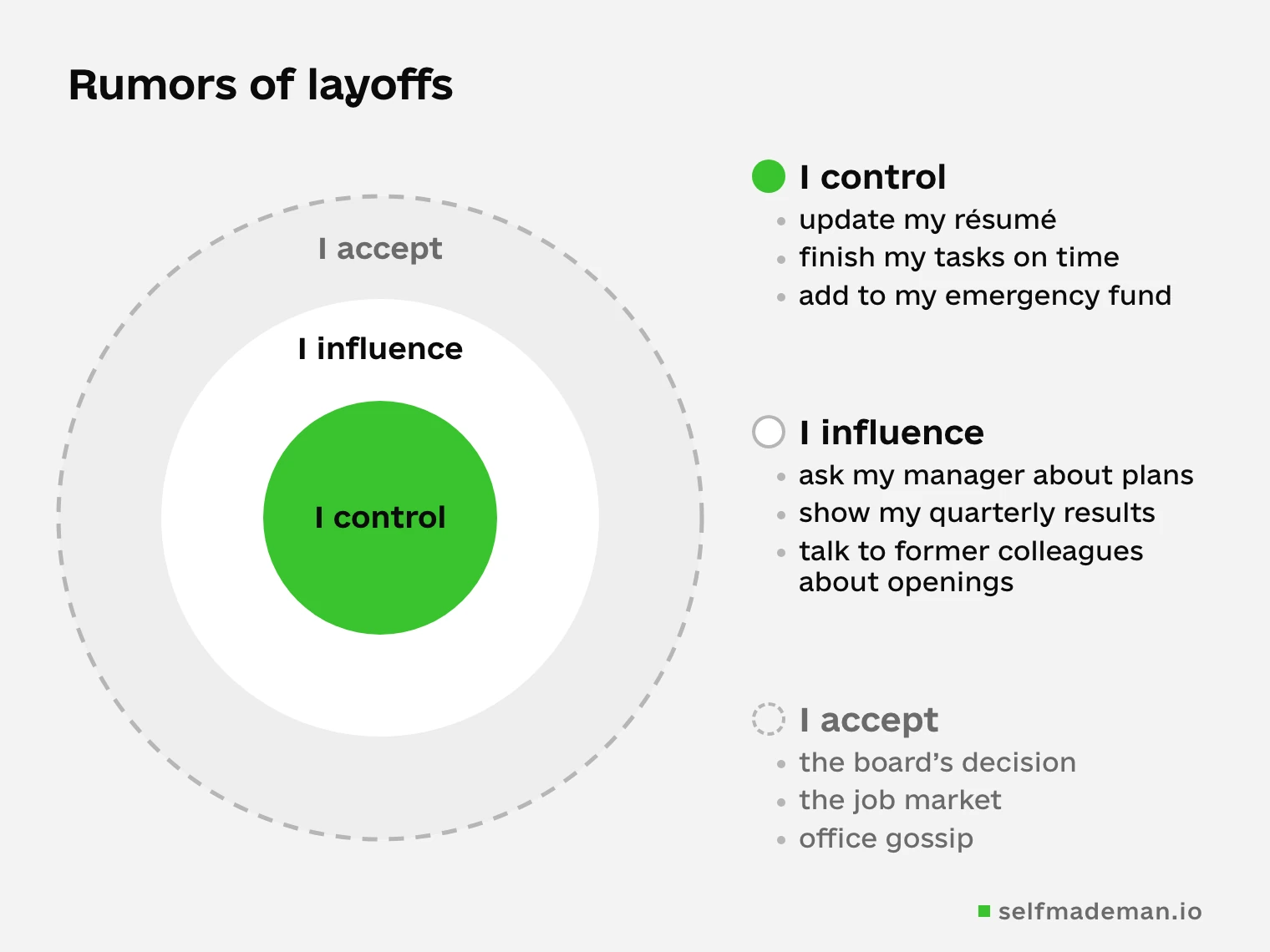
Circle of control, influence, and concern
- Circle of control. What you do on your own and can do today: your words, actions, decisions, routine, how you spend your evening. Nobody’s permission needed.
- Circle of influence. What changes through other people or a system: asking, negotiating, proposing, voting, applying. The result isn’t guaranteed, but you have a move.
- Circle of concern. Everything that worries you but doesn’t change because of what you do: other people’s decisions, the weather, exchange rates, the past, what others think of you.
The same diagram is widely used with kids as a “circle of control for kids” worksheet. The logic is identical, just with simpler examples.
What is locus of control?
Rotter described locus of control as a generalized expectancy. Through experience, a person learns to believe that rewards and setbacks (success, praise, money, failures) come either because of their own behavior or regardless of it1. To measure it, he built a questionnaire of paired statements: in each pair, you pick the one you agree with more. For example, “my grades depend on how I prepare” versus “grades are largely a matter of luck.”
Three things matter here.
- It’s a scale, not two camps. Almost everyone is somewhere in the middle, and it differs by area of life. You can feel fully in control at work and not at all over your health.
- It’s an expectation, not an inborn trait. Rotter built his theory on social learning: expectations come from experience. So you can revise them, also through experience.
- There’s a link to outcomes, but it’s a correlation. In a 2006 meta-analysis, Thomas Ng and colleagues pooled research on locus of control at work. On average, an internal locus went along with better well-being, motivation, and job satisfaction4. But that kind of data doesn’t show that one causes the other: success also makes your locus more internal.
Internal vs. external locus of control
| Internal locus | External locus | |
|---|---|---|
| How they explain a failure | “My prep was weak. Next time I’ll do it differently” | “Bad luck, an impossible client, the market crashed” |
| What they do next | Look for what they can change in their own actions | Wait for circumstances to change |
| Strength | Acts and learns from mistakes | Doesn’t blame themselves for what truly wasn’t up to them |
| Where it breaks | Takes on other people’s responsibility, beats themselves up | Stops trying: “nothing will change anyway” |
The goal isn’t to become “100% internal.” The goal is to see the line clearly: where things really depend on you and where they don’t. That’s exactly what the circle of control is for.
My experience
One of my personal rules goes like this: “Don’t hand my emotional state over to other people.” For me, that’s locus of control in one sentence. What a client said, how a contractor replied, what’s in the news: that’s the circle of concern. How I respond, what I do tomorrow morning, and what state I’m in when I sit down to work: that’s the circle of control.
Two more rules sit next to it. “Create certainty where it can be created” is about the circle of influence: when something hangs in the air, I don’t wait. I ask a question, set a deadline, put the agreement in writing. And “I solve problems step by step, not by emotion”: if a problem drags me down, I break it into actions instead of replaying it in my head.
I don’t run the circumstances — I run my next step.
How to use the circle of control: 6 steps
- Name one problem. Not “everything’s bad,” but “there’s talk of layoffs at work” or “the contractor missed the deadline a second time.” One line.
- List everything connected to it. Worries, facts, people, what-ifs. About five minutes, no filter.
- Sort each item into a circle. Ask: “Can I do this today without anyone else?” That’s control. “Can I ask, propose, negotiate?” That’s influence. “None of the above?” That’s concern.
- Check the circle of concern for hidden influence. Something you can at least partly influence often hides there. “Management’s decision” is concern. “Ask my manager what’s known about the plans” is already influence.
- One action each for control and influence. Specific, with a day: “update my résumé by Friday,” “ask my manager about the quarter’s plans on Monday.”
- A letting-go rule for the circle of concern. Not “stop thinking about it,” but a condition: “I come back to this if a new fact appears” or “I check the news once a day, in the evening.” A thought that has a place and a time intrudes less on the rest of your day.
Circle of control worksheet
-
1Problem. One, in one line. Not “everything is bad” and not “my life”, but something specific.
-
2Everything around it. Worries, facts, people, “what ifs”. One per line, about five minutes, no filter.
Ctrl + Enter adds the list. Sorting comes in the next step.
-
3Three circles. Put each item into its circle: with the buttons, by dragging it to a column or straight onto the diagram.Not sorted yetI controlCan I do it on my own, today, without anyone else?I influenceCan I ask, suggest or agree on it?I acceptNeither: it worries me, but doesn’t change from what I do.
-
4Check “I accept”. It’s easy to dump there what is unpleasant to do. “The management’s decision” is a worry. “Ask my manager what they know about the plans” is already influence.
-
5Actions and rules. For “I control” and “I influence”, an action with a day: “update my CV by Friday”. One to three in total is enough. For “I accept”, a letting-go rule: not “stop thinking”, but a condition.
If the worry lasts for weeks and gets in the way of sleep and work, the circles won’t replace a specialist. That’s a reason to see a psychologist or a doctor.
Did the worry come back an hour later? Open your analysis and check: is there a new fact? No: the item stays in “I accept”, and you go back to your action. Yes: move it to influence and add a step.
Everything stays in this browser.
Example: a contractor misses the deadline again
| Item | Circle | What I do |
|---|---|---|
| How I respond to the miss | Control | I reply tomorrow morning, not right now while I’m angry |
| Whether I have a backup | Control | By Friday I find two alternative contractors |
| A new deadline and a penalty for missing it | Influence | I propose putting it in writing |
| How the contractor organizes their work | Concern | I don’t tell them how to run their business; I look at results |
| Why they act this way | Concern | I don’t guess at motives |
| What the client will think | Influence | I warn the client myself about the delay and the plan B |
The last row shows a common mistake. “What the client will think” looks like pure concern at first: you can’t get inside someone else’s head. But warning them early and showing a backup plan is within your power. The client’s opinion won’t become yours to control, but the odds of the opinion you want go up.
Internal locus doesn’t mean “everything is on me”
There’s an opposite trap. A person with a strong internal locus starts believing they control more than they really do.
In 1975 psychologist Ellen Langer called this the illusion of control5. In one of her experiments, office workers bought $1 lottery tickets. Some got to pick their own ticket; others were handed one. Before the drawing, they were asked how much they’d sell their ticket for. Those who picked their own asked $8.67 on average; those who were handed one asked $1.96. The odds of winning were identical.
In real life, the illusion of control sounds like “I should have tried harder, then this wouldn’t have happened,” about a loved one’s illness, a market crisis, someone else’s decision. That isn’t responsibility. It’s self-blame.
In 1982 psychologists Rothbaum, Weisz, and Snyder described two kinds of control6. Primary control is changing the world to fit you. Secondary control is changing yourself to fit the world: your expectations, interpretations, plan. When primary control isn’t available, secondary control is still control, not defeat.
Accepting isn’t giving up. Accepting is no longer paying with your nerves for what won’t change.
Where it breaks
- Sorting “life in general.” Three circles on the topic “my life” give you a pretty diagram and zero actions. Only one specific problem.
- The circle of concern as a dumping ground. It’s easy to toss in whatever is unpleasant to do: “I can’t influence my boss.” But you can ask for a meeting. Step 4 is not optional.
- A circle of control with twenty items. You can’t do it all at once, the plan falls apart, and guilt is what’s left. One to three actions.
- Acceptance as suppression. “Accept it” and “forbid yourself to think about it” are different things. If a thought keeps coming back, give it a place: a journal, an evening review, a conversation. A self-improvement journal works well here.
- Blaming yourself for other people’s decisions. If almost everything ended up “in your control,” check yourself for the illusion of control.
- When anxiety is stronger than the diagram. If worry lasts for weeks and gets in the way of sleep and work, the circles won’t replace a professional. That’s a reason to see a therapist or a doctor.
Minimum version
No energy for the diagram? One question for the problem: “What part of this can I do on my own in the next 24 hours?” Do that one thing. The rest waits until tomorrow.
If you slip
You sorted the problem, and an hour later you’re replaying what doesn’t depend on you again. That’s normal: one diagram doesn’t switch the brain off. Don’t start over and don’t beat yourself up. Open your breakdown, find the item that’s bothering you again, and check: is there a new fact? No: the item stays in the circle of concern, and you go back to your action from the circle of control. Yes: move it to influence and add a step.
When you need to make a decision under uncertainty, not just ride it out, use the method for hard decisions.
FAQ
What is the circle of control?
A diagram of three nested circles. Control is what you do on your own. Influence is what changes through other people. Concern is what worries you but doesn’t depend on you. Stephen Covey popularized the circles of influence and concern in “The 7 Habits of Highly Effective People”; the circle of control was added later.
Is the circle of control CBT?
Not by origin. The idea comes from Covey’s book and, further back, the Stoic dichotomy of control. Therapists and counselors do use circle of control worksheets as a practical exercise, but the diagram on its own isn’t a treatment.
What is the difference between internal and external locus of control?
With an internal locus, you believe results depend a lot on your actions and look for what to change in yourself. With an external locus, you believe circumstances and other people decide the outcome. Both extremes hurt: self-blame on one side, helplessness on the other.
Which locus of control is better?
The one that matches reality in the specific situation. An internal locus is linked on average to better motivation and well-being at work, but holding yourself responsible for what doesn’t depend on you leads to self-blame.
Can you change your locus of control?
Rotter described it as an expectation built from experience, not an inborn trait. Expectations change through experience too: small actions that produce visible results. Sorting problems into three circles is one way to build that experience.
Is there a locus of control test?
The classic one is Rotter’s scale: pairs of statements where you pick one. For everyday life, a test is less useful than sorting a specific problem into three circles, because the circles give you actions right away.
Your action for today
Pick one thing that’s been spinning in your head for a few days. Draw three circles and break it down: what you control, what you influence, what you can only accept. Choose one action from the inner circle and do it before the evening. 15 minutes.
Sources
- Rotter J. B. Generalized expectancies for internal versus external control of reinforcement. Psychological Monographs: General and Applied, 1966, 80(1), 1–28. ↩
- Covey S. R. The 7 Habits of Highly Effective People. Free Press, 1989. Habit 1, “Be Proactive”; FranklinCovey’s overview of the habit. ↩
- Epictetus. Enchiridion, ch. 1. English translation by Elizabeth Carter. ↩
- Ng T. W. H., Sorensen K. L., Eby L. T. Locus of control at work: a meta-analysis. Journal of Organizational Behavior, 2006, 27(8), 1057–1087. ↩
- Langer E. J. The illusion of control. Journal of Personality and Social Psychology, 1975, 32(2), 311–328. ↩
- Rothbaum F., Weisz J. R., Snyder S. S. Changing the world and changing the self: A two-process model of perceived control. Journal of Personality and Social Psychology, 1982, 42(1), 5–37. ↩