Small talk is a short, light conversation with someone you barely know: about the place, the event, the commute, work. Here’s how to make small talk that doesn’t die: ask open-ended questions, especially follow-up questions about what the person just said. Answer with more than one word — add a small detail about yourself the other person can pick up on. Then, after a few minutes, go one step deeper: from facts to opinions, from opinions to experiences, from experiences to what the person really cares about. It almost always goes easier than you expect.
- We expect conversations with strangers to be more awkward than they actually are.
- A follow-up question beats any prepared topic.
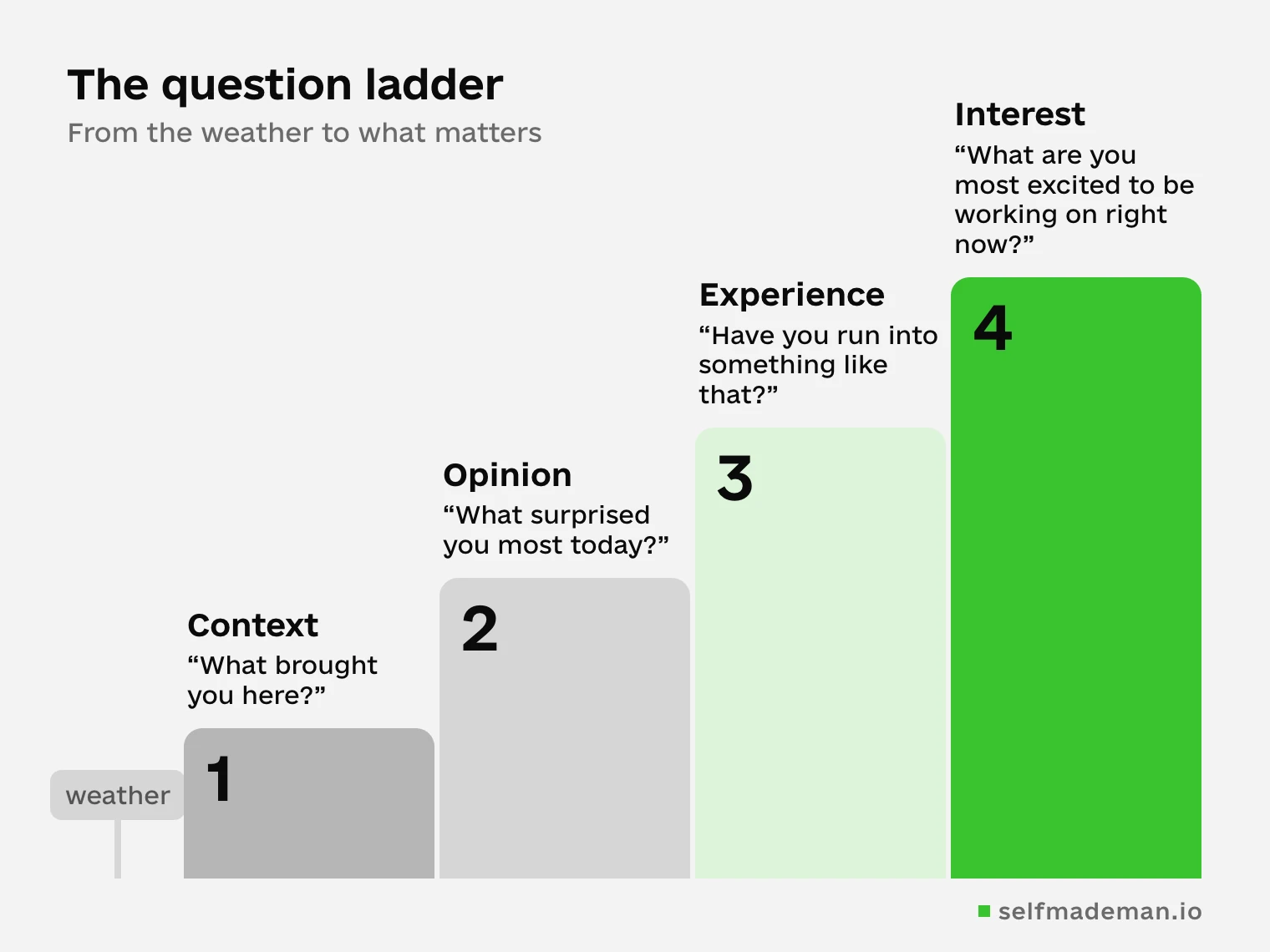
- The ladder: context → opinion → experience → interest. One step at a time.
- Answer with a “hook”: a detail about yourself someone can grab onto.
- Deeper doesn’t mean more intimate. It means about the person, not the weather.
Table of contents
- Why small talk feels scarier than it is
- Deep conversations beat small talk more than we think
- My experience
- How to keep a conversation going: 5 steps
- Small talk questions: a ladder from the weather to what matters
- Small talk topics and examples by situation
- Conversation question generator
- How to skip the small talk and get to a real conversation
- How to end a conversation gracefully
- Where it breaks down
- The minimum version
- If there’s an awkward pause
- FAQ
- Your action for today
- Sources
Why small talk feels scarier than it is
Because we’re bad at predicting how it will go. In 2014, Nicholas Epley and Juliana Schroeder asked Chicago commuters on trains and buses to either talk to the person next to them, sit in silence, or do whatever they normally do1. The ones who talked rated their commute as more pleasant. Meanwhile, other commuters who were only asked to imagine these options were sure of the opposite: talking to a stranger seemed like the worst choice. One reason — people assumed the stranger wouldn’t be interested in talking to them.
The mistake doesn’t go away after the conversation. In a 2018 study by Erica Boothby and colleagues, people who’d just talked to a stranger consistently underestimated how much the other person liked them2. The authors called this the “liking gap.”
If you think “I hate small talk,” you’re probably hating the conversation in your head. The awkwardness you imagine is almost always bigger than the awkwardness you get.
Deep conversations beat small talk more than we think
The main trap of small talk is getting stuck in it. The weather is safe, so the conversation stays on the weather.
In 2022, Michael Kardas, Amit Kumar, and Nicholas Epley published a series of experiments where strangers discussed either shallow or deep topics3. For example: “When was the last time you cried in front of another person?” Before talking, participants expected deep questions to be awkward. Afterward, those conversations turned out to create more connection and enjoyment than they’d expected. People overestimated the awkwardness and underestimated how interested the other person would be in them.
One more inconvenient detail. In 2026, Stav Atir and Nicholas Epley showed that after a good conversation, people’s expectations become more realistic — but within a week or two they slide back to the old pessimism4. The memory of one good conversation fades fast. That’s why small talk is a skill that only holds up with practice.
My experience
One of my personal rules goes: “I try to speak only to the point.” At first glance, small talk argues with it. But small talk isn’t chatter instead of substance — it’s the road to it. So what follows isn’t about how to talk about the weather longer. It’s about how to get past it.
How to keep a conversation going: 5 steps
- Start with shared context. The place, the event, the commute, the reason you’re both here. “Is this your first time at this conference?” “How was the drive in this weather?” Context is the one thing you definitely already have in common.
- Ask open-ended questions. Not “Did you like the talk?” (yes/no), but “Which talk did you get the most out of?” You can’t answer an open question with one word.
- Follow up on the answer. They mention they just moved from Denver — “What do you do out there?” beats switching topics. Follow-up questions are the ones most strongly linked to liking5.
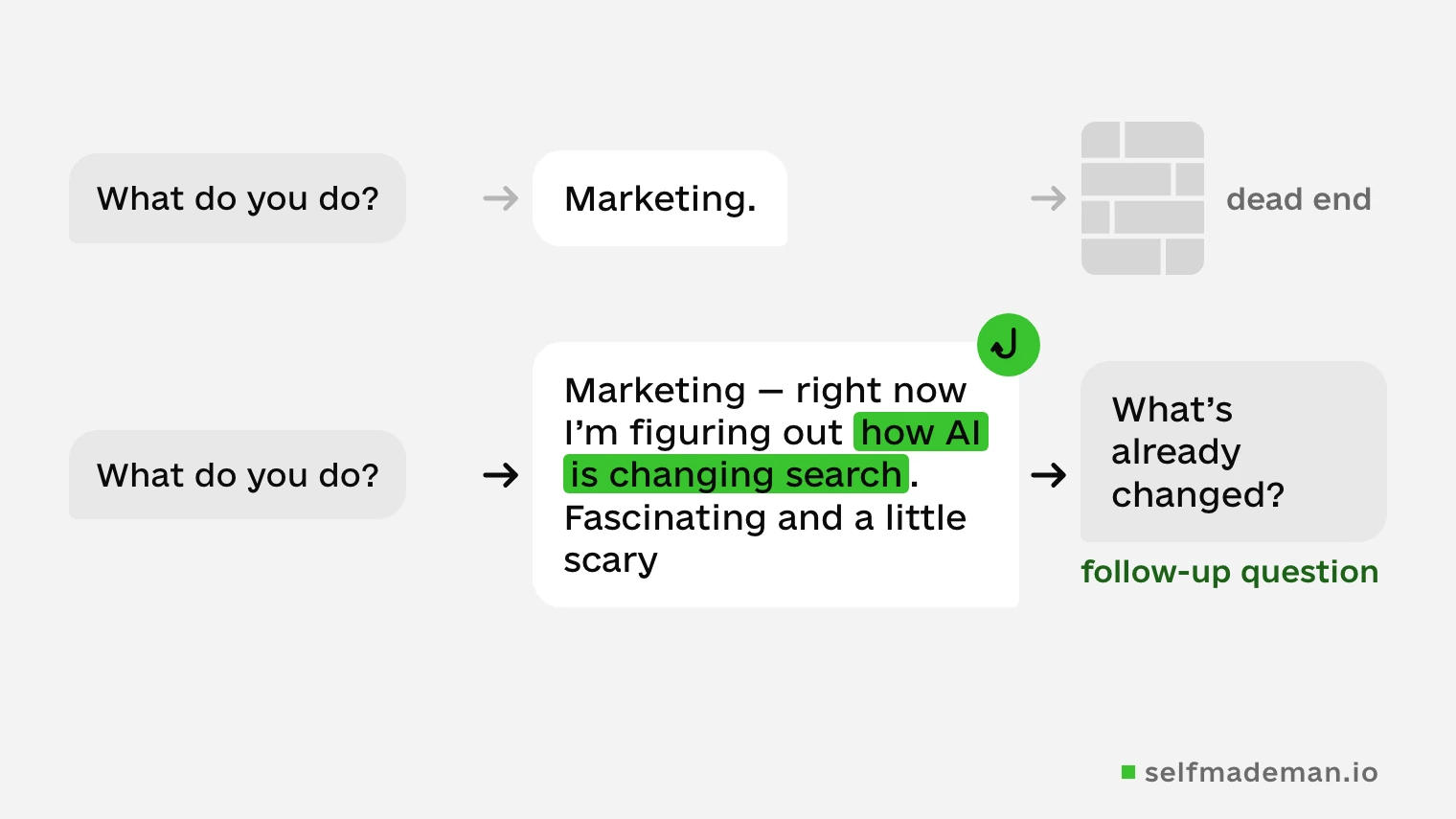
- Answer with a hook. When asked “What do you do?”, don’t say “Marketing.” Say “Marketing — right now I’m figuring out how AI is changing search. Fascinating and a little scary.” The detail is an invitation to ask more.
- Go up one step. After a few minutes of facts, ask about an opinion or an experience. Don’t dive straight to the bottom — one step at a time.
Follow-up questions aren’t my hunch. In 2017, Karen Huang and colleagues at Harvard analyzed live online chats between strangers and recordings of speed dates5. People who asked more questions were liked more by their partners. On speed dates, they were also more likely to get a yes to a second date. Follow-up questions — about what the person had just said — worked best. And participants themselves didn’t realize how much questions affected liking.
Small talk questions: a ladder from the weather to what matters
Four steps. Each has its own type of question.
| Step | About | Example question |
|---|---|---|
| 1. Context | The place, the event, the occasion | “What brought you here?” |
| 2. Opinion | What the person thinks | “What surprised you most today?” |
| 3. Experience | What happened to them | “Have you run into something like that? How did you handle it?” |
| 4. Interest | What they care about, where they’re headed | “What are you most excited to be working on right now?” |
You don’t have to reach step four. Sometimes step two is enough. What matters is not getting stuck on step one when the other person is clearly ready to go further.
Small talk topics and examples by situation
| Situation | Opener | One step deeper |
|---|---|---|
| Conference, networking | “Which talk did you like most?” | “What from it will you actually try at work?” |
| New team, first call | “Where are you calling in from?” | “What do you like about this project — or is it too early to tell?” |
| Parents at the playground | “Do you come here often?” | “What about this age turned out harder than you expected?” |
| A party at a friend’s place | “How do you know the hosts?” | “What are you into these days outside of work?” |
| Travel, a line, a flight | “Heading home or heading out?” | “What’s pulling you there?” |
Why are there no questions about money, politics, or war in the table? It’s not a ban. But with someone you barely know, it’s better to bring these up only if they do first.
Conversation question generator
The follow-up is an example. In a real conversation, ask about what the person has just said: that is what works best.
Money, politics, war, health and appearance are not banned. With someone you barely know, bring them up only if they did first.
On “What do you do?” answer not with one word but with a detail they can latch onto.
Small talk doesn’t have to last long. With a short reason or without one — like any polite no: how to say no →
The sheet has the questions you took with follow-ups, your hook, a way to end and what to do in a pause. If nothing is taken, the questions on screen go on it. Everything stays in this browser.
Questions are a start, not a script. If any conversation with a stranger brings panic rather than just awkwardness, phrases won’t help: that’s a reason to talk to a specialist.
How to skip the small talk and get to a real conversation
- Read the signal. They answer at length, ask you questions back, smile — you can go up a step. Short answers and glances at their phone — stay where you are or wrap up politely.
- Go first. Share a bit more about yourself than the question calls for: “Honestly, I came for one talk, and so far it’s not doing it for me.” Openness invites openness.
- Listen to understand, not to reply. A deep conversation is impossible if you’re busy preparing your next line.
- Don’t turn it into an interrogation. Question — answer — your comment — question. Three questions in a row without a word about yourself feels like a job interview.
How to end a conversation gracefully
Small talk doesn’t have to last long. Leaving is fine:
- “Great meeting you. I’m going to catch the speaker before they leave.”
- “I have to run, but let’s swap contacts — I’ll send you that article.”
- “I won’t keep you. Good luck with the project!”
A short reason or none at all — same as any polite “no”.
Where it breaks down
- A memorized list of questions. If you’re working through a list and not listening to the answers, people can tell. The list is for getting started; after that, only follow-ups.
- Too deep, too fast. “What are you afraid of in life?” two sentences in isn’t depth — it’s pressure. One step at a time.
- Talking about yourself. A detail about yourself is a hook. Five minutes about yourself is a monologue.
- Culture and context. What’s normal at a conference in New York may feel odd somewhere else — and vice versa. If in doubt, start with context and watch how they respond.
- Severe social anxiety. If any conversation with a stranger brings on panic, not just awkwardness, scripts won’t fix it. That’s a reason to talk to a mental health professional.
The minimum version
One open question and one follow-up on the answer. That’s it. It’s enough to keep the conversation from dying on the second line.
If there’s an awkward pause
A pause isn’t a failure. It happens in every conversation. Options:
- Go back to something they said earlier: “Back to your move — do you know where yet?”
- Name the awkwardness with humor: “Okay, we’ve officially exhausted the weather.”
- Wrap up politely. Not every conversation has to happen.
And remember the Atir and Epley study: memory quickly “erases” good conversations, and expectations turn gloomy again. So don’t judge yourself by one awkward pause.
FAQ
What is small talk?
A short, light conversation with someone you barely know about neutral topics: the place, the event, the commute, work. Its job isn’t to exchange information but to make a connection.
What are good questions for small talk?
Open-ended questions tied to the context: “What brought you here?” “What did you like most today?” Then follow-up questions about their answer. Those work better than anything you prepare.
What is the 3 question rule for small talk?
A popular tip without a scientific source: ask three follow-up questions on one topic before changing it. The idea matches what Huang and colleagues found: follow-up questions are the ones most strongly linked to liking.
What should I avoid saying in small talk?
With someone you barely know, it’s better not to be the first to bring up money, politics, religion, war, health, or appearance. If they raise it, you can go along — without arguing.
Why do I struggle so much with small talk?
Often because we overestimate the awkwardness in advance and underestimate the other person’s interest — that’s what studies by Epley and colleagues found. Practice helps: short conversations regularly, not once before a big event.
How do you move from small talk to a deeper conversation?
One step at a time: from context to opinion, from opinion to experience, from experience to interests. Go first: share a bit more about yourself than the question calls for.
Your action for today
Pick one person you usually stop at “hi — bye” with: a coworker, a neighbor, your barista. Ask them one open question and one follow-up on their answer. Five minutes. In the evening, write one line: was it as awkward as you expected?
Sources
- Epley N., Schroeder J. Mistakenly seeking solitude. Journal of Experimental Psychology: General, 2014, 143(5), 1980–1999. ↩
- Boothby E. J., Cooney G., Sandstrom G. M., Clark M. S. The liking gap in conversations: Do people like us more than we think? Psychological Science, 2018, 29(11), 1742–1756. ↩
- Kardas M., Kumar A., Epley N. Overly shallow?: Miscalibrated expectations create a barrier to deeper conversation. Journal of Personality and Social Psychology, 2022, 122(3), 367–398. ↩
- Atir S., Epley N. Fleeting generalization: How unstable belief updating keeps people overly pessimistic about talking to strangers. Journal of Personality and Social Psychology, 2026, 131(3), 422–443. ↩
- Huang K., Yeomans M., Brooks A. W., Minson J., Gino F. It doesn’t hurt to ask: Question-asking increases liking. Journal of Personality and Social Psychology, 2017, 113(3), 430–452. ↩