The four temperaments, sanguine, choleric, phlegmatic and melancholic, come from ancient medicine, which explained character by the balance of four bodily fluids. The fluids are long dead as science, but something in the scheme survived: two dimensions, how much you’re drawn to people and how strongly you react when things go wrong. Modern psychology doesn’t sort people into four boxes. It uses five scales, the Big Five, and most of us land somewhere in the middle of them. Below: where the types came from, what’s true in them, where they do harm, and a short research-based test to take instead of “guess your type.”
- The four temperaments are a leftover of the humoral theory of Hippocrates and Galen. Body fluids have nothing to do with it.
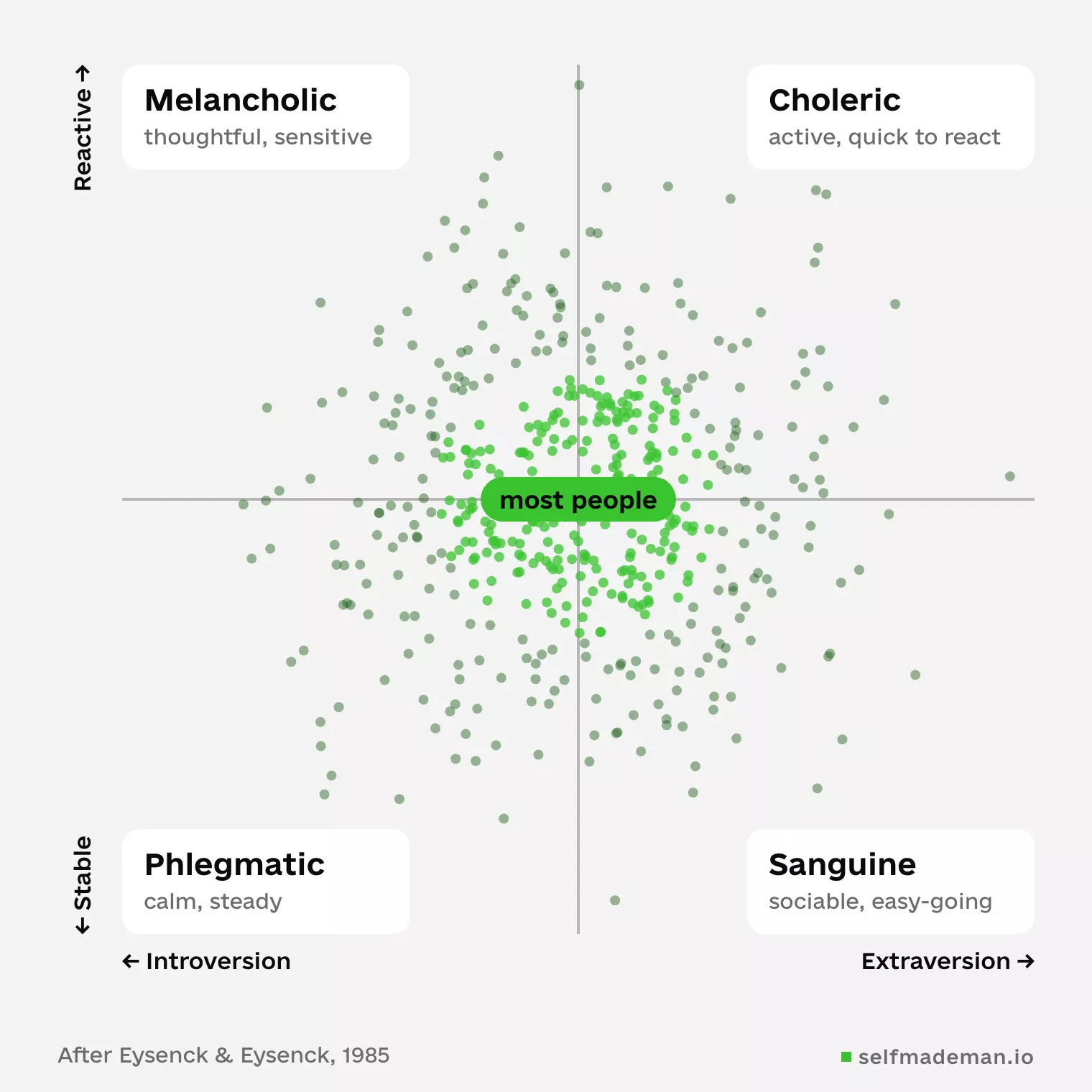
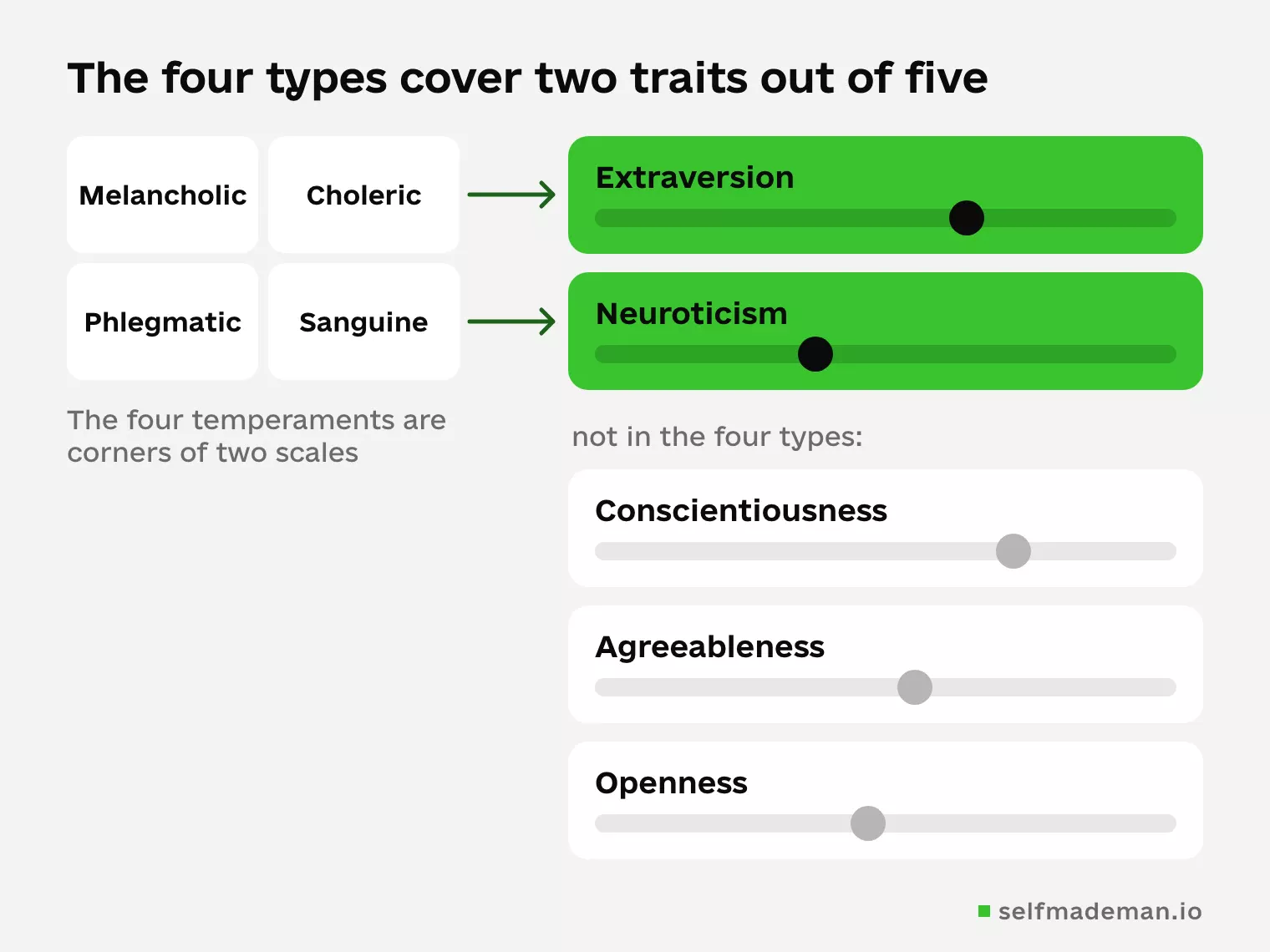
- Psychologist Hans Eysenck showed that the four types are the corners of two scales: extraversion and emotional reactivity (neuroticism).
- People don’t come in types. Traits are continuous, and most people sit near the middle, not in the corners.
- The main model today is the Big Five: five traits instead of four labels. There’s also a six-factor rival, HEXACO.
- What’s worth keeping from the old theory: noticing your energy and how fast you react. What’s harmful: using the label as an excuse or a verdict.
Table of contents
- Where the four temperaments came from
- Are the types of temperament real? What the research says
- What replaced the temperaments: the Big Five
- My take
- Free Big Five test: 20 questions
- What to keep from temperament theory
- Where it breaks: labels instead of understanding
- The minimum version
- If you slip
- FAQ
- Your action for today
- Sources
Where the four temperaments came from
It’s a long story, and every era rewrote it in its own terms.
| Who and when | The idea | What’s left of it |
|---|---|---|
| Hippocratic medicine, 5th–4th century BC | Health is a balance of four fluids: blood, phlegm, yellow bile and black bile | Just the names: sanguis is blood, phlegma is phlegm, cholē is bile, melaina cholē is black bile |
| Galen, 2nd century AD | Linked mixtures of bodily “qualities” to individual differences | Stelmack and Stalikas found that Galen wrote little about character, and his descriptions barely match the later portraits of the types1 |
| Kant, 1798 | Four temperaments as types of feeling (sanguine, melancholic) and of activity (choleric, phlegmatic)2 | The familiar psychological portraits of the types took shape in the 18th and 19th centuries1 |
| Pavlov, early 20th century | Types of nervous system by strength, balance and mobility, derived from conditioning experiments with dogs. Pavlov matched them to the four classical temperaments | The idea of a biological basis for temperament. Nervous-system properties were studied for decades, especially in Eastern Europe3 |
| Eysenck, 1960s–1980s | Two independent scales: extraversion vs. introversion, and neuroticism vs. emotional stability. The four temperaments fall into the four corners4 | Both scales live on in today’s Big Five |
The most interesting part is the Stelmack and Stalikas review. They compared what Galen actually wrote with what’s attributed to him. Their conclusion: what lasted wasn’t Galen’s medicine but a descriptive typology from the 18th and 19th centuries, and it looks remarkably like Eysenck’s two scales1. People noticed something real for centuries. They just explained it wrong.
Are the types of temperament real? What the research says
In short: the four-type scheme isn’t wrong so much as crude. It has three problems.
People don’t sort into boxes. For types to exist, people would have to cluster: here are the sanguines, there are the cholerics, and empty space in between. Psychologists test this with taxometric analysis. Nick Haslam and colleagues pooled 317 such findings in a meta-analysis. Results favoring dimensions outnumbered results favoring categories five to one, and no domain, normal personality included, supported a “types” model overall5. Think of height: there are tall and short people, but no “tall type.”
Four boxes lose three-fifths of personality. Eysenck’s two axes say nothing about how organized someone is, how attuned they are to others, or whether they love new ideas. Those are often what matters most at work and in relationships.
Even one person isn’t a single point. William Fleeson had people report their behavior several times a day. The same person was very outgoing at some moments and withdrawn at others within a week. The spread within one person was comparable to the differences between people6. A trait is closer to “where you tend to be most often” than a fixed state.
What replaced the temperaments: the Big Five
The current main model grew out of a simple idea: if a difference between people matters, language will have words for it. Researchers took thousands of adjectives people use to describe each other and looked at which ones cluster. Again and again, five broad factors came out78:
| Trait | What it’s about | Link to the old scheme |
|---|---|---|
| Extraversion | Energy from people and activity, or from quiet | The “sanguine/choleric vs. phlegmatic/melancholic” axis |
| Neuroticism (emotional reactivity) | How fast and strongly anxiety, irritation and sadness switch on | The “choleric/melancholic vs. sanguine/phlegmatic” axis |
| Conscientiousness | Order, follow-through, self-control | Missing from the four types |
| Agreeableness | Tuning in to other people’s feelings and interests | Missing |
| Openness to experience | Interest in ideas, imagination, the new | Missing |
There’s also a rival: the HEXACO model by Michael Ashton and Kibeom Lee. It has six factors, adding honesty-humility, the tendency not to cheat, manipulate or chase status9. For everyday self-reflection the difference is small. For conversations about trust in a team, the sixth factor is useful.
The real difference between the Big Five and the temperaments isn’t the number. It’s the logic: not “what are you” but “how much of this do you have.” And Big Five traits connect to real life. A review by Brent Roberts and colleagues found they predict health, longevity, divorce and career outcomes about as well as family socioeconomic status and cognitive ability do10.
My take
Two rules from my personal system are really about the same thing as the reactivity axis. “I solve problems step by step, not by emotion.” “Talk from calm, not from anxiety or fatigue.”
The rules say nothing about what “type” I am. But they do exactly what’s worth taking from temperament theory: they put a fuse between the first reaction and the action.
Temperament isn’t a verdict or an excuse. It’s your factory settings. Knowing them helps you build rules around them instead of fighting yourself.
People used to file me under “choleric.” Then I took a Big Five test, and even the refined label “choleric with a dash of sanguine” turned out to be too crude. Here’s what actually came out:
- Curiosity sits next to a need for order. Ideas and imagination maxed out — and so did schedules, details and high standards for work. I want to turn every new project into a plan and tasks right away. That’s also the tension: the pull to grow many directions and do each one properly.
- Sociability comes with empathy. Starting a conversation is easy for me, and I feel other people’s emotions strongly. Being assertive doesn’t mean being harsh.
- Interest in people and time for people don’t match. Feeling others’ emotions — 5 out of 5; “I make time for others” — 2 out of 5. A packed calendar is one explanation, but the test doesn’t show the cause.
- Irritation and getting upset are different reactions. I get irritated easily (4 out of 5) but rarely get upset (2 out of 5). “A very emotional person” would be too vague.
The test didn’t confirm any specific type. What it gave me instead is a description I can actually work with.
Free Big Five test: 20 questions
Instead of “guess your type,” take a short version of a research questionnaire. This is the Mini-IPIP: 20 statements, four per trait, from the IPIP, an open item pool anyone can use and translate11. Its authors tested it across five studies, and the short scales behaved much like the longer versions12.
Answer for how you usually are, not how you’d like to be. You’ll get five bars and a plain-language reading. As a bonus, you’ll see which classical temperament your result would resemble if you read extraversion and reactivity the way Eysenck did. That part is an illustration, not a diagnosis.
How accurately does each statement describe you?
Describe yourself as you generally are now, not as you wish to be. Compare yourself with people you know of roughly your age.
1 — very inaccurate, 3 — neither, 5 — very accurate.
How accurately does each statement describe you?
Describe yourself as you generally are now, not as you wish to be. Compare yourself with people you know of roughly your age.
1 — very inaccurate, 3 — neither, 5 — very accurate.
How accurately does each statement describe you?
Describe yourself as you generally are now, not as you wish to be. Compare yourself with people you know of roughly your age.
1 — very inaccurate, 3 — neither, 5 — very accurate.
How accurately does each statement describe you?
Describe yourself as you generally are now, not as you wish to be. Compare yourself with people you know of roughly your age.
1 — very inaccurate, 3 — neither, 5 — very accurate.
This is an example, not your result.
Average of four statements, from 1 to 5. “Above / below the middle” is about the middle of the scale, not about other people: this short test has no population norms.
An illustration, not a diagnosis. The four temperaments are historical labels for the corners of two scales. Your other three traits don’t fit into them at all.
A 20-item screening from the Mini-IPIP (Donnellan et al., 2006). Four statements per trait is enough for a rough picture, not for decisions about a person. It’s not a clinical or psychological diagnosis, and it shouldn’t be used for hiring. Your answers depend on mood and context, so a retake in a month may differ a little.
Items: International Personality Item Pool (ipip.ori.org), public domain. Everything stays in this browser.
What to keep from temperament theory
The scheme is outdated, but the observation behind it is real. Here’s how to make it useful.
- Notice your energy. For a week, write one word each evening: did you have more energy after people or after quiet? That’s your extraversion at work, no test needed.
- Know your reaction speed. For some people irritation flares in a second; for others it builds for days. Neither is bad, but each needs its own fuse: a pause before replying, or a habit of voicing frustration earlier.
- Build rules around your settings, not against them. If socializing drains you, leave a buffer after hard meetings. If you react fast, agree with yourself not to send important messages in the first ten minutes.
- Support your weaker trait with your environment. Conscientiousness is the easiest to build from the outside: lists, reminders, one main plan for the day. You don’t need to become a different person, just remove friction.
- Recheck once a year. Traits change, especially between 20 and 40: on average, people become more conscientious and more emotionally stable13.
Where it breaks: labels instead of understanding
The type as an excuse. “I’m choleric, that’s just how I am.” “I’m melancholic, I get to skip the party.” Temperament explains what comes easier to you. It doesn’t remove responsibility for what you do. Snapping at someone “because of your temperament” is still snapping at someone.
The type as a verdict on others. “He’s phlegmatic, you can’t get anything done with him.” A label saves effort: no need to find out what’s actually getting in someone’s way. But behavior depends on the situation more than it seems, and the same person in a different role can look completely different6.
Labels for kids. Child temperament is real and is studied seriously: differences in reactivity and self-regulation show up early14. But the researchers’ conclusion isn’t “you have a difficult child.” It’s “does the environment fit this child?” Psychiatrists Alexander Thomas and Stella Chess called this goodness of fit: problems arise more often when adults’ demands clash with a child’s temperament15. Calling a kid “the hothead” or “the shy one” doesn’t get you closer to that fit.
I notice differences in temperament in everyone — family, acquaintances. I only try to adapt with friends, to avoid conflict. Everywhere else I just stay myself and try not to step over other people’s boundaries.
Types in hiring. Personality traits do relate to job performance, but more modestly than test vendors promise. In the classic meta-analysis by Murray Barrick and Michael Mount, conscientiousness was the trait most consistently linked to performance across occupations; the others mattered only in specific roles16. Hiring “a sanguine for sales” means screening people by a label. In Frank Schmidt and John Hunter’s review of selection methods, work-sample tests and structured interviews predicted job performance better than personality questionnaires17.
I tried using personality types and tests at work — and dropped them.
The test as gospel. Twenty statements give a rough picture. Answers depend on your mood, your week and who you compare yourself to. Treat the result as something to think about, not a passport.
Can you change your temperament?
Partly, yes. A meta-analysis by Roberts, Walton and Viechtbauer across dozens of long-term studies found that traits keep changing on average throughout life, most of all in young adulthood13. There’s also evidence on intentional change. In two 16-week studies by Nathan Hudson and Chris Fraley, people who wanted to change a trait tended to shift in the direction they wanted18. In a randomized trial by Mirjam Stieger and colleagues with 1,523 participants, a three-month smartphone program also produced change in the desired direction. People who knew the participants noticed it too, and it held three months after the program ended19. The effects are small. But “you’re born this way and that’s it” isn’t true either.
Neither the four temperaments nor a short Big Five test diagnose anything. High neuroticism is a trait, not a disorder. But if anxiety, irritability or low mood last for weeks and get in the way of your life and work, that’s a reason to see a psychologist or doctor, not to look up your type.
The minimum version
No time for a test or a week of notes? Ask yourself two questions. After what do I usually have more energy: people or quiet? How fast do I get worked up, and how fast do I cool down? Two answers already tell you more than any label.
If you slip
Losing your temper and then telling yourself “well, I’m choleric” is the most common trap here. Don’t hide behind your temperament, and don’t beat yourself up over it either. Name what happened, apologize if someone got hurt, and ask: what was the trigger, and what fuse can I put in place next time? Temperament sets the speed of your reaction. What you do next is up to you.
FAQ
What are the four temperaments?
Sanguine, choleric, phlegmatic and melancholic. The names come from the ancient theory of four bodily fluids. Modern psychology uses scales instead of types, most often the five Big Five traits.
What are the types of temperament in psychology today?
Researchers rarely use types anymore. Adult personality is usually described with the Big Five: extraversion, agreeableness, conscientiousness, neuroticism and openness. Child temperament research uses dimensions too, such as reactivity and self-regulation14.
How do I find out my temperament?
There’s no reliable way to “find your type,” because people don’t come in types. You can measure the two traits the old scheme rests on, extraversion and emotional reactivity. The test above shows them along with the other three traits and tells you which corner of Eysenck’s scheme your result resembles.
What’s the difference between temperament and personality?
Temperament usually means the inborn base: how fast and strongly you react, your activity level. Personality is broader and includes habits, values and experience. The line is blurry, and in models like the Big Five the two merge.
Which temperament is best?
None. Each corner of the scheme has its strengths and flip sides. And the corners are extremes; most people are closer to the middle.
Can your temperament change?
Partly. Personality traits change over a lifetime, and in studies of intentional change people shifted their traits in the direction they wanted18. The effects are small but real.
Your action for today
Take the test above. It takes five minutes. Then pick the one trait that landed furthest from the middle and write down one rule built around it, not against it. For example: “after three meetings in a row, half an hour of quiet,” or “I send important emails no sooner than ten minutes after writing them.” One rule, one line.
Sources
- Stelmack R. M., Stalikas A. Galen and the humour theory of temperament. Personality and Individual Differences, 1991, 12(3), 255–263. ↩
- Kant I. Anthropology from a Pragmatic Point of View. Ed. and trans. R. B. Louden. Cambridge University Press, 2006 (original 1798). ↩
- Strelau J. The contribution of Pavlov’s typology of CNS properties to personality research. European Psychologist, 1997, 2(2), 125–138. ↩
- Eysenck H. J., Eysenck M. W. Personality and Individual Differences: A Natural Science Approach. Plenum Press, 1985. ↩
- Haslam N., McGrath M. J., Viechtbauer W., Kuppens P. Dimensions over categories: A meta-analysis of taxometric research. Psychological Medicine, 2020, 50(9), 1418–1432. ↩
- Fleeson W. Toward a structure- and process-integrated view of personality: Traits as density distributions of states. Journal of Personality and Social Psychology, 2001, 80(6), 1011–1027. ↩
- Goldberg L. R. An alternative “description of personality”: The Big-Five factor structure. Journal of Personality and Social Psychology, 1990, 59(6), 1216–1229. ↩
- McCrae R. R., John O. P. An introduction to the five-factor model and its applications. Journal of Personality, 1992, 60(2), 175–215. ↩
- Ashton M. C., Lee K. Empirical, theoretical, and practical advantages of the HEXACO model of personality structure. Personality and Social Psychology Review, 2007, 11(2), 150–166. ↩
- Roberts B. W., Kuncel N. R., Shiner R., Caspi A., Goldberg L. R. The power of personality: The comparative validity of personality traits, socioeconomic status, and cognitive ability for predicting important life outcomes. Perspectives on Psychological Science, 2007, 2(4), 313–345. ↩
- International Personality Item Pool: IPIP items and scales are in the public domain. ↩
- Donnellan M. B., Oswald F. L., Baird B. M., Lucas R. E. The Mini-IPIP scales: Tiny-yet-effective measures of the Big Five factors of personality. Psychological Assessment, 2006, 18(2), 192–203. ↩
- Roberts B. W., Walton K. E., Viechtbauer W. Patterns of mean-level change in personality traits across the life course: A meta-analysis of longitudinal studies. Psychological Bulletin, 2006, 132(1), 1–25. ↩
- Rothbart M. K. Temperament, development, and personality. Current Directions in Psychological Science, 2007, 16(4), 207–212. ↩
- Thomas A., Chess S. Temperament and Development. Brunner/Mazel, 1977. ↩
- Barrick M. R., Mount M. K. The Big Five personality dimensions and job performance: A meta-analysis. Personnel Psychology, 1991, 44(1), 1–26. ↩
- Schmidt F. L., Hunter J. E. The validity and utility of selection methods in personnel psychology: Practical and theoretical implications of 85 years of research findings. Psychological Bulletin, 1998, 124(2), 262–274. ↩
- Hudson N. W., Fraley R. C. Volitional personality trait change: Can people choose to change their personality traits? Journal of Personality and Social Psychology, 2015, 109(3), 490–507. ↩
- Stieger M., Flückiger C., Rüegger D., Kowatsch T., Roberts B. W., Allemand M. Changing personality traits with the help of a digital personality change intervention. PNAS, 2021, 118(8), e2017548118. ↩