
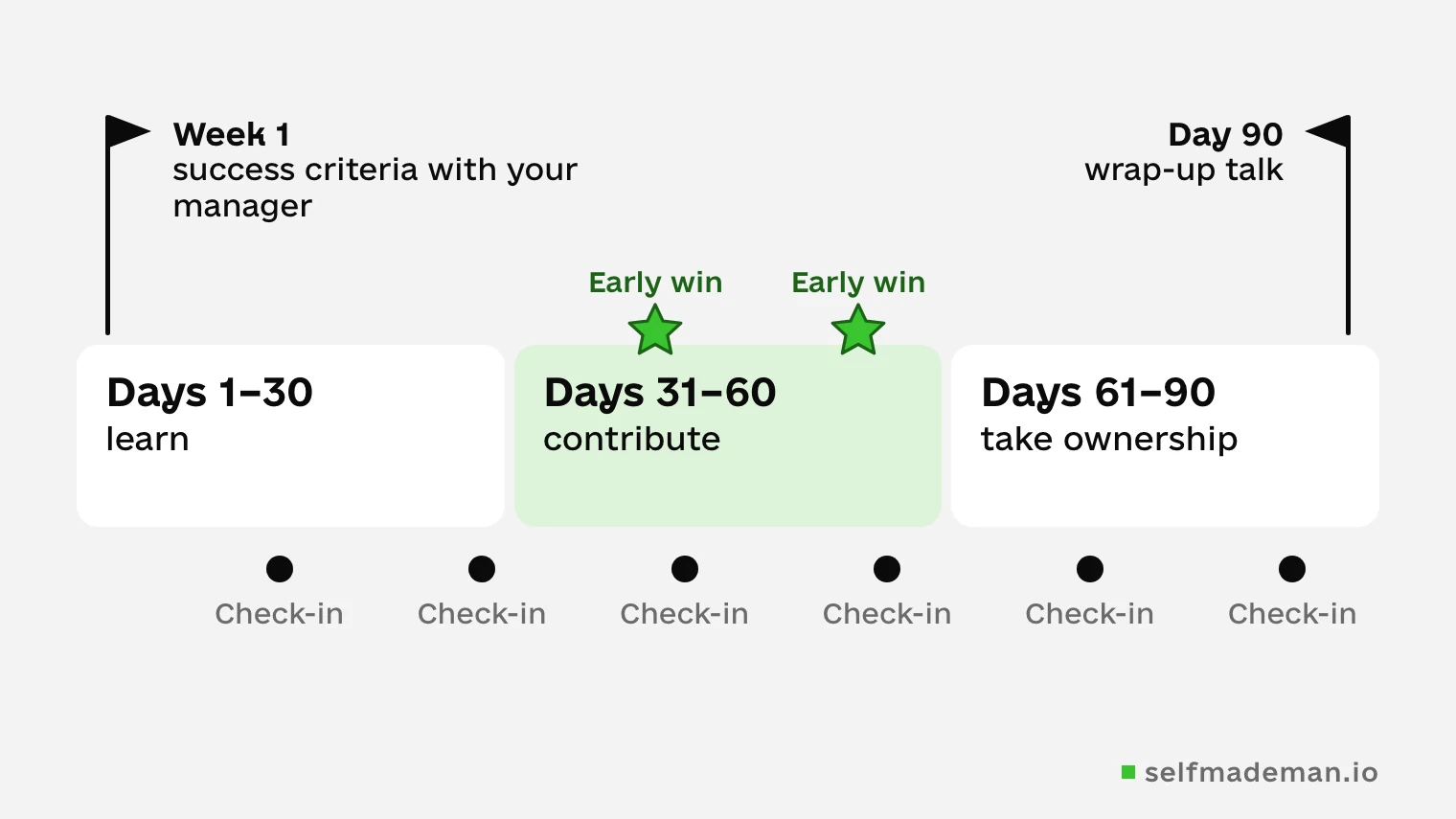
A 30-60-90 day plan splits your first three months at a new job into three 30-day stretches. Days 1–30: learn — the people, the processes, what’s expected of you. Days 31–60: contribute — one or two small but visible wins. Days 61–90: take ownership — run your area without hand-holding and propose your first improvement. The most important move happens in week one: agree with your manager on how they’ll judge these 90 days. Without that, you spend three months trying hard in a random direction.
- Days 1–30: listen and learn. Days 31–60: first results. Days 61–90: your own area of responsibility.
- In week one, talk to your manager about what success looks like at 90 days.
- One or two early wins beat ten half-started improvements.
- A check-in with your manager every two weeks. Put them on the calendar right away.
- Good onboarding is rare. Build your own plan instead of waiting for the company to hand you one.
Table of contents
- My experience
- What research says about starting a new job
- Michael Watkins’ ideas in plain words
- Your first 90 days in a new job: the 30-60-90 day plan, step by step
- 30-60-90 day plan example: a marketing specialist
- 30-60-90 day plan for managers and new leaders
- How to get through a probation period calmly
- Build your 90-day plan
- Where it breaks
- The minimum version
- If the first month went sideways
- FAQ
- Your move today
- Sources
My experience
I started out as the new guy too: I joined Promodo in 2007 and eventually grew into SEO Team Lead there. Now I’m on the other side: I run my own agency, UpMotion.
One of my personal rules: “Create certainty wherever certainty can be created.” A new hire needs that more than anyone. Until you know what result is expected of you in three months, any activity is just noise.
What research says about starting a new job
Talya Bauer’s team pooled 70 samples of new employees into a meta-analysis. Three things turned out to matter most: role clarity (I know what’s expected of me), self-efficacy (I can handle this), and social acceptance (I belong here). Through these three, a good adjustment is linked to job satisfaction, performance, and the intention to stay. And here’s the key part: these indicators grew not only from what the company did, but also from how actively the new hire sought out information1.
In a report for the SHRM Foundation, Bauer described onboarding through the “four Cs”: compliance (rules and paperwork), clarification (the role and expectations), culture (written and unwritten norms), and connection (relationships with people). She also cites data that half of hourly workers leave within their first four months, and half of senior outside hires fail within 18 months2.
The bad news: companies rarely get this right. In a Gallup survey, only 12% of U.S. employees said their organization does a great job onboarding new people. The good news: when the manager is actively involved, employees are 3.4 times as likely to feel their onboarding was successful. One more number to calm you down: it usually takes a new hire about a year to reach peak performance3. Nobody expects your peak within 90 days.
Bottom line: your onboarding plan is your job, not a gift from HR. And your manager is your main ally in it.
Michael Watkins’ ideas in plain words
Michael Watkins’ book *The First 90 Days* (2003, updated and expanded in 2013) is written for leaders, but its logic works for any new hire4.
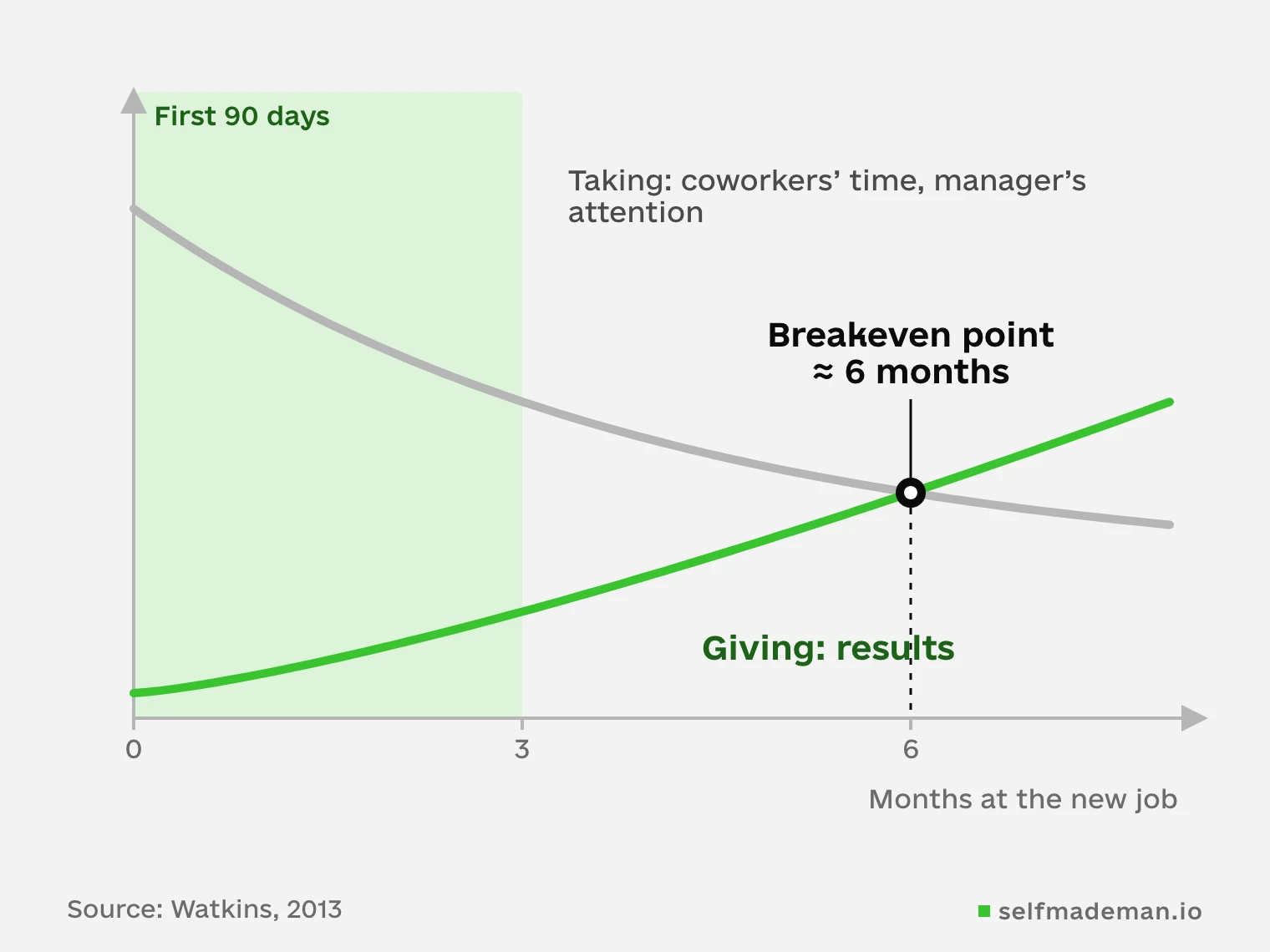
- The breakeven point. At first you take more than you give: your coworkers’ time, your manager’s attention. The goal of the first months is to reach the point where you give more than you take, as fast as you can. Watkins surveyed more than two hundred company presidents and CEOs: by their estimate, a mid-level manager needs about six months on average to get there4.
- Accelerate your learning. Not just “getting up to speed,” but on purpose: what do I need to understand about the product, the money, the people, and the history of past decisions so I don’t break things?
- Read the situation. Were you hired to launch something new, rescue something on fire, help something grow, fix something that started to stall, or keep something that already works running? That defines what success means.
- Negotiate success. A separate conversation with your manager: expectations, resources, communication style, how often to check in.
- Early wins. Small, visible results that matter to your manager. Not a revolution — proof that you can be relied on.
Your first 90 days in a new job: the 30-60-90 day plan, step by step
| Days 1–30: learn | Days 31–60: contribute | Days 61–90: take ownership | |
|---|---|---|---|
| People | Meet your team and adjacent teams: 15–20 minutes one-on-one, “how do you work, what should I know” | Learn who makes decisions and who to go to with problems | You have 2–3 people you work with directly, no middlemen |
| Work and processes | How tasks, tools, and reports work. Do it the way it’s done, even if you want to do it better | Your first task fully on you, start to finish | You run your area on your own. One improvement proposal, with numbers |
| Expectations | 90-day success criteria — in writing, agreed with your manager | Check-in: what’s working, what isn’t | Wrap-up conversation: what’s next, goals for the next six months |
| Personal growth | A list of questions and “oddities” — not to fix, just to write down | 1–2 early wins | Your own development plan for the next 6–12 months |
- Before day one. Reread the job posting and your interview notes. Write down what you were promised and what they expect. That’s a draft of your success criteria.
- Week one — talk to your manager. Five questions: What has to happen in 90 days for you to say “we made the right hire”? What’s on fire right now? Who should I meet first? How do you prefer to get updates — written or verbal, and how often? How will I know if I’m doing something wrong?
- Days 1–30 — listen more than you talk. One-on-ones, process walkthroughs, a running list of questions. Write your ideas down, but don’t push them yet: first understand why things are done the way they are.
- Pick your early wins. One or two tasks that matter to your manager, are visible to the team, and can be done in 2–4 weeks. Agree on them before you start.
- Days 31–60 — get it done. A win counts when the task is closed, not when it’s started. Show the result at your check-in.
- Days 61–90 — your own area and a first improvement. Take an area you’re fully responsible for. Pick the one “oddity” from your list you understand best and propose a change, with numbers.
- A check-in every two weeks. 15–20 minutes: what’s done, what’s in the way, what to change. Put all six meetings on the calendar in week one.
I don’t try to prove everything in month one — I agree on the result and work toward it.
If the new job is part of a bigger plan for the year, check your success criteria against your three goals for the year. And a skills matrix for the new role will show what to level up in the first months.
30-60-90 day plan example: a marketing specialist
- Week 1: success criteria agreed with the manager: “In 90 days I run two channels on my own, my reports on them need no edits, and one improvement is live.”
- Days 1–30: eight one-on-ones, a review of the last six months of reports, access to every tool, a list of 15 questions.
- Days 31–60: early win #1 — clean up the weekly report so the manager spends 10 minutes on it instead of an hour. Early win #2 — close a long-postponed task from the backlog.
- Days 61–90: two channels fully on me, a budget reallocation proposal with the math, a wrap-up meeting, and a six-month development plan.
The same structure works for a 30-60-90 day sales plan or an engineering role: swap the channels for your territory, your pipeline, or your part of the codebase.
30-60-90 day plan for managers and new leaders
The logic is the same, but the stakes are higher: your team is watching you. Three additions:
- Read the situation before you change anything. A launch, a turnaround, growth, a realignment, or sustaining success — in Watkins’ framework, these are different jobs with different first moves4. Starting reforms in a team that already works well is a bad idea.
- One-on-one with everyone in the first two weeks. What’s working, what’s in the way, what would you change if you were in my seat.
- Early wins for the team, not for yourself. Removing what gets in people’s way is worth more than a showcase project.
How to get through a probation period calmly
A probation period and your first 90 days often overlap. The legal details depend on your country and your contract, so check them with HR. The substance is the same:
- success criteria in writing, in week one;
- check-ins every two weeks — and be honest about problems, not just wins;
- two or three weeks before the period ends, a conversation with your manager: what worked, what didn’t, what’s next.
Last-day surprises happen to people who didn’t ask earlier.
Build your 90-day plan
What counts as success depends on it: discuss it with the manager in the first week.
- One on one with every team member in the first two weeks: what works, what gets in the way, what would you change in my place
- Early wins for the team, not for yourself: removing what gets in people’s way
Put all check-ins in the calendar in the first week: if they are not there, they will not happen. The print sheet is one A4 page in landscape; in the print dialog choose “Save as PDF”.
Probation rules depend on the country: check them in your contract and with HR. Data stays in this browser.
Start with your first day: the builder lays out the three stretches, the success-criteria talk in your first days, and the six check-ins. The starter items from the table above drop in with one click — rewrite them for your role. For a job interview, switch modes: the page keeps the plan’s logic without the dates.
Where it breaks
- Redoing everything in month one. You don’t know yet why things are done this way. Some of the “obvious” improvements have probably been tried already — and there were reasons they were dropped.
- Silence. A new hire who asks no questions doesn’t look smart. They look like someone who doesn’t understand and isn’t saying so.
- No success criteria. You judge yourself by effort, your manager by results. The gap shows up on day 89.
- Ten early wins. One closed task is worth more than five started ones.
- A plan that lives only on paper. If the check-ins aren’t on the calendar, they won’t happen.
- 12-hour days to prove yourself. The first three months are a marathon, not a sprint. One of my rules: “Don’t plan the day as if my energy were unlimited.” At a new job it applies double.
The minimum version
One conversation with your manager in week one: “What has to happen in 90 days for you to say we made the right hire?” Get the answer in writing. One check-in at the halfway mark. That’s it.
If the first month went sideways
You skipped the success-criteria talk, picked the wrong task, or got some tough feedback — that happens. Don’t wait for day 90. Ask for a meeting now: “I want to make sure I understand the expectations. What’s most important for me to change in the next 60 days?” That’s not admitting failure. It’s exactly what people who adjust well do: they go looking for information themselves1.
FAQ
What is a 30-60-90 day plan?
A plan for your first three months at a new job, split into three stretches: learn (days 1–30), contribute (31–60), take ownership (61–90). Each one has goals for people, work, and expectations. You’ll also hear it called the 30-60-90 day rule.
How do you answer the 30-60-90 day plan interview question?
Show the logic, not ready-made solutions: in month one I learn the people, the processes, and the success criteria; in month two I close one or two tasks that matter to my manager; in month three I run my own area and propose a first improvement. Add a couple of points specific to this company, based on what you learned in the interviews.
How long does it take to adjust to a new job?
The basic adjustment takes the first three months. But according to Gallup, new hires usually reach peak performance after about a year3.
What should you do on your first day at a new job?
Meet people, get your access set up, see how the team’s day runs, and book a meeting with your manager about success criteria for week one.
Do I need a plan if the company already has onboarding?
Yes. Company onboarding covers paperwork and access. Your plan answers what you’ll actually do and how you’ll know you’re doing well.
Your move today
If you’re starting a new job soon, enter your start date in the builder above, export the check-ins to your calendar, and schedule the success-criteria meeting within your first three days. The five questions for your manager are already there. If you’ve already started, ask your manager one question: “What has to happen in the next 90 days for you to be happy with my work?” Ten minutes.
Sources
- Bauer T. N., Bodner T., Erdogan B., Truxillo D. M., Tucker J. S. Newcomer adjustment during organizational socialization: A meta-analytic review of antecedents, outcomes, and methods. Journal of Applied Psychology, 2007, 92(3), 707–721. ↩
- Bauer T. N. Onboarding New Employees: Maximizing Success. SHRM Foundation, Effective Practice Guidelines Series, 2010. ↩
- Wetherell E., Nelson B. 8 Practical Tips for Leaders for a Better Onboarding Process. Gallup, August 12, 2021. ↩
- Watkins M. D. The First 90 Days: Critical Success Strategies for New Leaders at All Levels. Harvard Business School Press, 2003; Updated and Expanded edition, Harvard Business Review Press, 2013. ↩