To set career goals that actually move you forward, stop aiming at a job title or a salary number. A career goal for the year is a skill and proof that you have it. The title and the money follow. Decide where you want to be in three years, find the two or three skills you’re missing to get there, and for each one set a learning goal, a weekly practice and a result you can show. For new, complex work, a goal to “learn how” beats a goal to “hit a number”1.
- A direction for three years, a goal for one.
- Not “become a manager,” but “learn what makes someone a manager.”
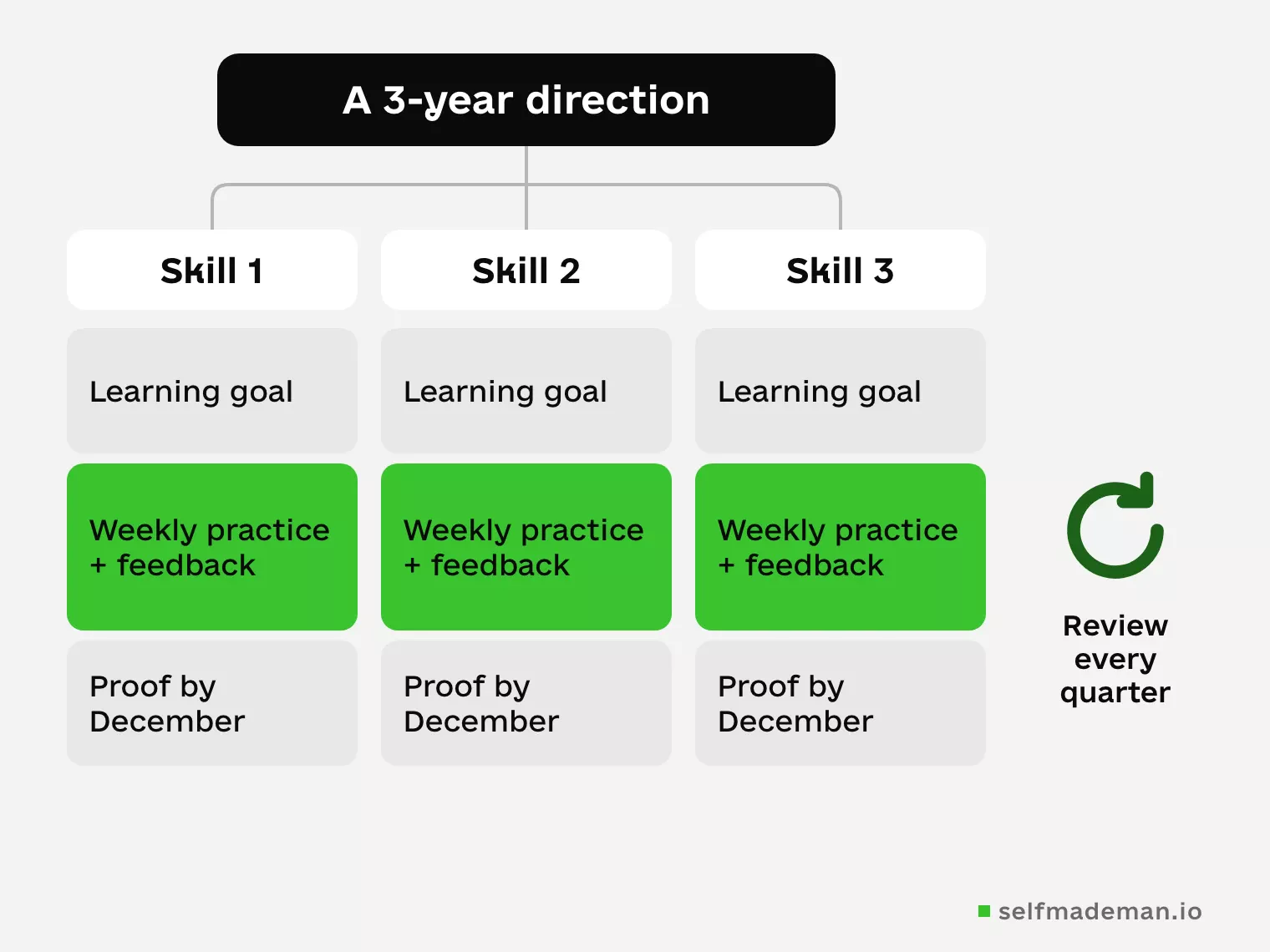
- Each skill = a learning goal + weekly practice + visible proof.
- Careers move on practice with feedback, not on courses.
Table of contents
My experience
I’ve been in SEO since 2007. At Promodo, a digital agency in Ukraine, I worked my way up to SEO Team Lead between 2007 and 2015, then founded my own agency, UpMotion. Along the way: a course on Diia.Education, Ukraine’s national online learning platform, lectures at WebPromoExperts, conference talks.
Two of my current work rules:
I delegate more.
Talk less about projects. Launch, improve and scale more.
The first is a skill. Without it, any manager hits the ceiling of their own hours. The second is about proof: careers grow from what you ship, not from what you say you’ll ship.
The skill I’m building in 2027 is systems. It shows up in my rules twice: “I systematize more” and “I build systems, not one-off tasks.”
What is a career goal? 4 types
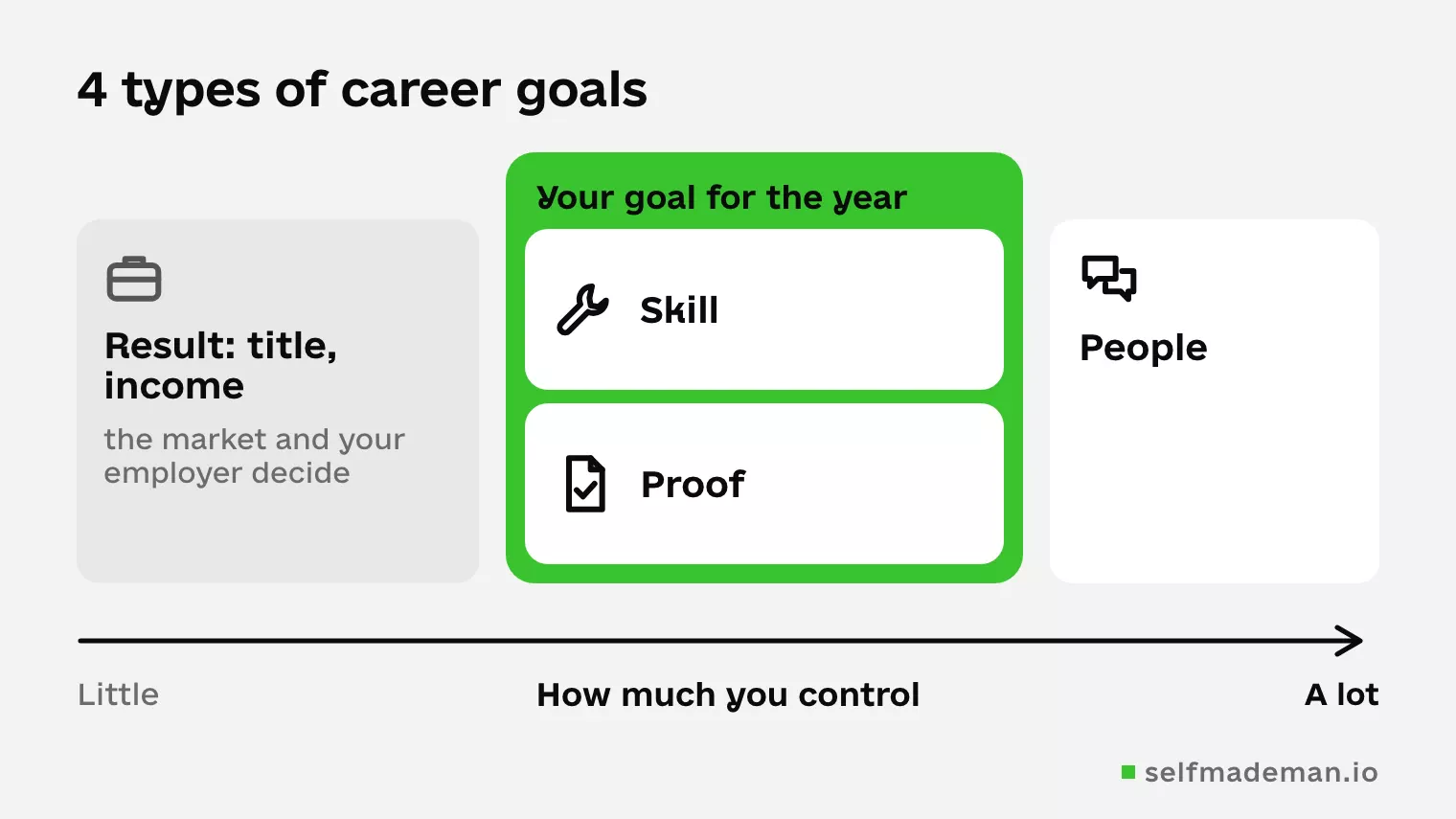
A career goal is a specific step in your professional growth with a deadline. It can be about a result, a skill, proof or people. They are not equal.
| Type | Example | How much you control |
|---|---|---|
| Result | Team lead title, +30% income | Little: the market and your employer decide |
| Skill | Learn to give feedback and delegate | A lot: depends on practice |
| Proof | A case study, a project, a published piece, a talk | A lot: you can do it on your own |
| People | Five conversations with people who are already where you want to be | A lot |
A good career goal for the year is a skill plus proof. Keep the result as a reference point, but don’t judge the year by it. If the market dipped and your skill grew, the year wasn’t a failure.
How to set career goals in 7 steps
- Set a three-year direction. One sentence about the work you want to do, not the title you want to hold. “Lead a team that builds a product,” not “be a director.” This is your long-term career goal.
- Find the gap. What can people at that level do that you can’t yet? Ask two or three of them, or read job posts for that level. Write down the skills you’re missing.
- Pick two or three skills. The ones with the most leverage. You can’t truly build more than three in a year.
- Set a learning goal for each. Not “read a book on management,” but “learn to run a feedback conversation so the other person knows exactly what to do next.”
- Practice every week. Skills grow from practice with feedback, not from hours logged2. Plan a situation where you’ll use the skill and a person who’ll tell you how it went.
- Define the proof. What can you show by the end of the year: a case study, a shipped project, a talk, a team that runs without you.
- Review every quarter. Is the skill growing? Can other people see it? Does the goal need to change?
Example: “In a year, I want to lead a small team”
| Skill | Learning goal | Weekly practice | Proof by December |
|---|---|---|---|
| Delegation | Hand off a task so it doesn’t need redoing | One task a week goes to someone else, then a review of the result | A process that runs without me |
| Feedback | Name a problem directly and with care | One feedback conversation, then ask what was clear | Peer comments in the performance review |
| Planning | See the team’s work a month ahead | A Friday plan for next week | A quarterly plan approved by my manager |
Career goals examples for the next year
These are professional development goals you can actually control. Each one is a skill or proof, not a title.
- Own a project end to end, from brief to launch.
- Learn to delegate: hand off one of your own tasks every week.
- Speak at an industry meetup or conference.
- Build a portfolio of three case studies with numbers.
- Master the tool your next level requires and use it on a real project.
- Talk to five people who work where you want to end up.
- Get your second language to the level of work calls: 30 minutes of speaking practice a week.
- Move from doer to lead: run at least one client meeting a month.
- Find a mentor and meet once a month.
- Automate one repetitive part of your job and free up an hour a week.
Career goal builder
Where do you want to be in three years?
One sentence: what work you want to do, not what position you want to hold. “Lead a team that builds a product”, not “be a director”.
Keep the result as a landmark, but do not measure the year by it: the market and the employer decide it. If the market dipped and the skill grew, the year is not lost.
What can the people who are already there do?
Ask two or three of them or look through job posts at that level. Write down the skills you do not have yet.
Skills you are missingChoose two or three skills
The ones with the most leverage: which skill moves you furthest towards the direction? More than three in a year cannot be built for real.
Each skill = a learning goal + practice every week + a visible result
Not “read a book about management”, but “learn to run a feedback conversation so that afterwards the person knows what to do”.
Review once a quarter
The job, the market or the manager changed? That is normal. The three-year direction holds, and the plan for the year can be rebuilt.
First practice this weekOne hour is enough. Minimal version: one skill, one hour of practice a week, one proof by the end of the year.
Everything stays in this browser.
If you work for yourself
Freelancers and founders have no manager to promote them. Here a career goal sounds like this: which skill will let you take on a different level of projects, or stop selling your hours? Often it isn’t a craft skill but a management one: delegation, sales, building processes. What your hour is worth and what follows from that is in the piece on how much your time is worth.
Where it breaks
- The goal is a title. Other people hand out titles. A year can pass without a promotion even though you grew. A skill-and-proof goal stays in your hands.
- Learning without practice. A fifth management course won’t make you a manager. Your first clumsy feedback conversation will, and then your tenth good one.
- Nobody sees the progress. The skill grew, but your manager or clients can’t see it. That’s why the plan has a “proof” step.
- Someone else’s goal. “You should move into management,” when you’d rather go deep as an expert. Career growth isn’t only up the org chart.
- Too many skills. Five directions at once means none of them for real.
The minimum version
One skill, one hour of practice a week, one piece of proof by year’s end. That’s already more than most people who “want to grow” ever do.
If the plan falls apart
New job, new market, new manager. It happens. The three-year direction holds; the yearly plan can be rebuilt. My rule for these moments: “Don’t scrap the whole plan when something goes wrong. Adjust and keep going.” The skill you’re building doesn’t stay behind when you change companies. It comes with you.
FAQ
What is a career goal?
A specific step in your professional growth with a deadline: a skill, a result, a project or a role. The combination that works best is a skill plus proof that you have it.
What’s the difference between short-term and long-term career goals?
A long-term career goal is your direction for 3–5 years. Short-term goals are the yearly and quarterly goals that lead there. Without the long-term one, short-term goals turn into a random to-do list.
How do I answer “What are your career goals?” in an interview?
Name your direction for the next 3–5 years and the skill you’re building right now, then tie it to the role. For example: “In a few years I want to lead a team. Right now I’m learning to delegate and give feedback, and this role gives me room to practice both.”
How do I decide on a career goal?
Start with the work you want to be doing in three years, not the title. Then talk to two or three people who already do that work and list what they can do that you can’t yet. The gap is your goal.
How many career goals should I set for a year?
One goal with two or three skills inside it. If work is one of your three goals for the year, that’s enough.
Your action for today
Write one sentence: the work you want to be doing three years from now. Under it, list three skills you’re missing. Pick one and block an hour in your calendar this week to practice it.
Sources
- Seijts G. H., Latham G. P., Tasa K., Latham B. W. Goal setting and goal orientation: An integration of two different yet related literatures. Academy of Management Journal, 2004. ↩
- Ericsson K. A., Krampe R. T., Tesch-Römer C. The role of deliberate practice in the acquisition of expert performance. Psychological Review, 1993. ↩