A gratitude journal is a short, regular note about what you feel grateful for. To keep it from turning into an empty ritual, you need three things. Specifics: not “for my family,” but for what exactly and why it matters. Variety: not the same five items every day. And a sensible pace: sometimes once a week works better than every night. The practice does have an effect, but I’ll be honest right away: it’s small. This is attention training, not magic.
- 3–5 items at a time, each one specific: who or what, for what, and why it matters.
- People and your own actions do more for you than things.
- Start with 1–3 entries a week. Go daily only as long as your entries don’t turn into copy-paste.
- Research shows a real but modest effect on well-being. It’s not a treatment.
- Reread once a month: whatever repeats is what matters.
Table of contents
- My experience: a gratitude list with 84 entries
- Does a gratitude journal work? What research says, without the hype
- How to start a gratitude journal: 6 steps
- What to write in a gratitude journal so it stays alive
- Gratitude journal prompts: ideas for your gratitude list when your mind goes blank
- Gratitude tracker
- Where it breaks down
- The minimum version
- If you fall off
- Questions
- Your action for today
- Sources
My experience: a gratitude list with 84 entries
I keep a gratitude list. Right now it has 84 items. It’s not a dated journal. It’s one long list that keeps growing, and I reread it. My rules also include a gratitude meditation before bed. But honestly, meditation is something I skip, so it doesn’t happen every night.
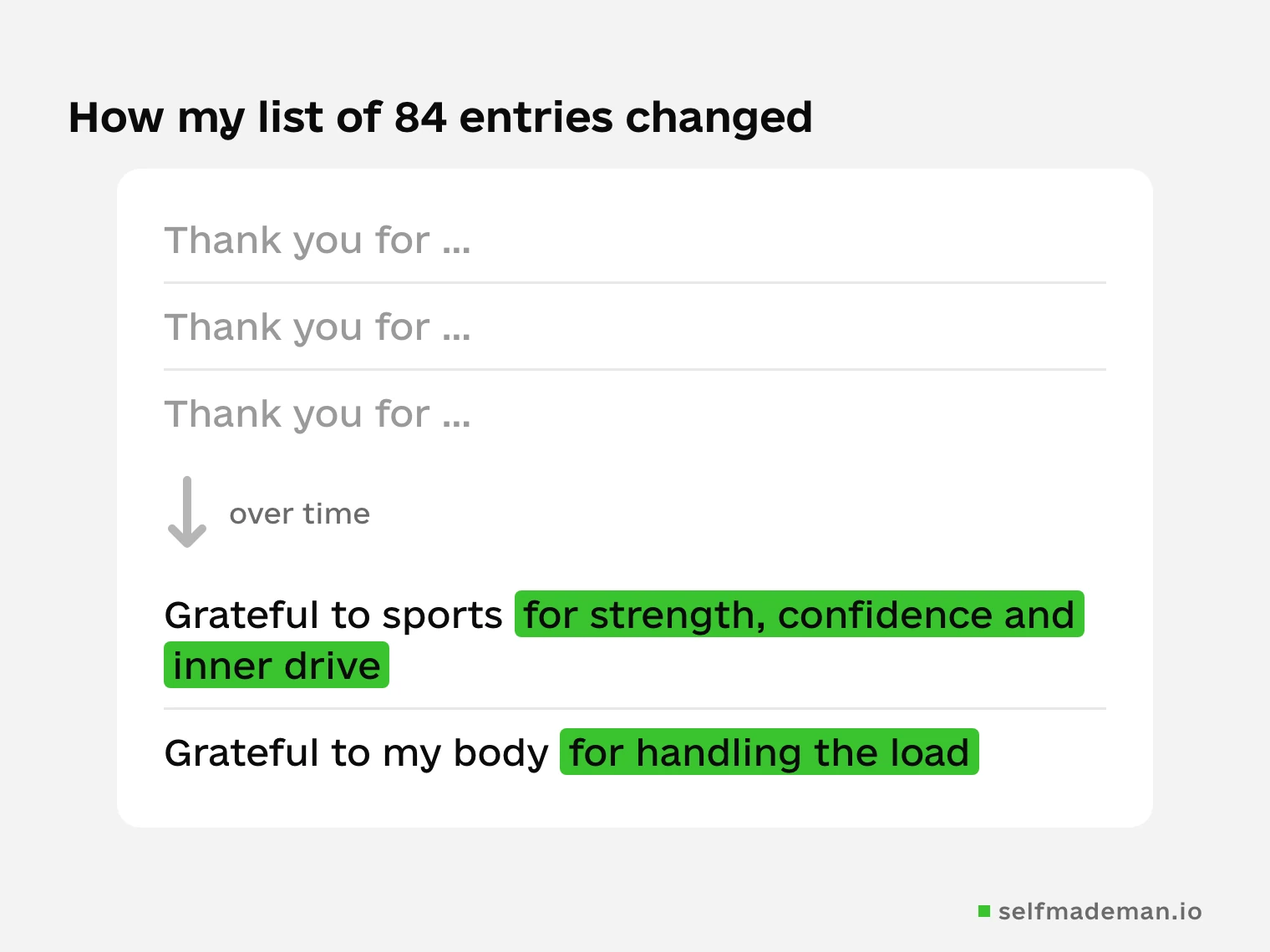
Read the list top to bottom and you can see how it changed. The first lines are short: “Thank you for…” followed by a person’s name. Or basic things, with no details. Lines like that are easy to write, and just as easy to skim past without feeling anything.
The later lines are different. They have a “for what.” Here are a few, with no names:
- Grateful to sports for strength, confidence and inner drive.
- Grateful to my body for handling the load.
- Grateful for simple moments: coffee, walks, the road, conversations.
- Grateful for AI tools that let me build websites and services faster.
- Grateful to myself for not stopping, even when I’m overloaded.
That last one is gratitude to myself. At first it feels strange. But your own actions are the thing you actually control. Noticing them is more useful than waiting for someone else to notice.
Does a gratitude journal work? What research says, without the hype
People write about gratitude as if it cures everything from insomnia to depression. The data is more modest. And that’s good news: it means you can expect something real instead of something out of a fairy tale.
The classic: Emmons and McCullough, 2003. Students wrote down up to five things they were grateful for once a week. Other groups wrote about hassles or just the events of the week. After nine weeks, the gratitude group rated their lives higher, felt more optimistic about the coming week, reported fewer physical complaints, and spent more time exercising. But in the second study, where people wrote every day, the differences in health and exercise were gone. The authors themselves name a rise in positive emotions as the most consistent result1.
More often doesn’t mean better. In Sonja Lyubomirsky’s study, students spent six weeks “counting their blessings” either once a week or three times a week. Well-being went up only in the once-a-week group. The authors suggest that frequent repetition gets boring and loses its meaning2.
Three good things. In Martin Seligman’s online experiment, participants wrote down three good things that happened each day, plus why they happened, every evening for a week. The boost in happiness lasted up to six months. A gratitude letter that people had to deliver in person gave a strong but short-lived spike3.
Meta-analyses. When researchers pooled dozens of studies, the effect on well-being turned out small, and the authors of a 2016 meta-analysis urged people not to overrate the practice until there are longer and more rigorous experiments4. The effect on symptoms of depression and anxiety is small too, and the authors say it plainly: for treatment, choose methods with stronger evidence5.
An unexpected trick: “subtraction.” If you imagine that a good event in your life might never have happened, your mood rises more than if you simply remember it. Yet people predict the opposite in advance6.
Gratitude isn’t a pill. It’s attention training. It teaches you to notice the good that’s already there. That’s reason enough to practice it, as long as you don’t expect miracles.
A gratitude journal doesn’t replace professional help. If low mood, anxiety, or insomnia have lasted for weeks, start with a conversation with a doctor or a therapist. Gratitude can stay as an add-on.
How to start a gratitude journal: 6 steps
- Tie your entry to something already in your day. My rules put it before bed. Any time that happens every day or every week works: Sunday evening, the commute home, your after-lunch coffee.
- Pick a pace that keeps the entries alive. To start, 1–3 times a week. If writing daily means writing the same thing, cut back. The question isn’t “how many times,” it’s “do I feel anything when I write?”
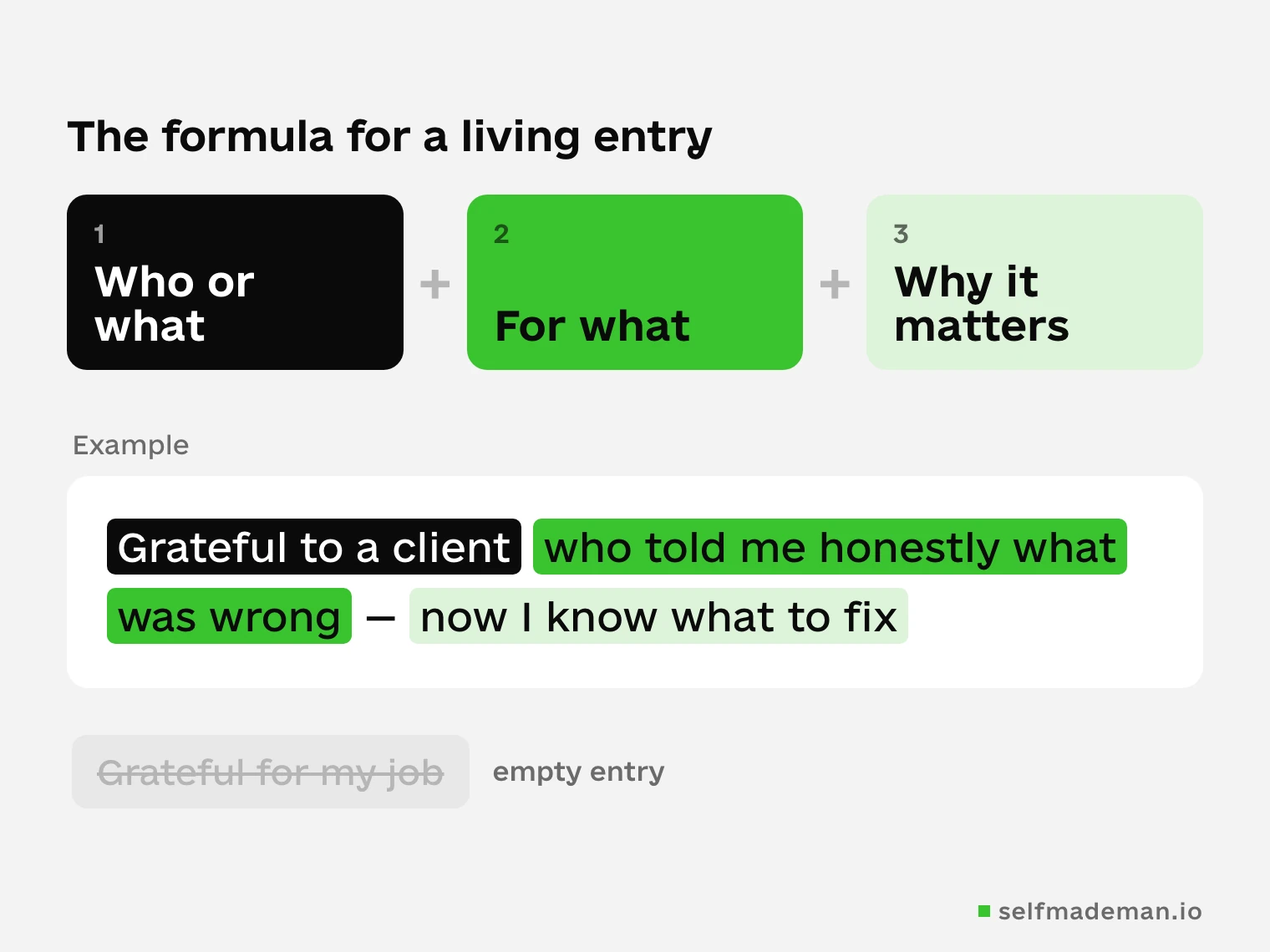
- Write 3–5 items, each one specific. The formula is simple: who or what + for what + why it matters. One living line beats five on autopilot.
- Put people above things. A new phone makes you happy for a week. A person who had your back stays with you for a long time. And don’t forget yourself: your own actions count too.
- Look for the unexpected and try “subtraction.” What went better today than you expected? Imagine it didn’t happen. What would the day have looked like?
- Reread once a month. Whatever repeats is what truly matters to you. Sometimes after rereading you’ll want to thank someone out loud. Do it.
What to write in a gratitude journal so it stays alive
| Empty entry | Living entry |
|---|---|
| Grateful for my family | Grateful for an evening with the people I love — the first one this week without phones |
| Grateful for my job | Grateful to a client who told me honestly what was wrong — now I know what to fix |
| Grateful for my health | Grateful to my knees: a 5K run and nothing hurts |
| Grateful for all the good things | Grateful to myself for finishing the report, even though I wanted to quit |
The examples on the right show the format. They aren’t my entries. You’ll write yours better.
Gratitude journal prompts: ideas for your gratitude list when your mind goes blank
Some days nothing comes to mind. Then go through the categories. Almost all of them are on my list too.
- People. Who helped you, listened to you, or made you laugh today? Who once taught you something important?
- Your body. What did it handle today? What can it do now that it couldn’t a year ago?
- The basics. A place to live and food to eat. Sounds trite until you lose them.
- Work and knowledge. What can you do now that you couldn’t before? Who gave you a chance?
- Your own actions. Where did you manage today not to give up, to hold back, to do the honest thing?
- Simple moments. Coffee, a walk, the drive, a conversation, quiet.
- Hard things. What did an unpleasant situation teach you?
Gratitude tracker
This is an example from the article. Your entries are not touched, and changes here are not saved.
Formula: who or what + for what + why it matters. One living line is better than five routine ones.
For a start, 1–3 times a week. In Lyubomirsky’s experiment, writing once a week worked, and three times a week did not. If writing every day stays alive, write every day. The test is not “how many times” but “do I feel something when I write”.
Tie the entry to something that already happens in your day: before sleep, Sunday evening, the way home, coffee after lunch.
A diary goes by dates, a list is one growing set you can reread in full. Write in the diary and move the best into the list: mark it with a star.
Entries stay in this browser only: nothing is sent anywhere. A reminder in the calendar is added by you.
Where it breaks down
- Copy-paste. Every night: “family, health, work.” Two weeks in, that’s not gratitude anymore. It’s a password. The fix is specifics and fewer entries.
- “I have to.” If the journal has become a chore you do with a sigh, it won’t do anything. Cut back the frequency instead of quitting altogether.
- Gratitude instead of solving problems. Being grateful for your job doesn’t mean you have to put up with a bad one. The practice helps you notice the good, not close your eyes to the bad.
- Comparing down. “Glad I’m not like them” isn’t gratitude. In Emmons’s experiment, comparing yourself to people who have it worse was a separate control group, not a version of the practice1.
- Expecting a miracle. If you expect five lines a day to cure anxiety, disappointment is guaranteed. The effect is modest, and that’s okay.
The minimum version
One line: who + for what. You don’t even have to write it down. Before bed, name in your head one thing you want to say thank you for today. Thirty seconds. If gratitude is one of several habits, check it off with the rest in your habit tracker.
If you fall off
Don’t try to “catch up” on missed days by writing five items for each one. Just write one line today. If the break has lasted a month, reread your old entries. That’s often the best way back, because you immediately see how much good there already was.
Questions
What do you write in a gratitude journal?
3–5 specific things: who or what, for what exactly, and why it matters. People, your body, your own actions, simple moments of the day. Don’t repeat the same thing every day.
How often should you write in a gratitude journal?
To start, 1–3 times a week. In Lyubomirsky’s experiment, writing once a week had an effect, and three times a week didn’t. If writing every day still feels alive, write every day.
Does a gratitude journal actually work?
Yes, but the effect is small. Meta-analyses show a small rise in positive emotions and life satisfaction, and only a small effect on depression and anxiety. It’s not a substitute for treatment.
What’s the difference between a gratitude list and a gratitude journal?
A journal goes by date: new entries each time. A list is one growing collection you can reread from start to finish. I keep a list. You can combine them: write in a journal and move the best lines to a list.
Is it better to write in the morning or at night?
I couldn’t find studies comparing morning and evening. Pick a time that’s always in your day. My rules put it before bed.
Paper or app?
Doesn’t matter, as long as it’s within reach. Paper doesn’t ping you with notifications. An app is always with you.
Your action for today
Before bed, write three lines using the formula “who or what + for what + why it matters.” At least one about a person, at least one about something you did. Five minutes. If you feel like it, tell one of those people tomorrow, out loud.
Gratitude also fits nicely into your year-end review: at the end of the year, the list shows what actually mattered.
Sources
- Emmons R. A., McCullough M. E. Counting blessings versus burdens: An experimental investigation of gratitude and subjective well-being in daily life. Journal of Personality and Social Psychology, 2003, 84(2), 377–389. ↩
- Lyubomirsky S., Sheldon K. M., Schkade D. Pursuing happiness: The architecture of sustainable change. Review of General Psychology, 2005, 9(2), 111–131. ↩
- Seligman M. E. P., Steen T. A., Park N., Peterson C. Positive psychology progress: Empirical validation of interventions. American Psychologist, 2005, 60(5), 410–421. ↩
- Davis D. E., Choe E., Meyers J., et al. Thankful for the little things: A meta-analysis of gratitude interventions. Journal of Counseling Psychology, 2016, 63(1), 20–31. ↩
- Cregg D. R., Cheavens J. S. Gratitude interventions: Effective self-help? A meta-analysis of the impact on symptoms of depression and anxiety. Journal of Happiness Studies, 2021, 22(1), 413–445. ↩
- Koo M., Algoe S. B., Wilson T. D., Gilbert D. T. It’s a wonderful life: Mentally subtracting positive events improves people’s affective states, contrary to their affective forecasts. Journal of Personality and Social Psychology, 2008, 95(5), 1217–1224. ↩