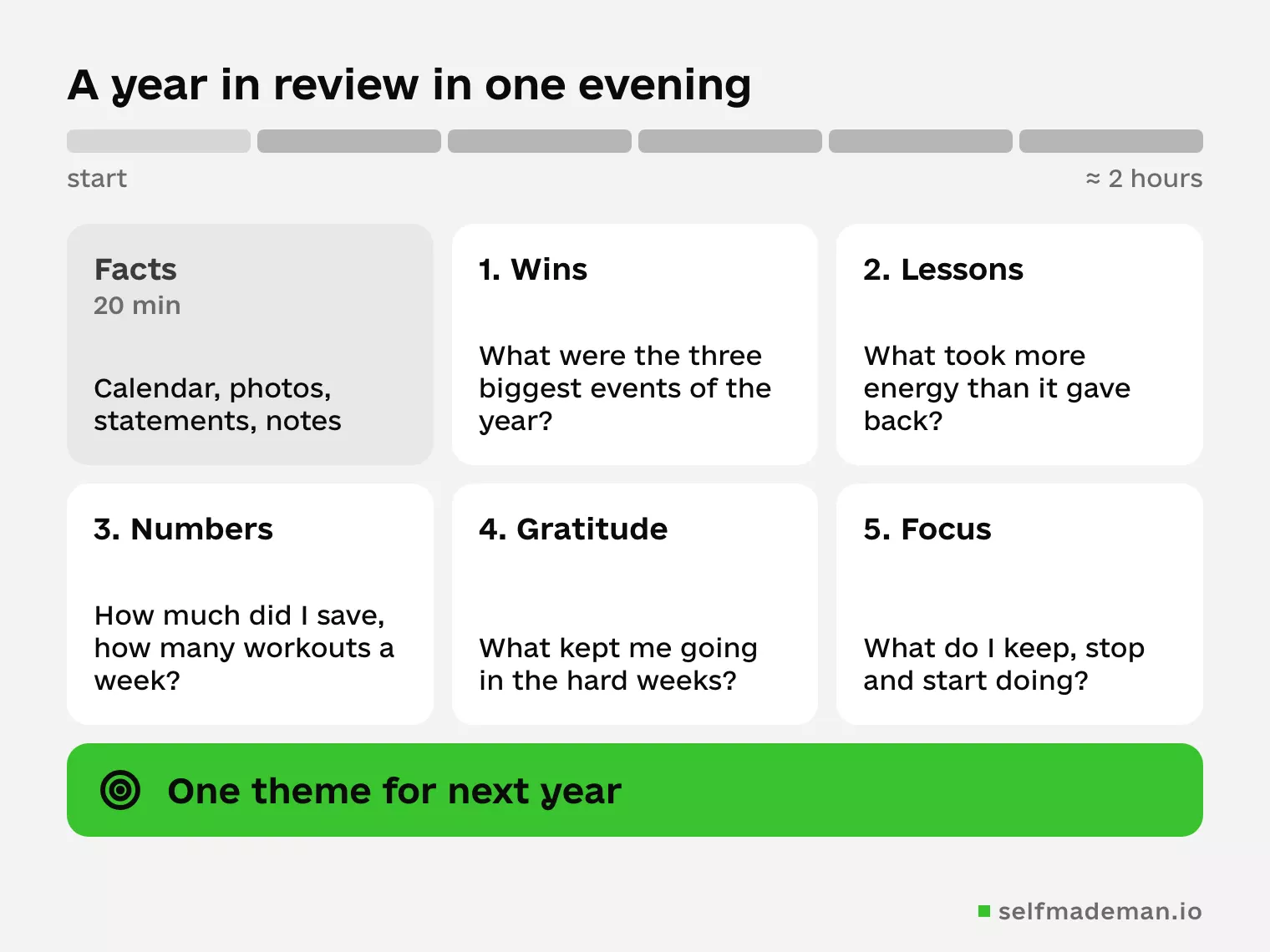
An end of year reflection takes one evening, about two hours. First, gather the facts: your calendar, photos, bank statements, notes. Then go through five blocks of questions: wins, lessons, numbers, gratitude, and focus for next year. Finish with one sentence: what’s the theme of the coming year? Work from facts, not memory — because your memory of a year is almost always skewed.
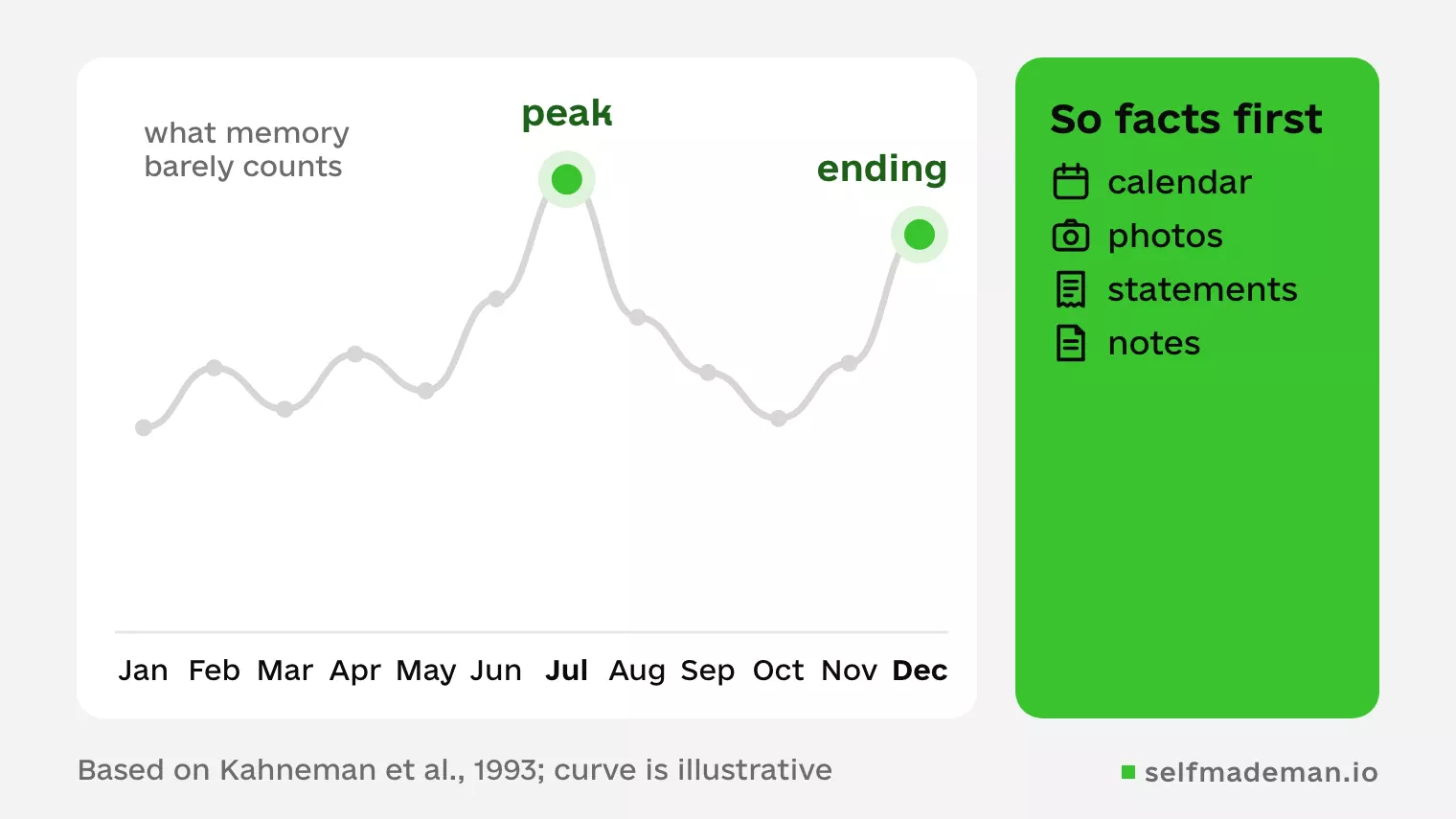
- Facts first, conclusions second. Memory keeps the peaks and the last few weeks, not the whole year.
- Five blocks: wins, lessons, numbers, gratitude, focus.
- The point isn’t to grade the year as “good” or “bad.” The point is the next step.
- Minimum version: 30 minutes and three questions.
Table of contents
Why reflect on the year at all
Experience alone doesn’t teach you much. Experience you’ve thought about does. In a Harvard Business School experiment, new call center employees spent 15 minutes at the end of each training day writing down what they’d learned. Eleven days later, they scored 22.8% higher on the final test than those who just kept working1.
A personal year in review is the same reflection, scaled up to a year. Without it, the year blurs into “stuff happened, not sure what” — and the next one goes the same way.
My experience
I keep a gratitude list. Right now it has 84 items. Read it top to bottom and you can see how I changed. The early entries are generic: “Grateful for opportunities,” “Grateful for energy.” The later ones are specific:
I’m grateful for simple moments: coffee, walks, the road, and conversations.
I’m grateful to myself for not stopping, even when I’m overloaded.
Generic gratitude says nothing about a year. Specific gratitude is a ready-made review: what gave you energy, what kept you going, what everything rested on.
My main lesson this year fits into one rule: “Build a system instead of living in bursts.”
Why not from memory
Memory doesn’t judge a period as a whole. It uses two points: the most intense moment and the ending. In a well-known experiment by Daniel Kahneman and colleagues, people chose to repeat a longer unpleasant procedure if it got slightly less unpleasant at the end2. A year works the same way: a rough December can cancel out a great March, and one bright vacation can hide months when nothing moved.
So before the questions, spend 20 minutes on facts:
- Calendar: scroll through all 12 months.
- Photos: a week or two at a time.
- Money: statements or your budgeting app — income, spending, how much you saved.
- Notes, journal, habit trackers, if you have them.
- Goals you set at the start of the year. If you didn’t set any, that’s a fact too.
End of year reflection questions in five blocks
1. Wins
- What were the three biggest events of the year?
- What did I plan that actually worked out?
- What worked out even though I didn’t plan it?
- How is this year different from last year?
2. Lessons
- What didn’t work — and what part of it was in my control and what wasn’t?
- What took more energy than it gave back?
- What was my best decision of the year? And the worst?
- What did this year show me about myself?
The lessons block isn’t a trial. The goal is to find what to change, not who to blame. Be direct about decisions — and kind to yourself.
3. Numbers
Numbers are more honest than feelings. Pick the ones that matter to you:
| Area | What to count |
|---|---|
| Money | income, how much you saved, big purchases |
| Health | workouts per week, steps, average bedtime |
| Work and business | finished projects, clients, income growth |
| Learning | books read, new skills |
| People | time with friends, phone-free time with family |
| Rest | vacation days, weekends without work |
4. Gratitude
- Who do I want to thank for this year — and for what, exactly?
- What kept me going in the hard weeks?
- What can I thank myself for?
Writing down gratitude isn’t magic, but it isn’t nothing either. In a study by Robert Emmons and Michael McCullough, people who regularly wrote down what they were grateful for had a consistently better mood than those who wrote down their hassles3. Specifics are what matter. “Grateful for my family” will tell you nothing a year from now. “For Sunday evening walks” will.
5. Focus
- What do I keep doing?
- What do I stop?
- What do I start?
- If next year has one theme, what is it?
The answer to that last question is your bridge to the next step: three goals for the year and one New Year’s resolution.
Year in review template
Facts first, conclusions second. Memory rates a period by its strongest moment and its ending, not as a whole: a hard December easily crosses out a good March. So, before the questions — 20 minutes for facts.
Put a two-hour “Year in review” slot in the calendar for the second half of December. And now, while you remember, write down the three main events of the year: the first line of the review is ready.
- 1
- 2
- 3
Compare the year only with your own previous year, not with other people’s best moments on social media.
The lessons block is not a trial. The task is to find what to change, not whom to blame. Direct about decisions, gentle with yourself. The rule: for every “did not work out”, one answer to “what will I do differently”.
Numbers are more honest than feelings. Pick the ones that matter to you: tap what to count. The last year column is optional — compare only with your own previous year.
A filled table without a conclusion is half the work. Numbers are material for the lessons block, not the result.
The main thing is concreteness. “Thank you for my family” will say nothing in a year. “For Sunday evening walks” will.
One line — one item.
No two hours? Take 30 minutes and three questions. It is less than the full review, but far more than nothing.
One line — one item.
Answers stay in this browser: separately for each year, nothing is sent anywhere.
Where it breaks
- Beating yourself up instead of drawing conclusions. The review turns into a list of failures. Rule: for every “didn’t work,” write one answer to “what will I do differently?”
- Only numbers, no meaning. The table is filled in, but there’s no takeaway. Numbers are raw material for the lessons block, not the result.
- Comparing with other people’s years. In December, social media is full of everyone else’s highlights. The only fair comparison for your year is your own last year.
- Too ambitious. A six-hour review gets pushed to February. Two hours is enough.
- If the year was hard. You still need the review, but start with gratitude: what helped you get through. That’s the main result of a year like that.
Minimum version
No two hours? Take 30 minutes and three questions:
- What was the best part of this year?
- What did this year teach me?
- What will I focus on next year?
It’s less than a full review, but it’s far more than nothing.
If December didn’t happen
No big deal. A review works in January too, or on your birthday — any fresh-start marker will do. And so next time you don’t have to piece the year together from scraps, do a 20-minute mini review once a quarter: the three questions above plus your numbers. In December, you just add them up.
FAQ
When is the best time for an end of year reflection?
The second half of December, while the year is still fresh but most of the work is wrapped up. The first weeks of January work too.
How long does it take?
A full review takes about two hours: 20 minutes on facts, the rest on questions. The minimum version takes 30 minutes.
Should I do it alone or with my partner?
Alone first, then you can talk it over. A joint review is useful for shared goals: home, money, vacations, kids.
What do I do with the results?
Turn the conclusion into goals. The focus block is a rough draft of your goals for the year.
Today’s action
Open your calendar and block two hours in the second half of December: “Year in review.” And right now, while you remember, write down the three biggest events of this year. The first line of your review is already done.
Sources
- Di Stefano G., Gino F., Pisano G., Staats B. Learning by Thinking: How Reflection Aids Performance. Harvard Business School Working Paper, 2014. Summary on HBS Working Knowledge. ↩
- Kahneman D., Fredrickson B. L., Schreiber C. A., Redelmeier D. A. When More Pain Is Preferred to Less: Adding a Better End. Psychological Science, 1993. ↩
- Emmons R. A., McCullough M. E. Counting blessings versus burdens: An experimental investigation of gratitude and subjective well-being in daily life. Journal of Personality and Social Psychology, 2003. ↩