A morning workout routine sticks because of three things, not willpower. Tie it to something you already do every morning. Do the same short set every time, so you don’t burn energy choosing. And keep a 2-minute minimum version for bad days. Ten minutes won’t cover your weekly activity needs, and that’s fine: a morning workout is how you start the day, not your training. Below is my experience, a simple 10-minute routine and a timer for it.
I’m sharing my rules about morning exercise, being honest about how hard they are to keep, and I refer to the WHO guidelines. If you have health issues, pain, blood pressure problems, injuries, or you haven’t moved much in a long time, see a doctor first. Drop any exercise that causes pain.
- A morning workout runs on an anchor: “after I…”, not “at 7:00.”
- Same set of exercises every day. Don’t pick a new one each morning.
- The minimum is 2 minutes. That’s what saves the habit on bad days.
- One missed day doesn’t break the habit. Two in a row is the start of a new script.
- 10 minutes isn’t all the movement you need. It’s the start of the day; training is separate.
Table of contents
My experience
Morning exercise is the first rule on my personal list. Literally the first: “I always do my morning exercises.” Later a shorter version showed up on the list: “Exercise every day.” It sits in the same block as sleep, water, steps and the line “Health is project #1.”
The change in wording matters. “Always” is gone. “Morning” is gone. What’s left is “every day.”
To be honest, though: the rule exists, but it doesn’t come easy. Getting myself to do morning exercise and workouts is really hard for me. So what’s below isn’t my “secret” set. It’s a standard, simple routine, plus ways not to quit entirely.
How much exercise you actually need
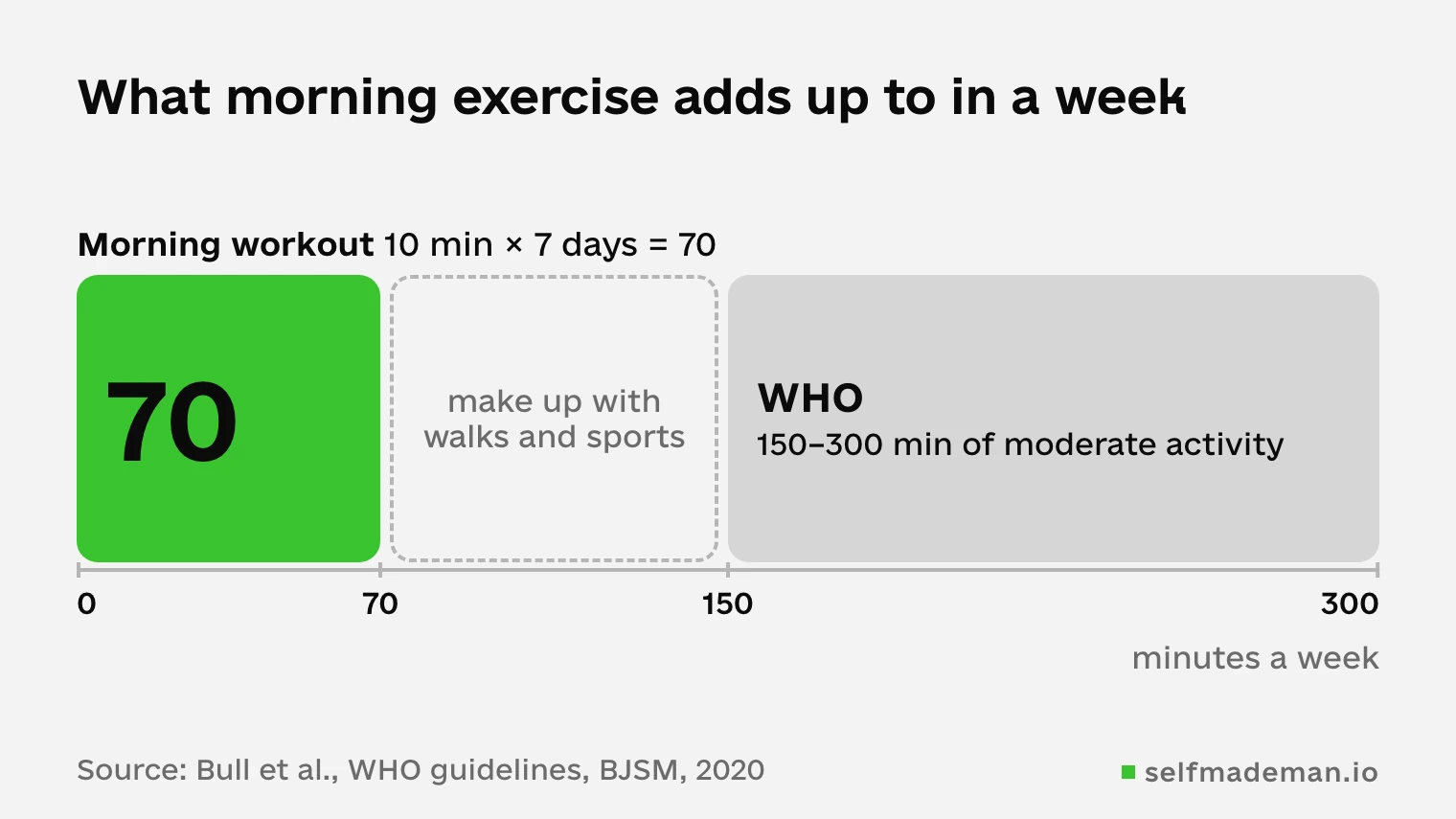
Let’s be honest about the numbers. The 2020 WHO guidelines say adults need 150–300 minutes of moderate activity a week, or 75–150 minutes of vigorous activity. Plus muscle-strengthening work for all major muscle groups at least two days a week1.
Ten minutes of morning exercise every day is 70 minutes a week. Less than half the minimum. So a morning workout doesn’t replace the gym, running or long walks.
But the same guidelines contain two ideas that matter here. First: some activity is better than none12. Second: movement of any length counts. The 2010 version only counted bouts of 10 minutes or more; in 2020 that requirement was dropped1.
A morning workout isn’t training. It’s a daily “I move” that makes everything else easier to build on.
How to make morning exercise a daily habit: 6 steps
- Pick an anchor. Not a time, but something you already do every morning: “after I wash my face,” “after a glass of water.” Wake-up time drifts; the anchor doesn’t. In a small study on flossing, people who flossed after brushing rather than before built a stronger habit3. And the “when X, I do Y” formula noticeably raises the odds that you follow through on a plan4.
- Set up the spot the night before. Mat on the floor, comfortable clothes nearby. Every extra step in the morning is a reason to change your mind.
- Lock in one set. Six to eight exercises in the same order. In the morning your brain shouldn’t decide what to do — only start.
- Define your minimum. Two minutes: one or two exercises. That’s not slacking, it’s insurance for the habit on days with an early start, a sick kid or bad sleep.
- Track it. A check mark in a habit tracker or on a calendar. Not to report to anyone, but to see your streak and stay honest with yourself.
- Never miss twice. One missed day is an accident. Two in a row is a new habit of not doing it. That’s James Clear’s rule5, and it fits the data: in Phillippa Lally’s study, missing a single day barely affected habit formation6.
A 10-minute morning workout routine at home
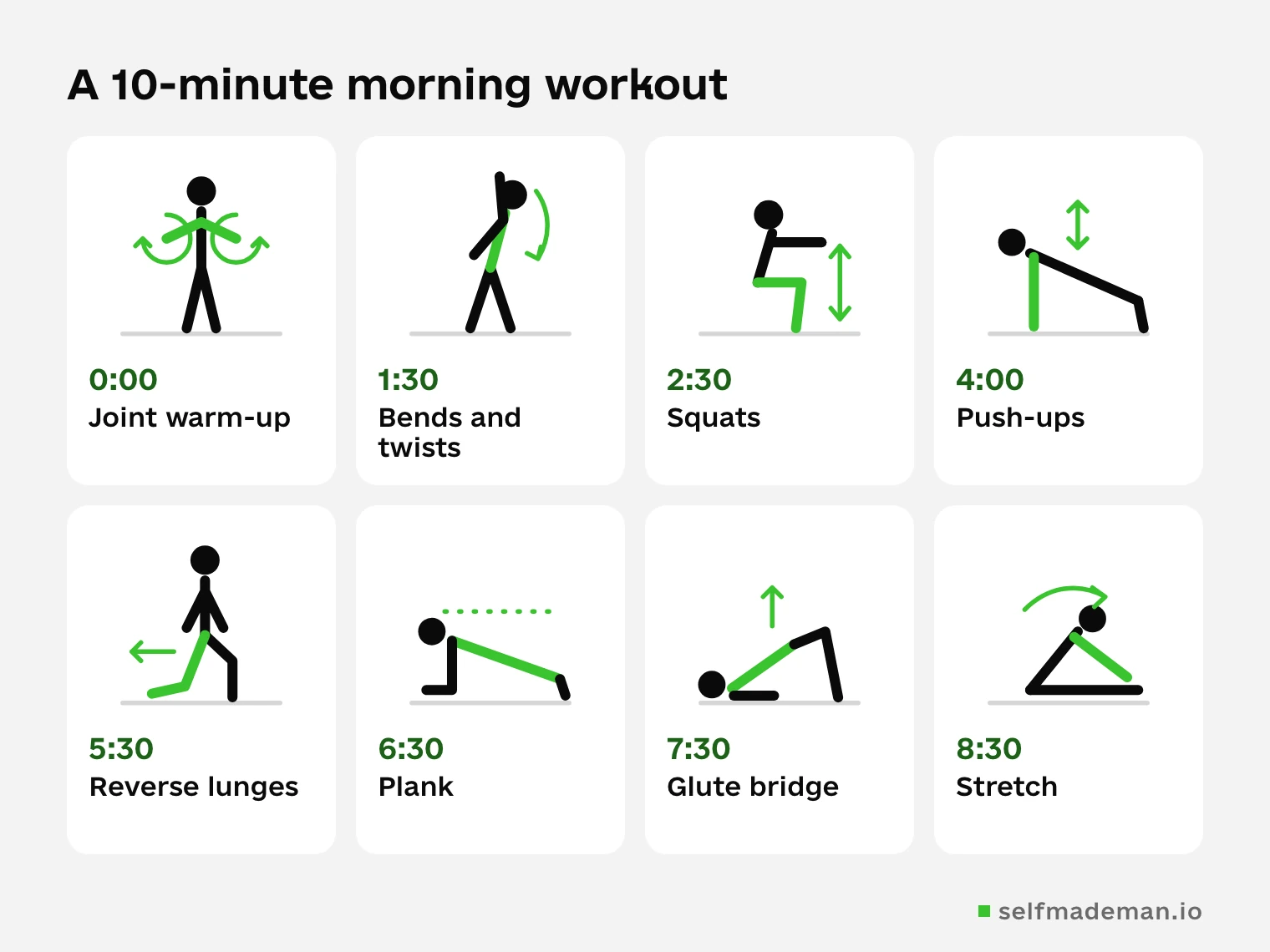
This is a starter set, not a training program. Everything is done at home with no equipment. Keep a calm pace, no jerking. If an exercise is too hard, use the easier version. If it hurts, drop it.
| Time | Exercise | Easier version |
|---|---|---|
| 0:00–1:30 | March in place, shoulder, arm and wrist circles | Shoulders and arms only |
| 1:30–2:30 | Standing side bends and torso twists | Smaller range of motion |
| 2:30–4:00 | Squats | Sit down on a chair and stand up |
| 4:00–5:30 | Push-ups | Against a wall or table |
| 5:30–6:30 | Reverse lunges, alternating legs | Calf raises at a wall |
| 6:30–7:30 | Plank, 2 sets of 20–30 seconds | Plank on your knees |
| 7:30–8:30 | Glute bridge, lying on your back | Fewer reps |
| 8:30–10:00 | Stretch: hamstrings, chest, back | Seated on a chair |
After a couple of weeks, if it all feels easy, add reps or swap an exercise for a harder one. If you’d rather do a morning stretch routine than a workout, keep the first two rows and the last one, and stretch them out to 10 minutes.
Do your morning workout with a timer
Work 20 s, rest 10 s, rounds: 8.
Longer than three hours: check the numbers.
Tap the timer to bring the sound back.
Did not finish? It still counts: a little activity is better than none.
No marks this week yet. Two minutes count too.
A week or more without workouts? Don’t start with the full version: two minutes for three or four days in a row, then back to ten.
WHO guideline for adults: 150–300 minutes of moderate activity a week and strength exercises at least two days a week. Ten minutes a day is a start, not the whole norm.
Space starts and pauses. The timer keeps going in a background tab and after a page reload. On a phone, the sound may stop once the screen locks.
The timer counts time, not load. This is not medical advice. If you have heart, blood pressure or joint conditions, or any doubts, see a doctor first. Chest pain, severe dizziness or sudden shortness of breath during a workout: stop and get medical help. The log stays only in this browser.
Pick the “10-minute workout” mode: the timer walks you through the eight exercises from the table, shows the easier version and beeps at every switch. For a bad day there’s “2-minute minimum.”
Where it breaks
- Starting with 30 minutes. In week one, motivation covers everything. By week two, mornings get shorter and the long workout drops out completely. Start with 10, or even 5.
- Tying it to the clock. “At 7:00” breaks the first day you sleep through the alarm or leave early. The anchor “after I wash my face” works at any time.
- A new video every day. While you’re picking a video, the workout has already not happened. Videos are for learning the set, not for every morning.
- Bad sleep. If getting up is a struggle, the problem is often your evening, not the exercise. More on that in how to wake up early without sleep debt.
- Your morning is fully booked. Small kids, an early shift, a commute. Then it’s more honest to move the workout to a different anchor — after work, before your shower — than to lose to the morning every day.
- Pain and illness. Exercise doesn’t treat anything and shouldn’t hurt. If something feels off, see a doctor, not the next video.
The minimum version
Two minutes. For example, 15 squats and a 30-second plank. Or just stand up, stretch and do some shoulder circles. The point of the minimum isn’t the load. It’s keeping the habit “in the morning, I move.”
If you fall off
Missed a day — nothing happened. Tomorrow you do it as usual, without “making up” a double dose.
Missed a week — don’t restart with the full version. Go back to the minimum: two minutes for three or four days in a row, then back to ten. The habit itself doesn’t reset: you still have the anchor, the spot and the set. You just need to start again.
FAQ
Is a 10-minute morning workout enough?
For the habit, yes. For the WHO weekly guidelines, no: adults are advised to get 150–300 minutes of moderate activity a week plus strength training on two days1. A 10-minute morning workout is a good start; make up the rest with walks and sports.
Is it good to exercise immediately after waking up?
Light exercise is fine for most people. Start slowly, with a joint warm-up. If you have heart, blood pressure or joint conditions, or any doubts, ask your doctor.
What type of workout is best for the morning?
The one you’ll do every day. Ideally your set has both stretching and strength moves: the WHO specifically recommends muscle-strengthening activity1.
How long does it take for morning exercise to become a habit?
There’s no exact number. In Lally’s study, reaching automaticity took 18 to 254 days, about two months on average6. If after three weeks you still have to talk yourself into it, that’s normal.
What if I have no time in the morning?
Do the 2-minute minimum, or move your workout to a different anchor later in the day.
Do this today
Pick your anchor: what you’ll do right before your workout tomorrow morning. Write down the sentence “After I _, I do my morning workout.” Put your mat where you’ll trip over it in the morning. Tomorrow, do at least two minutes: start the timer in “2-minute minimum” mode. Five minutes of prep today.
Sources
- Bull F. C., Al-Ansari S. S., Biddle S., et al. World Health Organization 2020 guidelines on physical activity and sedentary behaviour. British Journal of Sports Medicine, 2020, 54(24), 1451–1462. ↩
- World Health Organization. Physical activity: fact sheet, June 26, 2024. ↩
- Judah G., Gardner B., Aunger R. Forming a flossing habit: an exploratory study of the psychological determinants of habit formation. British Journal of Health Psychology, 2013, 18(2), 338–353. ↩
- Gollwitzer P. M., Sheeran P. Implementation intentions and goal achievement: A meta-analysis of effects and processes. Advances in Experimental Social Psychology, 2006, 38, 69–119. ↩
- Clear J. Atomic Habits. Avery, 2018. ↩
- Lally P., van Jaarsveld C. H. M., Potts H. W. W., Wardle J. How are habits formed: Modelling habit formation in the real world. European Journal of Social Psychology, 2010, 40(6), 998–1009. ↩