
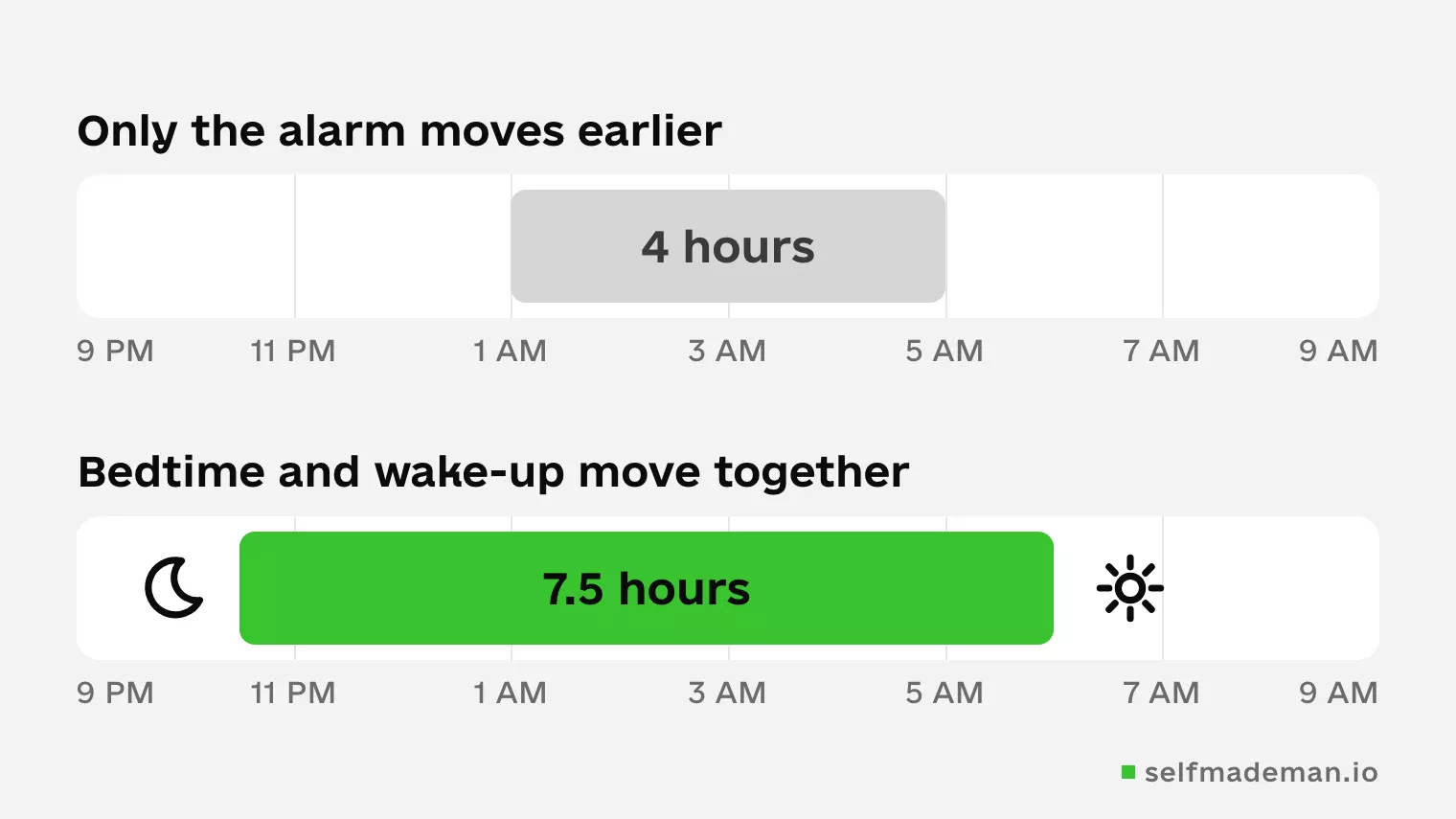
How to wake up early: start with bedtime, not the alarm. Work out when you need to be asleep to get at least seven hours, then move bedtime earlier gradually — roughly 15 minutes every few days. Get up at the same time every day, weekends included, and get some light in the morning. If you just set the alarm an hour earlier, you don’t become an early riser. You become chronically short on sleep.
I’m sharing how my own sleep rules changed and pointing to sleep medicine consensus statements and studies. If you sleep enough but still have no energy, snore, struggle to fall asleep or keep waking up at night, that’s a reason to see a doctor, not to move your alarm. There’s no advice on medications or supplements here, and there won’t be.
- Waking up earlier = going to bed earlier. Otherwise you’re just sleeping less.
- Sleep medicine experts recommend 7 or more hours of sleep a night for adults, regularly.
- Shift your schedule in small steps. Your body clock can’t keep up with big jumps.
- Same wake-up time every day, weekends included.
- Light in the morning; dim light and fewer screens in the evening.
Table of contents
My experience: from “by 1 a.m.” to “by 11 p.m.”
Sleep made it into my personal rules a long time ago. The old version went: “I go to bed by 1 a.m., no exceptions.” Next to it was another one: “I sleep at least 6 hours.”
Today a different rule stands in that spot — “Asleep by 11 p.m.” Two hours of difference. And next to it are rules about the evening: the evening is for order, routine and prep for tomorrow, and in the evening I recover instead of pushing through tasks at any cost.
It’s a good example of how rules grow along with a person. And an honest detail: six hours of sleep is less than doctors recommend. Per the sleep medicine consensus, adults need at least seven1.
Waking up early isn’t about willpower. It’s about the evening.
How much sleep you need and how to work out your bedtime
These numbers aren’t mine — they’re consensus. In 2015, the American Academy of Sleep Medicine and the Sleep Research Society agreed that adults should sleep 7 or more hours per night on a regular basis1. The same year, the US National Sleep Foundation gave a range: 7–9 hours for adults up to 64 and 7–8 hours from 65 on2.
That gives you simple math. Bedtime = wake-up time − how much sleep you need − time to fall asleep.
| I want to wake up at | 7 h of sleep | 7.5 h of sleep | 8 h of sleep |
|---|---|---|---|
| 5:30 a.m. | 10:30 p.m. | 10:00 p.m. | 9:30 p.m. |
| 6:00 a.m. | 11:00 p.m. | 10:30 p.m. | 10:00 p.m. |
| 6:30 a.m. | 11:30 p.m. | 11:00 p.m. | 10:30 p.m. |
| 7:00 a.m. | 12:00 a.m. | 11:30 p.m. | 11:00 p.m. |
That’s the time you’re already asleep, not the time you get into bed with your phone. If it takes you 20–30 minutes to fall asleep, go to bed that much earlier.
If a number in the table looks unrealistic, that’s an honest answer: waking up at 5:30 without sleep debt only works with a bedtime around 10 p.m. If that’s impossible for you, “wake up at 5:30” isn’t your goal yet.
How to become a morning person (and whether you have to)
Chronotype isn’t an excuse, but it isn’t made up either. A study of nearly 700,000 people found 351 regions of the genome linked to how much of a “morning person” someone is3. So the tendency is partly inborn.
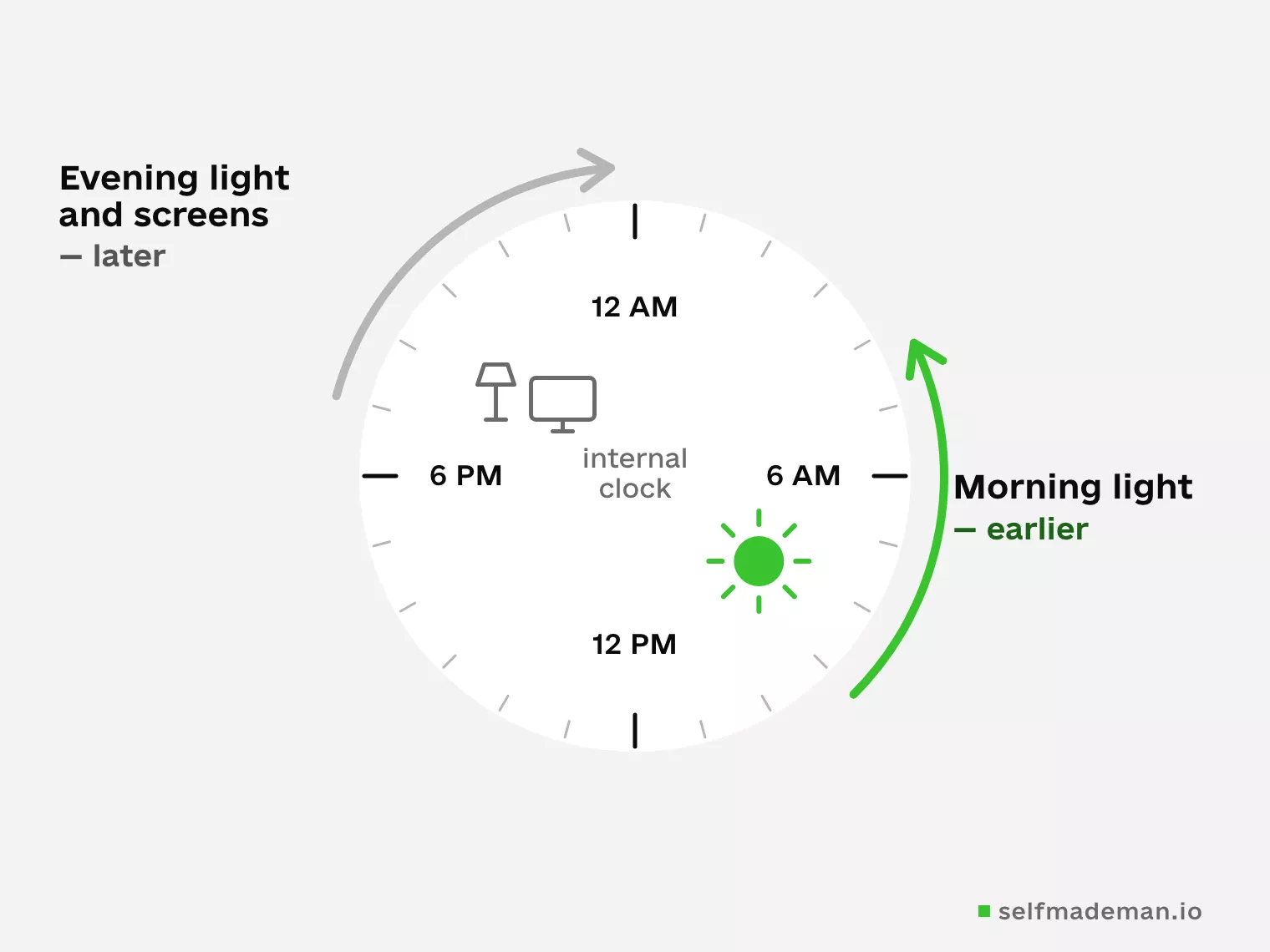
At the same time, your environment moves your clock more than you’d think. In Kenneth Wright’s experiment, eight people spent a week camping with no artificial light. Their internal clocks shifted almost two hours earlier, closer to sunset4. The main lever is light: morning light shifts your body clock earlier, evening light shifts it later5.
The practical takeaway: a night owl can become an “early owl.” But an owl is no more obligated to become a 5 a.m. person than a lark is to become a 2 a.m. person.
How to go to bed earlier and wake up early: 7 steps
- Work out bedtime from your wake-up time. Use the table above. Sleep goal first, alarm second.
- Shift gradually. The planner below uses 15 minutes every few days as a guide: bedtime and wake-up time together. That’s a cautious step, not a scientific standard. But research points the same way: even in a lab with bright lamps, shifting sleep by two hours a day worked no better than by one — the body clock couldn’t keep up6.
- Get up at the same time every day. Weekends included. The gap between weekdays and weekends creates “social jetlag” — as if every Monday you flew in from another time zone7.
- Get light in the morning. In the first half hour after waking, open the curtains, step out onto a balcony or outside. Morning light is the main signal to your clock that the day has started5.
- Dim light and fewer screens in the evening. An hour before bed, turn the overhead lights down. In Anne-Marie Chang’s experiment, reading on a tablet before bed for several evenings in a row shifted the clock later; people took longer to fall asleep and were less alert in the morning8.
- Set a bedtime alarm. Not just a wake-up alarm. 60 minutes before sleep — a “closing the laptop, the evening is mine” signal. This ties into my rule: evening is for order, routine, prep.
- Give your morning a purpose. Getting up early for an extra hour on your phone won’t last. My version: mornings are for important tasks and a workout. Decide in advance what you’re getting up for.
Plan your schedule shift
Falling asleep takes you 20–30 minutes? Add them: lights out moves earlier by that much. Bedtime and wake-up move together by 15 min per step.
Fill in when you fall asleep and wake up now, and the wake-up you want. Or look at the example.
Two events for each step: the wind-down alarm in the evening and morning light after waking. The last step repeats every day. Google Calendar opens the file via Settings → Import.
A guide, not medical advice. If you sleep 7–9 hours and still have no energy, snore, gasp for air in your sleep or cannot fall asleep for weeks, see a doctor: no schedule fixes that. Shift work, small children and night shifts need a different approach. Data stays in this browser.
Where it breaks
- Getting up earlier while going to bed at the same time. The most common mistake. A 5 a.m. alarm with a 1 a.m. bedtime is four hours of sleep, not a productive morning.
- Weekends. You hold the schedule all week, sleep until noon on Saturday — and on Monday it feels like you just got off a flight again.
- Shift work, small kids, night shifts. The standard approach doesn’t work here. The goal isn’t a wake-up time — it’s enough sleep in the windows you actually have.
- Medical issues. If you sleep 7–9 hours and still have no energy, snore, gasp for air in your sleep, or can’t fall asleep for weeks on end, see a doctor. No schedule will fix that.
- The 5 a.m. cult. A wake-up time guarantees nothing by itself. What matters isn’t when you get up, but whether you slept enough and what you do with the morning.
Minimum version
Bad week, the schedule won’t hold? Keep one thing: get up at the same time and spend five minutes in morning light. That’s the anchor that makes it easier to bring bedtime back later.
If you slip
One late night isn’t a disaster. The next day, get up at your usual time instead of sleeping in until noon: that’s exactly the social jetlag from above7. Go to bed on plan that evening.
If your schedule drifted for a week, don’t snap back all at once. Start from where you are now and shift 15 minutes at a time again. It’s faster than it seems, and more honest than fighting your alarm.
FAQ
How long does it take to make waking up early a habit?
There’s no exact number. The shift itself — one hour in 15-minute steps every three days — takes about two weeks. For the new schedule to become a habit, it can take a couple of months: in Phillippa Lally’s habit study, reaching automaticity took anywhere from 18 to 254 days9.
Why can’t I wake up early even though I go to bed early?
Maybe you’re still not getting enough sleep, or you go to bed early but take a long time to fall asleep. Maybe it’s your chronotype. If you sleep 7–9 hours and still have no energy, that’s a reason to see a doctor.
What’s the best time to wake up?
There isn’t a universal one. The best one is the time that lets you sleep at least seven hours and that you can keep every day, weekends included.
How do I wake up at 5 a.m.?
Only if you’re asleep by about 9–10 p.m., depending on whether you need 7 or 8 hours — same math as the table above. If that bedtime doesn’t fit your life, 5 a.m. isn’t worth chasing. A later time you can keep beats an early one you can’t.
Can you sleep 6 hours and feel fine?
The medical consensus for adults is 7 hours or more on a regular basis1. If you want to sleep less than recommended, that’s a question for a doctor, not an article.
How do I become a morning person if I’m a night owl?
Chronotype is partly inborn3. You can shift your schedule an hour or two earlier with light and a gradual plan. Fully changing your nature — unlikely, and you don’t need to.
Do this today
Decide when you want to wake up and use the table to work out your bedtime. Tonight, go to bed 15 minutes earlier than usual and set a bedtime alarm: one hour before sleep — “closing the laptop.” Ten minutes to do the math and set it up.
Sources
- Watson N. F., Badr M. S., Belenky G. et al. Recommended Amount of Sleep for a Healthy Adult: A Joint Consensus Statement of the American Academy of Sleep Medicine and Sleep Research Society. Sleep, 2015, 38(6), 843–844. ↩
- Hirshkowitz M., Whiton K., Albert S. M. et al. National Sleep Foundation’s sleep time duration recommendations: methodology and results summary. Sleep Health, 2015, 1(1), 40–43. ↩
- Jones S. E. et al. Genome-wide association analyses of chronotype in 697,828 individuals provides insights into circadian rhythms. Nature Communications, 2019, 10, 343. ↩
- Wright K. P., McHill A. W., Birks B. R. et al. Entrainment of the human circadian clock to the natural light-dark cycle. Current Biology, 2013, 23(16), 1554–1558. ↩
- Khalsa S. B. S., Jewett M. E., Cajochen C., Czeisler C. A. A phase response curve to single bright light pulses in human subjects. Journal of Physiology, 2003, 549(3), 945–952. ↩
- Eastman C. I., Gazda C. J., Burgess H. J., Crowley S. J., Fogg L. F. Advancing circadian rhythms before eastward flight: a strategy to prevent or reduce jet lag. Sleep, 2005, 28(1), 33–44. ↩
- Wittmann M., Dinich J., Merrow M., Roenneberg T. Social jetlag: misalignment of biological and social time. Chronobiology International, 2006, 23(1–2), 497–509. ↩
- Chang A.-M., Aeschbach D., Duffy J. F., Czeisler C. A. Evening use of light-emitting eReaders negatively affects sleep, circadian timing, and next-morning alertness. PNAS, 2015, 112(4), 1232–1237. ↩
- Lally P., van Jaarsveld C. H. M., Potts H. W. W., Wardle J. How are habits formed: Modelling habit formation in the real world. European Journal of Social Psychology, 2010, 40(6), 998–1009. ↩