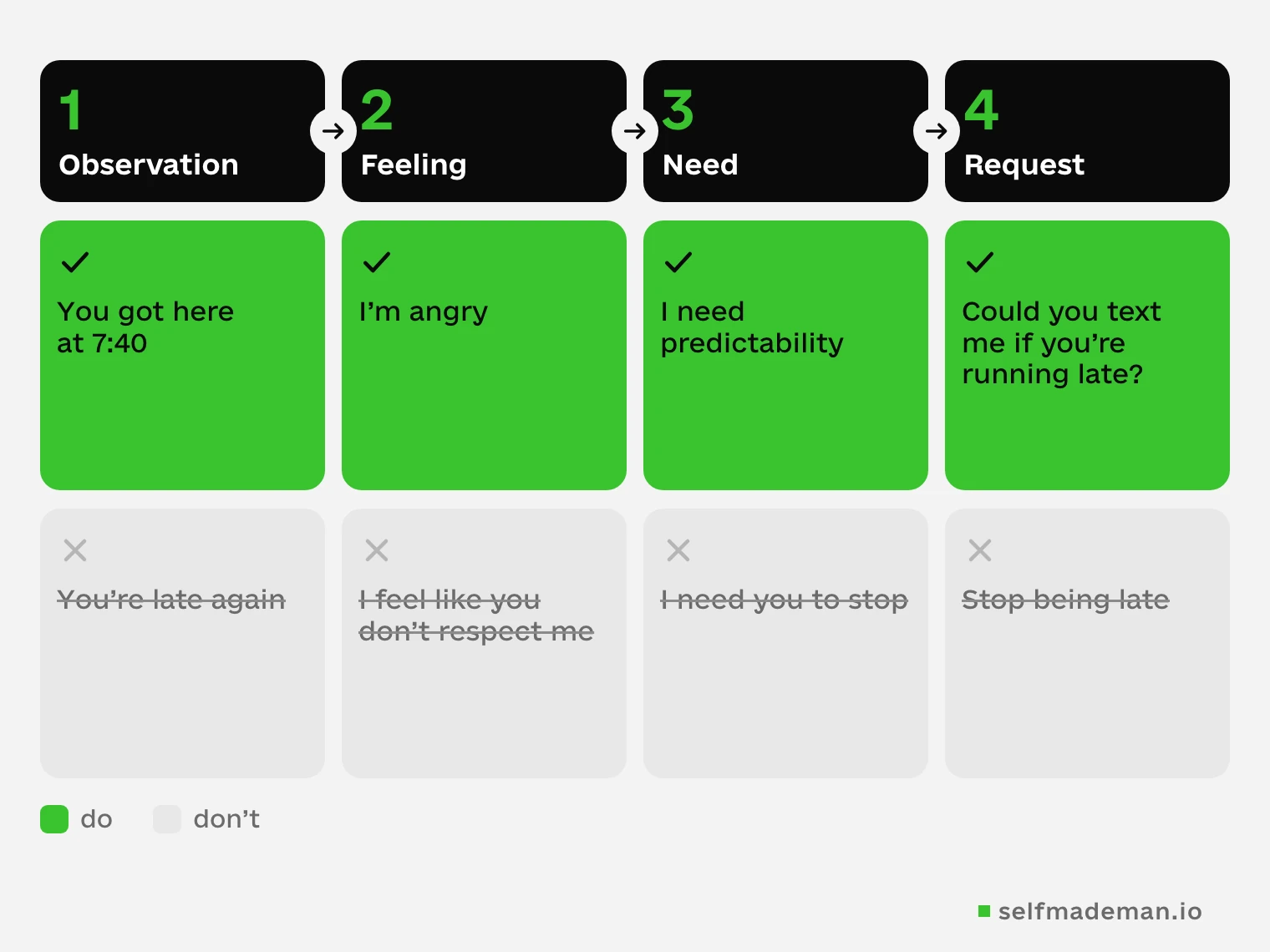
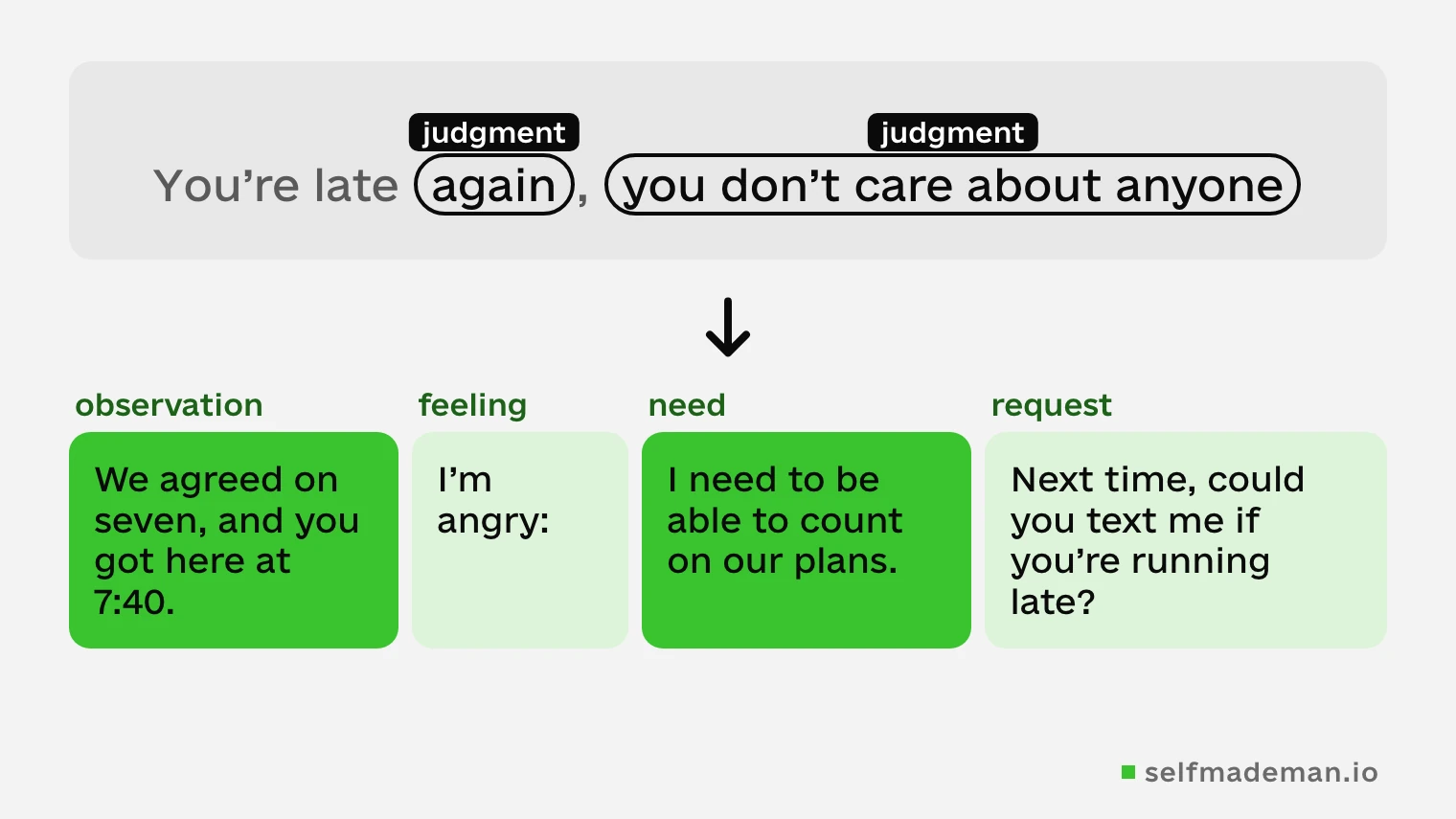
Nonviolent communication (NVC) is a way to talk about hard things so the other person hears you instead of bracing for a fight. Marshall Rosenberg’s model has four steps: what I see (without judgment), what I feel, what I need, and what I’m asking for. Instead of “You’re late again, you don’t care about anyone,” you say: “We agreed on seven, and you got here at 7:40. I’m angry: I need to be able to count on our plans. Next time, could you text me if you’re running late?” It’s not a magic formula, and it’s not a script for every conversation. It’s a draft for the sentence you’d otherwise say in the heat of the moment.
- Four steps: observation, feeling, need, request.
- The core move: strip judgment (“again,” “always,” “irresponsible”) and demands out of the sentence.
- “I feel like you don’t respect me” isn’t a feeling. It’s an accusation.
- A request is something the other person can say no to. Otherwise it’s a demand.
- The evidence is modest: studies are small and mostly self-reported. Use it as a tool, not a religion.
Table of contents
- What is nonviolent communication?
- The 4 steps of nonviolent communication
- Nonviolent communication examples
- The other half: listening the NVC way
- My experience
- Build your own sentence
- Does nonviolent communication actually work?
- Where it breaks
- The minimum version
- If you already blew it
- FAQ
- Today’s action
- Sources
What is nonviolent communication?
The method comes from Marshall Rosenberg, an American clinical psychologist. He studied under Carl Rogers — the same Rogers who described active listening. Rosenberg first used the approach in the 1960s, working as a mediator on school integration projects in the US1. The main book is *Nonviolent Communication: A Language of Life*; the third edition came out in 20152.
The method has two halves. The first is saying honestly what’s going on with you. The second is listening with empathy to what’s going on with the other person. Both use the same four steps.
You’ll sometimes hear NVC called “giraffe language.” The image stuck among practitioners: one German book on the method is even titled *Die Sprache der Giraffen*1.
The 4 steps of nonviolent communication
1. Observation without evaluation
Describe what happened the way a camera would record it. “You got here at 7:40” is an observation. “You’re late again” is already a verdict — it’s hiding in the word “again.” Red-flag words: always, never, again, constantly, as usual, plus any label — lazy, irresponsible, selfish.
Why it matters: people answer judgment with defense. With a plain fact, there’s almost nothing to argue about.
2. A feeling, not an opinion about the other person
Name what you feel: angry, anxious, drained, hurt, lost. The trap is the pseudo-feeling. “I feel like you’re ignoring me” isn’t a feeling. It’s an opinion about someone else with “I feel” stuck in front1. Quick test: if “I feel” is followed by “like you…” or “that you…,” it’s a judgment.
3. Need
Rosenberg argued that other people’s actions are the trigger for our feelings, not the cause. The cause is what matters to us2. So the third step is about you, not them: “I need predictability,” “I need rest,” “it matters to me to be consulted.” Not “I need you to stop.”
4. A request, not a demand
A concrete action the other person can actually do. “What to do” works better than “what to stop doing.” “Could you text me if you’re going to be more than 15 minutes late?” instead of “stop being late.”
And the honesty test: what happens if they say no? If the answer is hurt, blame, or punishment, it wasn’t a request. It was a demand in polite wrapping. The rule works both ways: you’re allowed to refuse too, and here’s how to say no without over-explaining.
NVC doesn’t make you softer. It makes you clearer.
Nonviolent communication examples
These situations are generic, from everyday life. In a real conversation the sentence gets shorter and sounds like you. The model is there to check for hidden judgment.
| Situation | The usual way | The four-step way |
|---|---|---|
| A coworker hands in their part late | “You’re letting everyone down” | “Your part came in Friday, not Wednesday. I’m stressed: that leaves me one day instead of three. Could you give me a heads-up on Monday if the deadline is slipping?” |
| Your partner is on their phone all through dinner | “You’re bored with me” | “You’ve been on your phone the whole dinner. I’m sad: I was hoping we’d talk tonight. How about an hour with no phones?” |
| Your kid leaves stuff everywhere | “You always make a mess” | “There’s a jacket and two sneakers in the hallway. I get irritated because I want to walk through without stepping over things. Can you hang them up before dinner?” |
| A client messages at 11 p.m. | “Do you even know what time it is?” | “Your messages are coming in late at night. I reply more slowly then because evenings are my time off. If it’s urgent, call. Everything else I’ll handle in the morning.” |
| A neighbor plays music at night | “Have you no shame?” | “The music was audible after midnight. I have to get up early and I slept badly. Could you keep it down after eleven?” |
The other half: listening the NVC way
When someone throws “you don’t care about anyone” at you, NVC suggests you don’t defend yourself. Instead, guess what’s behind it. Same steps, just about the other person: “Are you angry because you need a heads-up?”
Guess right, and they exhale and the conversation keeps going. Guess wrong, and they’ll correct you — and you’ll learn more. It’s the same active listening, focused on feelings and needs.
My experience
My personal rules include one that seems to contradict NVC at first glance: “Emotions go in the journal, not into conversations.” Rosenberg, on the other hand, wants you to name feelings out loud.
In practice, the rule doesn’t ban saying “I’m angry.” It sets an order: first I write it all out on paper, then in the conversation I name the feeling in one word. What it cuts out is dumping anger on someone in a flood.
A second rule matches Rosenberg almost word for word: “Don’t put your emotional state in someone else’s hands.” His idea that another person’s action is the trigger, not the cause, of my feelings says the same thing. “You drove me to this” hands my state over to someone else. “I’m angry because I need…” keeps it with me. And a third rule: talk from calm, not from anxiety or exhaustion. NVC doesn’t work when you’re wound up. The model falls apart on the first word.
Build your own sentence
-
1Observation. What happened, the way a camera would record it. Without “again”, “always” or labels.
-
2Feeling. What you feel. Not your opinion of the other person.
-
3Need. What matters to you. This step is about you, not about them.
-
4Request. A specific action the person can carry out. Better what to do than what to stop doing.Honesty test: what will you do if they say “no”?
Nonviolent communication is a tool for ordinary conflicts, not protection from violence. If you are threatened or harmed, the right phrase won’t help. Get help: in an emergency, call 911 (US), 112 (EU) or your local emergency number.
The builder doesn’t put phrases together for this case. This tick is not saved; if you ticked it by mistake, untick it.
Everything stays in this browser.
Does nonviolent communication actually work?
Honest answer: probably yes, but the evidence is weaker than the method’s popularity.
In 2013, Carme Mampel Juncadella, in a master’s dissertation at the University of Sheffield, collected everything published on NVC’s effect on empathy. Out of 2,634 publications, 14 papers with 13 experiments made the cut. All but two found a rise in empathy. But the methods and scales were so different that the results couldn’t be pooled into a meta-analysis. The main weaknesses: small samples, non-random selection of participants, homemade questionnaires1.
One of the better studies came later. In France, 312 medical students were randomly split into two groups: one got two and a half days of NVC training, the other got regular classes3. Three months later, self-rated empathy in the NVC group was up by 0.95 points on one scale. On another scale and on objective perspective-taking tasks, nothing changed. Complete data survived for only about half the participants.
Bottom line: after training, people feel more empathetic. That they argue less and reach agreements more easily is plausible, but not rigorously proven.
Where it breaks
- It sounds unnatural. This is the top complaint in the research: people drop the method because they end up “not talking like a human”1. The fix: use the model to check your sentence, then say it your way.
- Polite pressure. “I feel sad when you don’t do what I ask” is still a demand, just in NVC packaging. Critics describe exactly this paradox: a technique meant to remove violence starts creating it1.
- You need a feelings vocabulary. If it’s hard to tell “angry” from “drained” from “hurt,” your first step isn’t NVC. It’s emotional intelligence.
- Observation is also interpretation. The same action can be described in different ways. A perfectly neutral fact often doesn’t exist. Dropping the obvious labels is enough.
- “I feel” doesn’t fit everywhere. At work and with people you barely know, talking about feelings can come across as too personal. The fact and the request are enough there.
- Your interests really do clash. NVC helps when you both care about the relationship. If you want incompatible things, one good sentence isn’t enough. You need to choose a strategy: give in, hold your ground, or solve it together.
- Abuse and threats. NVC is a tool for everyday conflicts, not protection against abuse. If someone threatens or hurts you, the right wording won’t help. Get help: in the US, the National Domestic Violence Hotline is 1-800-799-7233; in an emergency, call 911. Elsewhere, call your local emergency number.
The minimum version
Two parts out of four: the fact and the request. “The report came in Friday instead of Wednesday. Could you tell me ahead of time if the deadline moves?” No judgment, no demand — that alone is often enough to keep a conversation from turning into a fight.
If you already blew it
“You don’t care about anyone” slipped out in the moment? Come back to it once you’ve cooled down:
“Yesterday I said you don’t care about anyone. That wasn’t fair. What was really going on is that I was angry: I need a heads-up. Could you text me when you’re running late?”
Same model, just with an apology up front. It works the next day, and it works a week later.
FAQ
What is nonviolent communication in simple terms?
A way to talk about hard things in four steps: describe the fact without judgment, name your feeling, name your need, and make a concrete request. The goal is for the other person to hear you instead of getting defensive.
Who created nonviolent communication?
Marshall Rosenberg, an American clinical psychologist and a student of Carl Rogers. He started developing the method in the 1960s. His main book is *Nonviolent Communication: A Language of Life*2.
What is the Nonviolent Communication book about?
It lays out the four steps and the two directions of the method: expressing yourself honestly and listening with empathy. Its central idea is that other people’s actions trigger our feelings but don’t cause them — our needs do2.
What is “giraffe language”?
A nickname for nonviolent communication that’s common among practitioners. Books and workshops use it, but the core is the same: Rosenberg’s four steps.
Does nonviolent communication actually work?
Most studies show a rise in empathy, but they’re small and often based on self-reports. In a randomized study with French medical students, only self-rated empathy went up; objective tests didn’t change3.
Can you use nonviolent communication at work?
Yes, in the short version: fact and request, sometimes the need. “I’m angry” in a meeting can sound too personal; “I need to know about deadline changes in advance” is fine.
Today’s action
Think of one complaint you’ve been carrying around, or one that already came out too harsh. Rewrite it in four steps: fact, feeling, need, request. Check it for “again,” “always,” and “you’re so…”. Say it or send it today — or at least decide when you will. Ten minutes.
Sources
- Juncadella C. M. What is the impact of the application of the Nonviolent Communication model on the development of empathy? Overview of research and outcomes. MSc dissertation, University of Sheffield, 2013. ↩
- Rosenberg M. B. Nonviolent Communication: A Language of Life. 3rd ed. Encinitas, CA: PuddleDancer Press, 2015. ↩
- Epinat-Duclos J., Foncelle A., Quesque F. et al. Does nonviolent communication education improve empathy in French medical students? International Journal of Medical Education, 2021, 12, 205–218. ↩