Personal rules to live by are decisions you make once instead of every morning. “Asleep by 11:00 p.m.” instead of the nightly “one more episode or bed?” To write your own, find the 3–5 decisions you argue with yourself about most often, write each one as a short, checkable sentence, and once a month look at which rules are alive and which ones need a rewrite. I have 69 of these rules, and many of the later ones are new versions of old ones.
- A rule is a decision made in advance. Not a slogan, not a dream.
- Start with 3–5 rules where you argue with yourself the most.
- A good rule is checkable: in the evening it’s clear whether you followed it.
- “Decision fatigue” as a willpower battery didn’t hold up in large replications. Rules work for a different reason: they remove unnecessary choices and turn into habits.
- Rules get old. Rewriting a rule is normal, not a failure.
Table of contents
- My experience: 69 rules and how they changed
- Personal code of conduct vs. values, goals, principles and habits
- Decision fatigue: what we actually know
- How to write your own rules to live by: 7 steps
- Personal code of conduct examples by area of life
- Personal rules builder
- Where it breaks
- The minimum version
- If you slip
- FAQ
- Your action for today
- Sources
My experience: 69 rules and how they changed
I keep a list of personal rules in LifeBoard, next to my roles, values and gratitude list, and I reread it once a week. Right now it has 69 items: sleep, exercise, work, mental order, communication. It’s not a set of laws carved in stone. It’s a working document I rewrite as I change.
You see this best when you put early and late rules side by side. The early ones sounded like “I always…” and “I try to…” The later ones are shorter, calmer and more honest:
| Before | After |
|---|---|
| In bed by 1:00 a.m. | Asleep by 11:00 p.m. |
| I eat only healthy food | Eating without extremes |
| I get the maximum number of tasks done each day | I don’t plan my day as if I have unlimited energy |
| I do the hardest task at the start of the day | One main focus per day, and I do it first |
See the difference? The old rules demanded “maximum” and “only.” A rule like that breaks at the first donut or the first bad day, and it takes your sense of control down with it. The new rules set a direction and leave room for normal life. You can follow them for years.
A rule you can’t keep for long isn’t a rule. It’s a punishment.
Personal code of conduct vs. values, goals, principles and habits
These words get mixed up all the time, but each one has its own job.
| What | Answers the question | Example |
|---|---|---|
| Value | What matters to me? | Health |
| Goal | What result, and by when? | Run a 10K by September |
| Rule | What do I do in a recurring situation? | I don’t skip a workout without a serious reason |
| Habit | What do I already do on autopilot? | In the morning I put on my sneakers without thinking |
A rule is the bridge between a value and a habit. Until the action is automatic, the rule saves you from bargaining with yourself. Once it is automatic, you can even cross the rule out: it’s done its job.
Personal principles sit one level higher: “health comes before work” sets a direction, but doesn’t tell you what to do at 10:30 p.m. A personal code of conduct is where principles turn into rules you can actually check.
Decision fatigue: what we actually know
Almost every article on personal rules starts with decision fatigue: we have a daily supply of willpower, every decision drains it, and by evening the battery is dead. A nice idea. Let’s be honest about what’s left of it.
Where the idea came from. In 1998, Roy Baumeister and colleagues ran a famous experiment: some students were allowed to eat chocolate chip cookies, others only radishes. The “radish” group later gave up faster on an unsolvable puzzle1. That gave birth to the theory of ego depletion. In 2008, the same school showed that even choosing between products or college courses reduced self-control afterward2.
The most quoted example: hungry judges. Researchers in Israel looked at more than a thousand parole decisions. At the start of each session, about 65% of requests were approved; by the end, almost none were; and after the food break, it was back to about 65%3. Sounds damning. But it later turned out that cases weren’t heard in random order, and that explains a good part of the picture4. And simulations showed that if judges simply avoid starting a long case right before a break, that alone could produce most of the effect5.
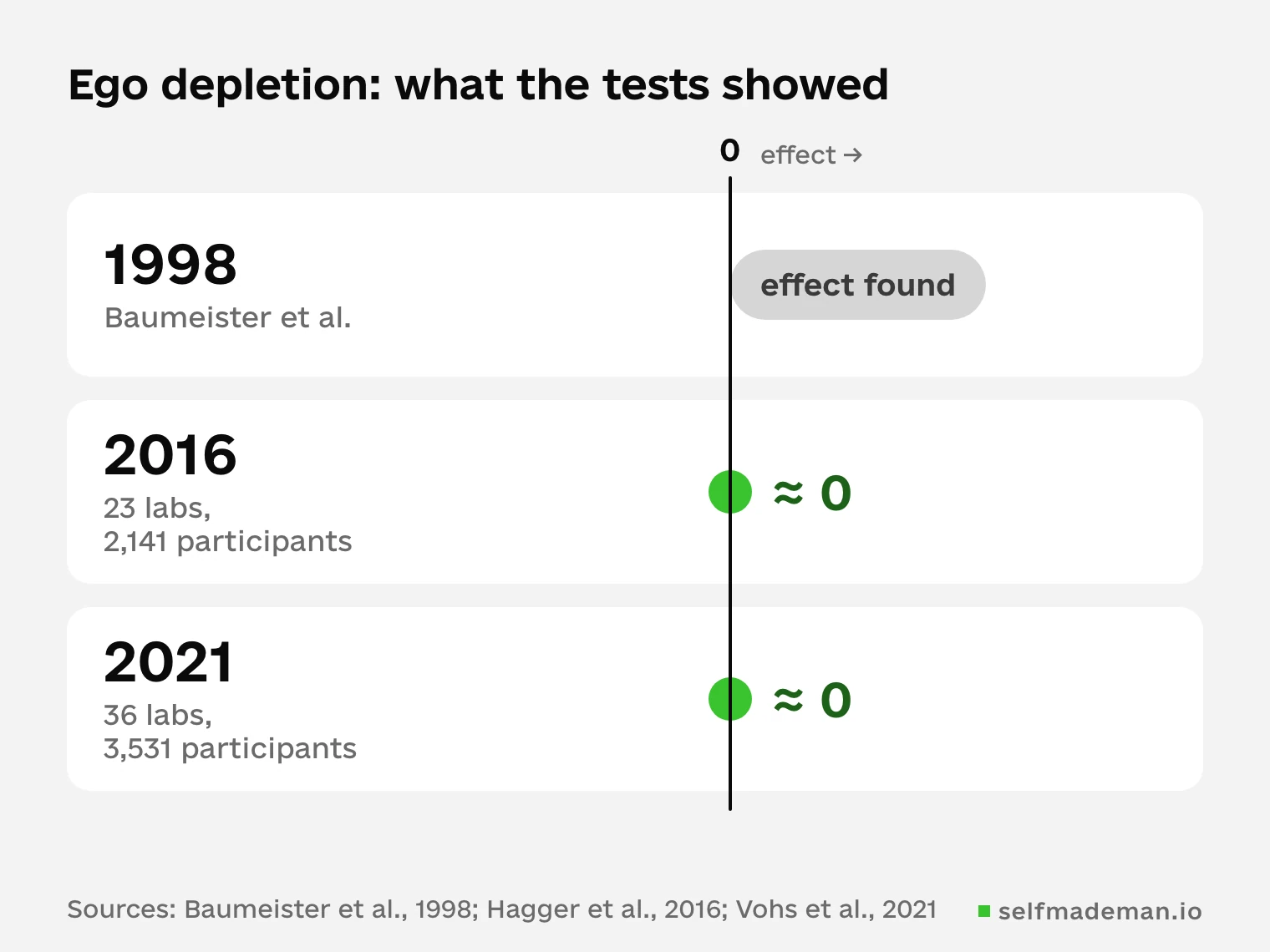
The big tests. In 2016, 23 labs tested the ego depletion effect using one shared protocol. 2,141 participants, and the effect was practically zero6. In 2021, another test: 36 labs, 3,531 participants, and again a result indistinguishable from zero7.
And about “35,000 decisions a day.” That number gets passed around articles and slide decks. I couldn’t find an original source: the chain of links ends in blogs, not in research. So it’s not in this article.
So rules are useless? No, they work — just for a different reason.
- A rule removes the choice itself. Barack Obama explained that he wore only gray or blue suits so he wouldn’t have to spend decisions on clothes and food8. Maybe there’s no willpower battery. But time, distraction and bargaining with yourself are very real.
- A decision made in advance as “if–then” works. In a meta-analysis of 94 experiments, plans of the form “if situation X, I do Y” noticeably raised the odds of reaching a goal: the effect was medium to large9. A good personal rule is exactly that kind of plan.
- A rule becomes a habit. People with high self-control achieve more largely thanks to good habits, not constant resistance to temptation10. A rule is a step toward that kind of habit.
That’s how to avoid decision fatigue in practice: not by saving willpower, but by deciding ahead of time.
Not willpower — a decision made in advance.
How to write your own rules to live by: 7 steps
- Find the arguments you keep having with yourself. For a week, write down where you make the same decision every day: what time to go to bed, whether to check your phone first thing, whether to grab a small task instead of the main one, whether to buy the thing that popped up in your feed.
- Pick 3–5 decisions to start. Not 69. My list grew gradually, and many rules on it are rewritten versions of old ones. Five rules that work beat thirty you can’t remember.
- Write each one as a decision, not a wish. “Get enough sleep” is a wish. “Asleep by 11:00 p.m.” is a decision. The test: could a stranger tell in the evening whether the rule was followed?
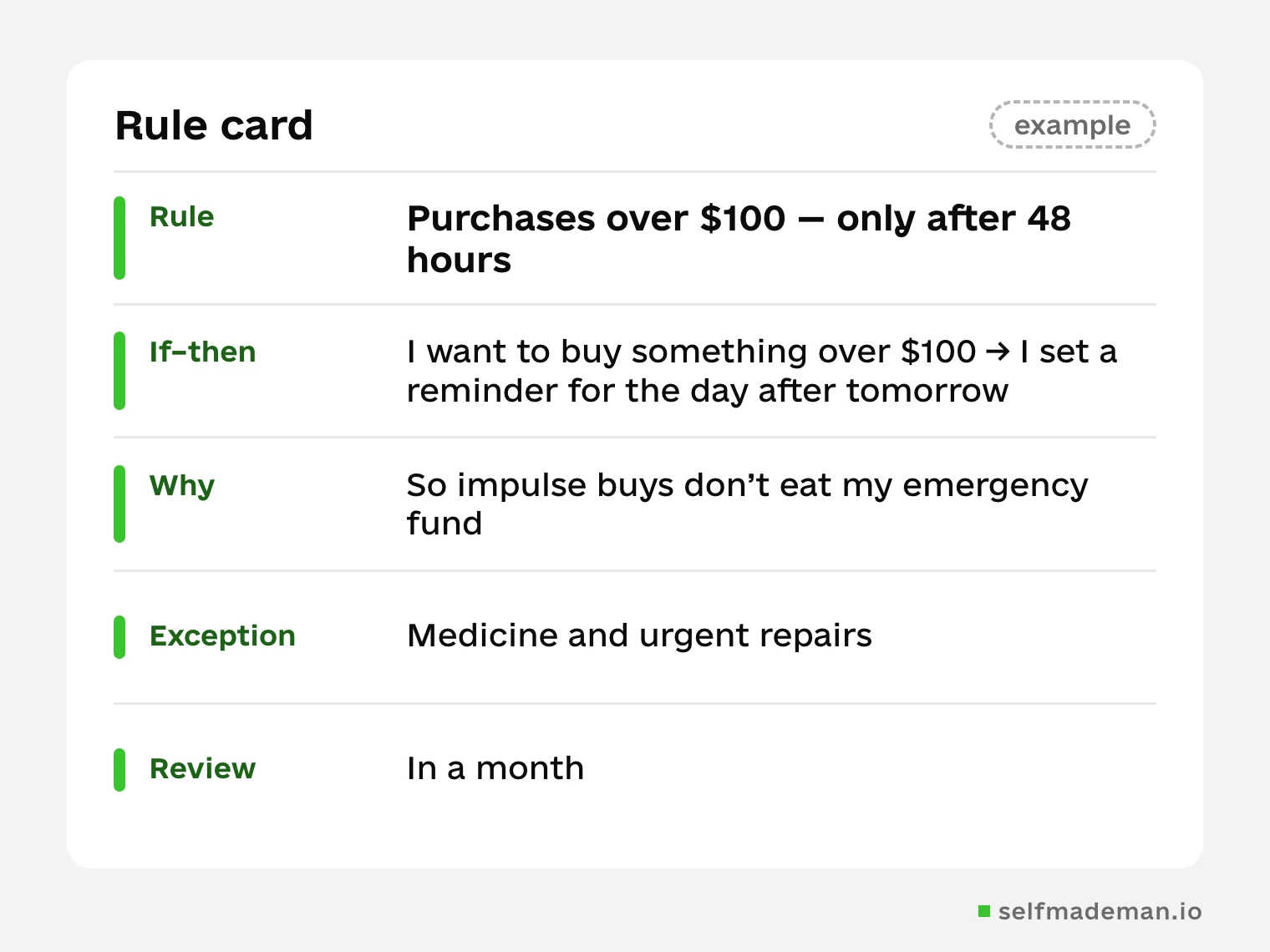
- Use “if–then” for situations. “If a purchase is over $100, I wait 48 hours.” “If a task takes less than two minutes, I do it right away.” That way the rule fires on its own when the situation shows up.
- Add one line of “why.” Just for yourself. Six months from now you’ll forget why the rule exists and want to toss it. The “why” line helps you tell an outdated rule from an inconvenient one.
- Decide in advance what counts as an exception. I have a rule not to skip a planned workout without a serious reason. What counts as a serious reason for you is better written down ahead of time: a fever, for example. “Don’t feel like it” doesn’t make the list. Exceptions you invent in the moment will always turn up.
- Review once a month. Go through the list and decide for each rule: keep, rewrite or delete. A rule that doesn’t work is worse than no rule at all: it teaches you to ignore the whole list.
Personal code of conduct examples by area of life
These are the areas where decisions repeat most often. Where a rule comes from my own list, I’m retelling it in my own words. Where I don’t have a rule of my own, I give an example to start with.
| Area | Example rule | Whose |
|---|---|---|
| Sleep and energy | Asleep by 11:00 p.m. | mine |
| Work | The main thing first, then the operational stuff | mine |
| Head space | If a task can be written down, I don’t keep it in my head | mine |
| Digital environment | I clear out extra tabs, files and information sources | mine |
| Honesty | If a task isn’t really finished, I don’t check it off | mine |
| Communication | I talk from a calm place, not from fatigue or anxiety | mine |
| Routine | Any repetitive manual work gets the question “Can this be automated?” | mine |
| Money | Purchases over $100 — only after 48 hours | example |
| Phone | No social media for the first 30 minutes after waking up | example |
Notice: none of these rules has the words “always,” “never” or “maximum.” That’s not an accident. It’s a lesson from the old versions of my list.
Personal rules builder
-
1Where do you argue with yourself most often? Pick 3–5 spheres where you make the same decision anew every day.
-
2Turn each argument into a rule. A decision made in advance, an “if — then” for situations, one line “why” and exceptions decided beforehand.Time to review the code
For each rule decide: it lives, rewrite it or delete it. A rule that doesn’t work is worse than none: it teaches you to ignore the whole list.
If a rule is broken again and again, the problem is not you but the rule: it is too big, too absolute or no longer needed.
Pick a sphere above, and a rule card will appear here.
-
3Set the review date. Once a month at the start, then once a quarter. And right away if a rule is broken three times in a row.
The tracker shows how many days each rule holds: which rule lives and which only exists on paper.
Everything stays in this browser.
Where it breaks
- Too many rules at once. Thirty new rules on a Monday isn’t a code. It’s a New Year’s resolution in different packaging. Start with three to five.
- The slogan rule. “Be the best version of myself” can’t be checked in the evening. Which means it can’t be followed either.
- Absolutes. “Only healthy food,” “not a single miss.” The first violation devalues the whole rule. My list went through this.
- Other people’s rules. Lists like “12 rules for life” or “7 rules to live by” are useful as ideas. But a rule without your own “why” line won’t last a month.
- Rules for other people. A personal code governs your actions. “People should reply to me on time” is an expectation, not a rule. The rule sounds like this: “If there’s no reply in two days, I write again.”
- Rules instead of rest. If your rules turn every day into an exam, something’s off. I’m glad my list has rules like this one too: “recover in the evening instead of pushing through tasks at any cost.”
The minimum version
One rule for the one decision that annoys you most. Write it on paper and put it where that decision comes up: by your bed, on your desk, on your lock screen. Two weeks. If it works, add a second one.
If you slip
One of my later rules is not to break the whole plan when something goes wrong, but to adjust and keep going. Broke a rule yesterday — just follow it again today. Don’t start the list over, and don’t “punish” yourself with a double dose.
The data on habits backs this up: in Phillippa Lally’s study, a single miss didn’t derail habit formation11. What derails it isn’t the miss. It’s the decision “it’s broken, so it’s all over.”
If a rule keeps getting broken again and again, the problem isn’t you. It’s the rule. It’s too big, too absolute, or you don’t need it anymore. Rewrite it. A habit tracker is a handy way to see how many days a rule actually holds: you’ll quickly see which rules are alive and which ones just sit on the list.
To be honest about my own list: the rule I break most often is meditation. I skip it. And getting myself to do morning exercise and workouts is really hard, even though both rules are on the list.
FAQ
What are the 7 rules to live by?
There’s no single official list: “7 rules,” “12 rules” and “50 rules” are different people’s collections. Use them as ideas, not as a code. Rules work when they’re yours: written for the decisions you actually remake every day, each with its own line of “why.”
How many personal rules should you have?
Start with 3–5. More than that, you simply won’t keep in your head. My list grew to 69 gradually, and not every rule on it is equally active.
What’s the difference between personal rules and personal principles?
A principle sets a direction (“health comes before work”). A rule says what exactly to do in a recurring situation (“asleep by 11:00 p.m.”). Principles are good for hard decisions, rules for everyday ones.
What is decision fatigue?
The idea that every decision drains a limited supply of willpower, so by evening we decide worse. The classic experiments supported it, but large replications in 23 and 36 labs found almost no effect. Rules are still useful: they remove unnecessary choices and help an action become a habit.
Do we really make 35,000 decisions a day?
There’s no original source for that number. Articles and presentations repeat it, but there’s no research behind it.
How often should you review your rules?
Once a month at the start, then once a quarter. And right away if a rule gets broken three times in a row: that’s a signal to rewrite it.
Your action for today
Think of one decision you had to make again today, even though you make it every day. Write a rule for it: one line, checkable in the evening. Under it, one line of “why.” Five minutes. Tomorrow, just follow it.
Sources
- Baumeister R. F., Bratslavsky E., Muraven M., Tice D. M. Ego depletion: Is the active self a limited resource? Journal of Personality and Social Psychology, 1998, 74(5), 1252–1265. ↩
- Vohs K. D., Baumeister R. F., Schmeichel B. J., Twenge J. M., Nelson N. M., Tice D. M. Making choices impairs subsequent self-control: A limited-resource account of decision making, self-regulation, and active initiative. Journal of Personality and Social Psychology, 2008, 94(5), 883–898. ↩
- Danziger S., Levav J., Avnaim-Pesso L. Extraneous factors in judicial decisions. PNAS, 2011, 108(17), 6889–6892. ↩
- Weinshall-Margel K., Shapard J. Overlooked factors in the analysis of parole decisions. PNAS, 2011, 108(42), E833. ↩
- Glöckner A. The irrational hungry judge effect revisited: Simulations reveal that the magnitude of the effect is overestimated. Judgment and Decision Making, 2016, 11(6), 601–610. ↩
- Hagger M. S., Chatzisarantis N. L. D., et al. A multilab preregistered replication of the ego-depletion effect. Perspectives on Psychological Science, 2016, 11(4), 546–573. ↩
- Vohs K. D., Schmeichel B. J., et al. A multisite preregistered paradigmatic test of the ego-depletion effect. Psychological Science, 2021, 32(10), 1566–1581. ↩
- Lewis M. Obama’s Way. Vanity Fair, October 2012. ↩
- Gollwitzer P. M., Sheeran P. Implementation intentions and goal achievement: A meta-analysis of effects and processes. Advances in Experimental Social Psychology, 2006, 38, 69–119. ↩
- Galla B. M., Duckworth A. L. More than resisting temptation: Beneficial habits mediate the relationship between self-control and positive life outcomes. Journal of Personality and Social Psychology, 2015, 109(3), 508–525. ↩
- Lally P., van Jaarsveld C. H. M., Potts H. W. W., Wardle J. How are habits formed: Modelling habit formation in the real world. European Journal of Social Psychology, 2010, 40(6), 998–1009. ↩