An emergency fund is money for when your income disappears or a big unplanned expense hits: a job loss, an illness, a broken car, a move. So how much emergency fund do you need? The usual benchmark is three to six months of essential expenses. Not income — just what you can’t live without: housing, food, utilities, transportation, phone, loan payments. The more stable your income and the fewer people depend on you, the closer to three months. The less predictable your income and the more dependents you have, the closer to six and beyond. Build it in steps: one month first, then the rest.
- Emergency fund = essential monthly expenses × number of months.
- The benchmark is 3–6 months. For business owners and freelancers, six or more.
- Step one is one month of essential expenses. It covers most “surprise” bills.
- A separate account, an automatic transfer on payday, and every windfall goes there.
- An emergency fund isn’t an investment. Its job is to be available, not to earn.
Table of contents
- My experience
- Why this isn’t paranoia
- How much emergency fund should you have
- How to calculate your emergency fund
- How to build an emergency fund: 7 steps
- Your emergency fund in numbers
- Where to keep your emergency fund
- When you can spend your emergency fund
- Where it breaks
- The minimum version
- If you had to spend it
- FAQ
- Your action for today
- Sources
My experience
I run my own agency and a portfolio of websites. By definition, an entrepreneur’s income doesn’t arrive as the same amount on the first of every month. So the question “what happens if there’s no money next month” isn’t theory for me. It’s part of the job.
One of my rules describes the point of an emergency fund perfectly: “Create certainty where it can be created.” I can’t know what will happen next year. But I can know how many months of calm life my money covers. That’s the certainty you can create.
And a second rule: “I don’t get rattled — I act consistently.” Without a reserve, every unpleasant phone call turns into panic and emotional decisions. With a reserve, it turns into a problem you solve one step at a time.
I keep a reserve of more than six months of essential expenses. Not income — expenses.
Why this isn’t paranoia
The numbers look similar across countries.
- US. In the Federal Reserve’s survey for 2025, 63% of adults said they would cover an unexpected $400 expense with cash or its equivalent. 55% had a rainy day fund covering three months of expenses. And 30% couldn’t get through three months without their main income by any means — not from savings, not by borrowing, not by selling something1.
- EU. According to Eurostat, in 2024, 30.0% of people in the European Union lived in households that couldn’t cover an unexpected necessary expense from their own resources2.
- Ordinary life, no disasters. The JPMorgan Chase Institute analyzed the accounts of 6 million families and found that to get through a month when income dips and expenses spike at the same time, a typical family needs about six weeks of take-home income. 65% of families didn’t have that cushion3.
An emergency fund isn’t about the end of the world. It’s about a broken laptop, a tooth and a late client payment all in the same month.
How much emergency fund should you have
Why save 3–6 months of expenses in your emergency fund? The logic: that should be enough to find a new job or new clients, or to restructure your spending, without panic. FINRA, the US self-regulatory organization that oversees brokers and publishes investor education, puts it plainly: ideally, your emergency fund should build over time to cover about three to six months’ worth of living expenses, but even a small emergency fund is better than nothing4. The US Consumer Financial Protection Bureau (CFPB) is more cautious: the amount depends on your situation, and a good place to start is what your unexpected expenses usually cost5.
Two important details:
- Base it on expenses, not income. If you earn $2,500 and your essential expenses are $1,200, a three-month fund is $3,600, not $7,500. In a crisis you won’t live “as usual” — you’ll cut everything extra.
- Essentials are an honest minimum. No eating out, no subscriptions, no vacation. But with payments you can’t stop: rent, loans, insurance, school.
| Situation | Benchmark | Why |
|---|---|---|
| Steady paycheck, no dependents, a second income in the household | 3 months | Finding a new job is realistic, and the risk of “both without income” is lower |
| Family, one income, kids | 6 months | Others depend on you, and rushed decisions cost more |
| Business owner, freelancer, seasonal income | 6 months or more | Income swings even without a crisis |
| Mortgage, chronic illness, an old car | Closer to the upper end | Big unexpected expenses are more likely |
There’s a number for business owners too: in the same Fed survey, 58% of self-employed people said their income varies from month to month, and 22% had trouble paying bills at some point during the year because of those swings1. If that’s you, you need a bigger fund, plus a separate buffer-account setup from the article on budgeting with an irregular income.
How to calculate your emergency fund
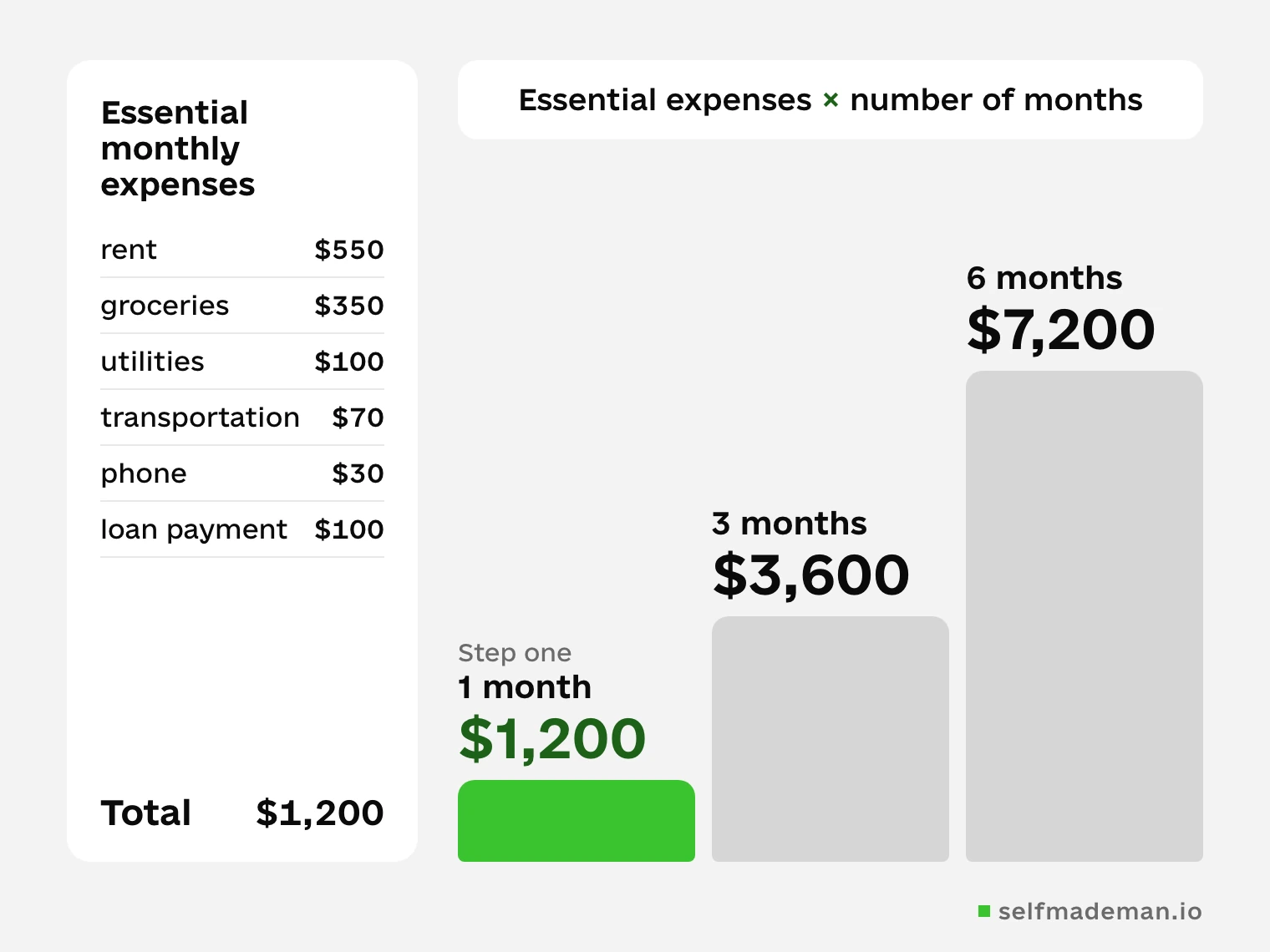
Formula: essential monthly expenses × number of months.
Example. Essential expenses: rent $550, groceries $350, utilities $100, transportation $70, phone $30, loan payment $100. Total $1,200 a month.
- Step one, one month — $1,200.
- Three-month fund — $3,600.
- Six-month fund — $7,200.
An honest word about timing. If you save $150 a month, step one takes 8 months, and three months of expenses take two years. That’s slow, and that’s exactly why steps and windfalls matter: bonuses, tax refunds and gifts speed things up more than you’d think.
An emergency fund isn’t built in a month — it’s built every payday.
How to build an emergency fund: 7 steps
- Calculate your essential expenses. Open two or three months of statements. Write down only what you can’t live without.
- Pick the number of months. Use the table above. If in doubt, go with six.
- Set step one. One month of essential expenses. If even that feels out of reach, aim for $400–500: enough for most small emergencies.
- Open a separate account. Not on the card you use every day. A fund you see in your everyday balance quietly gets spent. It’s one of the four accounts in a simple budgeting system.
- Set up an automatic transfer on payday. A fixed percentage or amount. That’s exactly what the CFPB recommends: make saving automatic so you don’t decide again every month5.
- Send windfalls there. A bonus, a tax refund, a gift, money from selling something you don’t need — all of it, or at least half.
- Find money in your spending. One line you can cut without pain. Often it’s subscriptions you don’t use.
Your emergency fund in numbers
Enter your essential expenses, pick your situation and how much you can save. The calculator shows your target, the steps and an honest timeline for each — in dollars or euros. The button below it fills in the example from this article.
An honest minimum: no cafés, subscriptions or holidays, but with payments you cannot stop. Count from expenses, not from income.
Enter your unavoidable expenses: the calculator counts from them, not from income.
Keep the cushion in a separate account you can reach in minutes, not on your everyday card, and not in stocks or crypto. Set up an automatic transfer on payday.
A guide for your own calculation, not financial advice. Decisions about savings, debts and investments depend on your situation; if in doubt, discuss them with a financial adviser. Numbers stay in this browser.
If the timeline looks long, that’s normal. Steps and the windfalls from step 6 shorten it more than you’d expect.
Where to keep your emergency fund
The CFPB lists three requirements: the money should be safe, quick to access, and not so visible that you’re tempted to spend it. The CFPB calls a bank account one of the safest places for it5.
- A separate bank account or savings bucket. Access in minutes, but not in the same wallet as your daily spending.
- Deposit insurance. In the US, the FDIC insures deposits up to $250,000 per depositor, per insured bank, for each ownership category6. In the EU, deposits are protected up to €100,000 per depositor per bank7. In other countries, check the current limit on your deposit guarantee fund’s website, and don’t keep more than the limit in one bank.
- Currency. That’s a separate decision with no universal answer. The main rule: in an emergency, the money must quickly turn into whatever you pay for your life with.
- Not in investments. Stocks, crypto and other assets can drop exactly when you need the money. An emergency fund isn’t there to make money.
When you can spend your emergency fund
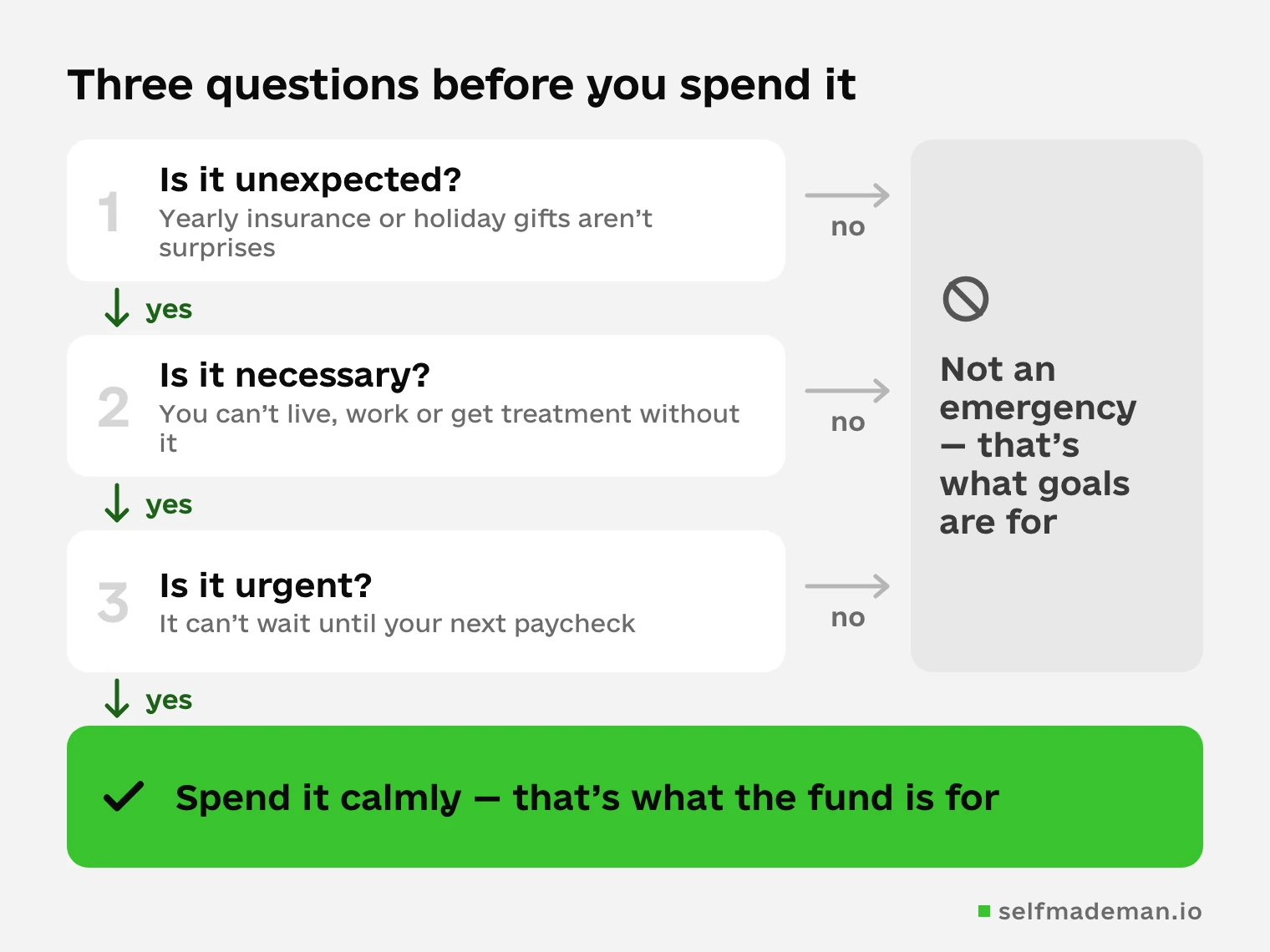
Three questions to ask yourself before you spend your emergency fund:
- Is it unexpected? Yearly insurance or holiday gifts aren’t surprises. Those are what goals are for.
- Is it necessary? You can’t live, work or get treatment without it.
- Is it urgent? It can’t wait until your next paycheck.
Three yeses — spend it calmly, that’s what the fund is for. Even one “no” means it’s not an emergency.
Where it breaks
- “I’ll never save six months.” Maybe not soon. That’s why the target is step one, not the perfect amount. One month of expenses already changes how life feels.
- The fund goes to “almost emergencies.” A sale, a vacation, a new phone “because the old one is slow.” If the fund gets drained every couple of months, some of those expenses belong in goals.
- Emergency fund vs. expensive debt. Keeping a reserve while paying high interest on a credit card is costly. But paying off debt with no reserve at all is risky too: at the first emergency you’ll have to borrow again. How to strike the balance in your situation is best discussed with a professional.
- The amount goes stale. Prices rise, expenses change, kids arrive. FINRA recommends checking periodically whether your fund still covers the same number of months4. Every six months works well.
- A credit card instead of a fund. A credit limit isn’t a reserve. It’s debt you’ll have to repay exactly when money is tightest.
This is about personal money and habits, not investment advice. If you have debt, a business or a complicated tax situation, talk your plan over with a professional.
The minimum version
No energy to calculate and plan? Do one thing: open a separate account and set up an automatic transfer of any amount, even $10 a week, on payday. Your near-term target is $400. That’s a minimal emergency fund that already covers small surprises.
If you had to spend it
The money went to a real emergency — so the fund worked. That’s not a failure. It’s exactly what you saved it for.
Next comes rebuilding. For a few months, raise the automatic transfer or redirect money from your goals account to the reserve. Restore step one first, then the rest. Don’t try to rebuild everything in a month: a life cut to zero is a straight path to the next slip.
FAQ
How much should I have in my emergency fund?
The usual benchmark is three to six months of essential expenses. Three if your income is stable and you have no dependents; six or more for one-income families, business owners and freelancers.
Should I base my emergency fund on income or expenses?
On essential expenses. In a crisis you’ll cut everything extra, so count the honest minimum: housing, food, utilities, transportation, phone, payments.
What is an emergency fund?
Money set aside for when your income disappears or a big unplanned expense hits: a job loss, an illness, a major repair. It sits in a separate account and isn’t touched for anything else.
Where should I keep my emergency fund?
In a separate bank account you can reach within minutes, but not on the card you use for everyday spending. Not in stocks or crypto: they can drop exactly when you need the money.
How do I build an emergency fund fast?
In steps: one month of expenses first, then three, then six. An automatic transfer on payday plus every windfall — bonuses, tax refunds, gifts.
How much should I have in savings besides my emergency fund?
That depends on your goals. In the four-account system, the emergency fund lives in “reserve,” and money for vacations, gadgets and yearly payments lives separately in “goals,” with an amount and a deadline for each.
Do I need an emergency fund if I have a credit card?
Yes. A credit limit is debt. It can cover an emergency, but you’ll repay it with interest, and right when money is tightest.
How big an emergency fund does a freelancer or business owner need?
Six months of essential expenses or more, plus a separate buffer account you pay yourself a fixed “salary” from. Income swings even without a crisis.
Your action for today
Open last month’s statement and write down your essential expenses. Multiply the total by three — that’s your target. Divide it by three — that’s step one. Or enter your expenses in the calculator above; it shows the timeline too. Open a separate account and set up an automatic transfer to it on payday. 15 minutes.
Sources
- Board of Governors of the Federal Reserve System. Economic Well-Being of U.S. Households in 2025. May 2026. Survey of Household Economics and Decisionmaking, October 2025. ↩
- Eurostat. Quality of life indicators — economic security and physical safety. Statistics Explained. EU-SILC data for 2024. ↩
- Yu C., Farrell D., Greig F. Weathering Volatility 2.0: A Monthly Stress Test to Guide Savings. JPMorgan Chase Institute, October 2019. ↩
- FINRA. Avoid Bad Financial Luck This Friday the 13th With These 5 Tips. FINRA.org, March 13, 2026. ↩
- Consumer Financial Protection Bureau. An essential guide to building an emergency fund. Updated October 29, 2025. ↩
- Federal Deposit Insurance Corporation. Deposit Insurance. FDIC.gov. ↩
- Directive 2014/49/EU of the European Parliament and of the Council on deposit guarantee schemes, Article 6. ↩