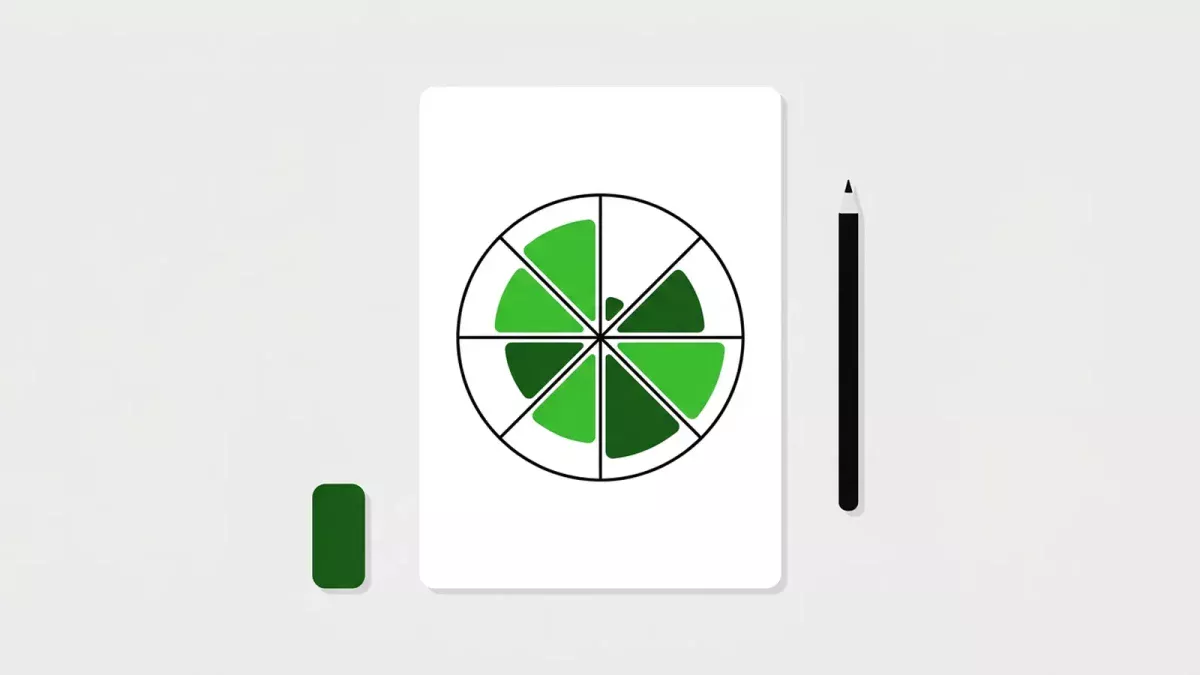
The wheel of life is a circle of eight life areas, and you rate each one from 1 to 10. Connect the dots and you’ll see where your wheel is lopsided. Then comes the part that matters: pick one or two areas that pull the others down the most, and set one weekly action for each for 90 days. The assessment itself takes 15 minutes. It’s not a diagnosis or a scientific method. It’s a mirror: it shows you where to look.
- 8 areas, each rated 1 to 10 — as things are now, not on average over the year.
- Before you rate, define what a “10” means to you in each area.
- Don’t try to raise everything. One or two areas for 90 days.
- After 90 days, retake it and compare.
Table of contents
What is the wheel of life
The wheel of life, also called the life balance wheel, is usually credited to Paul J. Meyer, founder of the Success Motivation Institute in the US. The story goes that he came up with it in the 1960s as a goal-setting tool. Later it became a staple exercise in coaching. It has nothing in common with the Buddhist wheel of life or with balancing your car’s wheels except the name.
An honest word about its main limitation: the wheel isn’t a validated psychological test. By comparison, Ed Diener’s Satisfaction With Life Scale was tested for reliability and has been used in a huge number of studies1. The wheel hasn’t been tested that way. It doesn’t measure how you live. It helps you ask yourself the right questions, fast. That’s what we use it for.
Take the wheel of life assessment online
Take the eight areas or replace them with your own, or with roles: “father”, “entrepreneur”. Then describe for each one what 10 out of 10 looks like for you. Without this step, ratings follow your mood.
Rate how it is now: not the average for the year and not how it should be, but the last two or three weeks. 1 is the centre of the wheel, 10 is the edge.
If this area rises by 2 points, what will follow it?
Not necessarily the lowest. Sleep often lifts energy, work and relationships at once. You do not drop the other areas, you keep them at the current level.
Compare only with yourself three months ago, not with someone else’s wheel. Everything stays in this browser.
A mirror for 15 minutes, not a diagnosis and not a validated psychological test: it shows where to look. Answers stay in this browser.
My experience
I don’t describe my life through abstract areas. I use roles: father, son, friend, entrepreneur, manager, expert, writer, student, mentor, healthy person — sixteen of them in total. For each one, I’ve written down who I want to be in it. For example, the father role: “I pay attention to my sons, spend a lot of time with them, teach them, and listen to them.”
Roles work like the same wheel, only more honestly. “Family: 7 out of 10” is easy to write down and forget. “A father who spends a lot of time with his kids — how many out of 10 this week?” isn’t.
My scores right now, honest and without overthinking: father 8, manager 8, entrepreneur 7, son 4, health 4, writer (this site) 3, friend 2. The work roles and fatherhood are holding up. My roles as a friend and a son, my health, and the site you’re reading are sagging.
Wheel of life categories and questions to rate them
You can rename the areas or swap them for your own roles. What matters is having 6–10 of them, and that they cover your whole life, not just work.
| Area | Question to rate it |
|---|---|
| Health and energy | Do I have enough energy for the day? How do I sleep, move, eat? |
| Money | Do I have enough to live on, a safety cushion, and a clear idea of where the money goes? |
| Work and career | Am I moving where I want to go? Does what I do have meaning? |
| Partner and love | Is there closeness and time for each other? |
| Family and friends | Do I have people I stay in touch with and can lean on? |
| Growth and learning | Am I learning something new? Am I growing? |
| Fun and recreation | Do I have time for what recharges me, without guilt? |
| Environment | Do I like where I live and work, and how organized it is? |
How to do the wheel of life exercise: 7 steps
- Pick your areas. Take the eight from the table or replace them with your own.
- Describe a “10” for each. One sentence: what 10 out of 10 looks like for you specifically. Skip this step and your ratings will follow your mood.
- Rate things as they are now. Not the yearly average and not “how it should be” — the last two or three weeks.
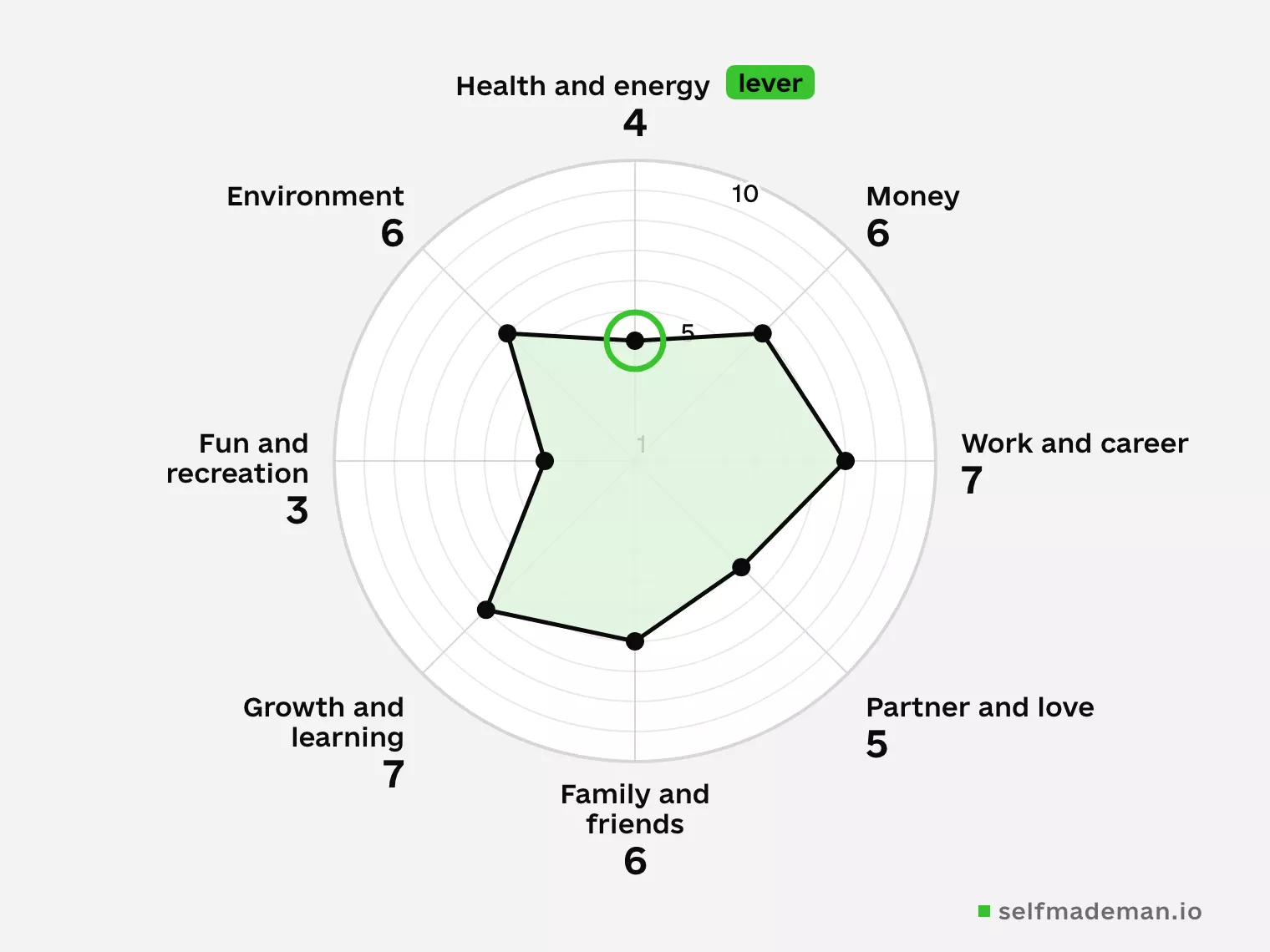
- Draw the wheel. A circle, eight spokes, a dot on each from the center (1) to the edge (10). Connect the dots.
- Find the lever area. It doesn’t have to be the lowest one. Ask: “If this area goes up 2 points, what comes up with it?” Sleep often lifts energy, work, and relationships all at once.
- Pick one or two areas for 90 days. You don’t drop the rest. You hold them at their current level.
- For each, one weekly action and a review date. After 90 days, take the assessment again.
How to read your result
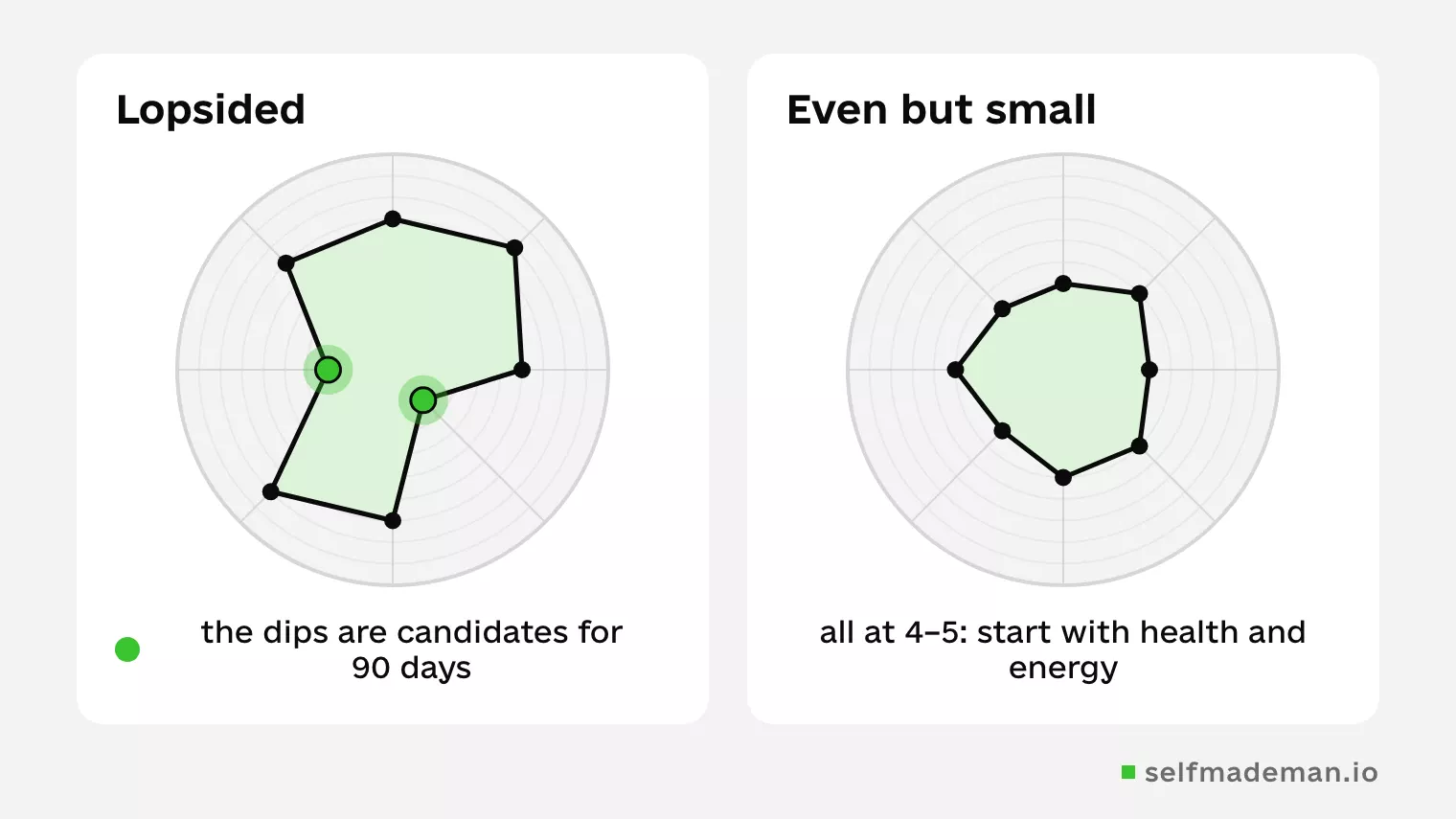
- The wheel is lopsided. One or two areas are much lower than the rest. Those are your candidates for 90 days, if they matter to you right now.
- The wheel is even, but small. Everything sits at 4–5. That’s usually a sign of general exhaustion, not eight separate problems. Start with health and energy — nothing else rises without them.
- A low score isn’t always a problem. In a year when you’re launching your own business, fun might sit at 4 on purpose. The question isn’t “why not a 10?” but “am I OK with this right now?”
- Balance isn’t eight 10s. The goal isn’t a perfect circle. It’s a wheel that rolls: no area sinks so low that it drags the others down.
Your 90-day plan
For each area you picked, answer four questions:
| Question | Example: “Health and energy,” currently 4 |
|---|---|
| What score do I want in 90 days? | 6 |
| What will be different at 6? | Enough energy for the evening, no afternoon crashes |
| One action every week | In bed by 11 p.m. at least five nights out of seven |
| When’s the review? | A date 90 days out — into the calendar right away |
90 days is long enough for the action to make a noticeable difference, and short enough that you don’t lose the thread. If you picked two areas, you get two actions, no more: the more goals you pursue at once, the worse each one gets done2.
Where it breaks
- Rating by mood. On a bad day everything’s a 3, on a good one an 8. The fix is step 2: describe your “10” in advance.
- Trying to raise all eight. Two weeks later, none of them has moved.
- Comparing with someone else’s wheel. A parent of small kids and a college student have different 10s. Compare only with yourself three months ago.
- The assessment for its own sake. A nice chart with no action is just a picture. Without step 7, the wheel is useless.
Minimum version
Don’t have 15 minutes? Rate three areas: health, money, people. Pick the lowest one and one action for this week.
After 90 days
Take the assessment again and put it next to the first one. If the area you picked went up, keep the action and move on to the next area. If it didn’t, the problem isn’t you, it’s the action: it was too big, the wrong one, or not tied to a time. Shrink it or swap it.
The wheel works well together with an end of year reflection: the review shows what happened, the wheel shows where you are now, and yearly goals show where to go next.
FAQ
Who created the wheel of life?
It’s credited to Paul J. Meyer, founder of the Success Motivation Institute, in the 1960s. The exact date is unknown.
How many categories should a wheel of life have?
Usually 8. Anywhere from 6 to 10 works — as long as they cover your whole life, not just work.
How often should I do the wheel of life assessment?
Every 90 days, plus at the end of the year along with your year in review.
Is the wheel of life the same as the balance wheel?
Yes. They’re two names for the same exercise.
Today’s action
Grab a sheet of paper, draw a circle with eight segments, and rate each area from 1 to 10 for the last two weeks. Circle the one that will pull the others up and write down one action for this week. 15 minutes.
Sources
- Diener E., Emmons R. A., Larsen R. J., Griffin S. The Satisfaction With Life Scale. Journal of Personality Assessment, 1985. ↩
- Dalton A. N., Spiller S. A. Too Much of a Good Thing: The Benefits of Implementation Intentions Depend on the Number of Goals. Journal of Consumer Research, 2012. ↩