
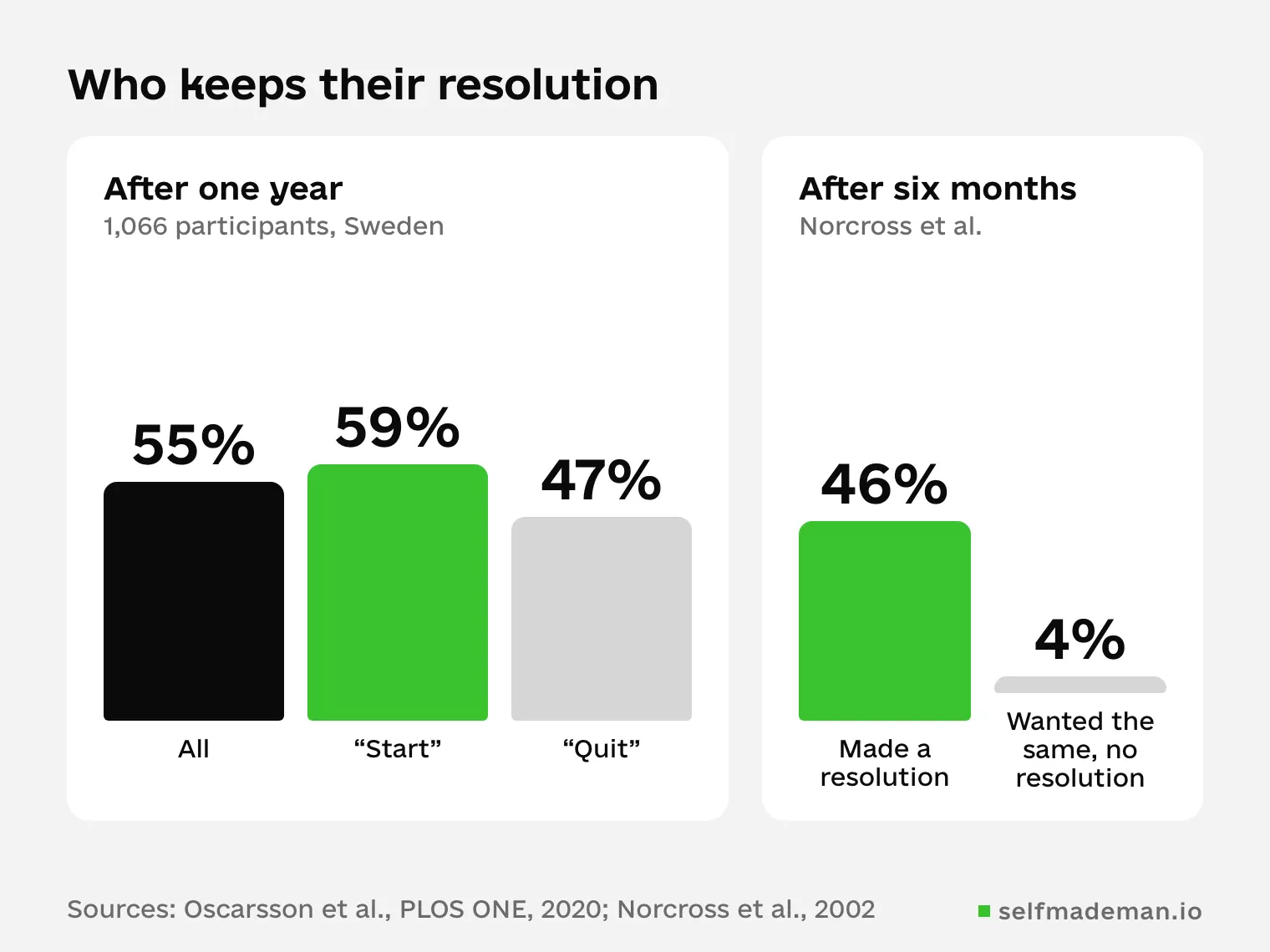
A New Year’s resolution is a promise to yourself to change something, made around January 1. Most New Year’s resolutions fail for the same reasons, and the fix is simple. Pick one resolution, not ten. Word it as something you start doing, not something you quit. Tie it to a specific time and place, and decide in advance what you’ll do in a bad week. That’s not a pep talk, it’s what the data shows: a year later, 55% of participants in a large Swedish experiment said they had kept their resolution, and among those who started something it was 59%, versus 47% among those who quit something1.
- One resolution instead of a list. A plan helps you hit one goal and stops helping when you have many.
- “I start,” not “I quit.”
- Not “someday,” but “after my morning coffee, in the kitchen.”
- A minimum version for bad days.
- Slipping isn’t the end. Every Monday is a fresh start.
Table of contents
Why New Year’s resolutions fail
First, the number that floats around the internet: “80% of people give up on their resolutions by February.” It has no original source. Articles cite each other, and the chain ends in a dead link. Same with “only 8% keep them.”
Actual research paints a calmer picture. In Norcross’s 2002 study, 46% of people who made a resolution were still keeping it six months later. Among people who wanted to change the same thing but made no resolution, it was 4%2. Resolutions work. They break for three clear reasons.
Too many goals. When people planned for one goal, the plan helped them achieve it. When they had six goals, the same plan just highlighted how hard it was to juggle them all, and people gave up sooner3. A list of ten isn’t ambition. It’s a guarantee that none of them happens.
“Quit” instead of “start.” “No sugar,” “less phone time,” “stop procrastinating.” In the Swedish experiment, resolutions like these were kept less often than resolutions to start something1. A ban runs on willpower all year. A new action turns into a habit over time.
No “when and where” plan. “I’ll run” is a wish. “Tuesdays and Thursdays at 7:00 a.m., I run from my door to the park and back” is a plan. A simple plan of the form “if situation, then action” noticeably raises your odds of reaching a goal: a meta-analysis of 94 experiments found a medium-to-large effect4.
My experience
I think I’ve tried every planning system out there. Now I have my own: habits, goals, lists, finances. And two of its rules are directly about New Year’s resolutions:
One main focus for the day — and I do it first.
I don’t choose by tasks — I choose by direction.
The second one is my answer to a list of ten resolutions. I’m not trying to close every task of the year. I choose where I’m heading, and every day I take one small step in that direction.
I pick a resolution for the year the same way: one direction, not a list. For 2027, it’s “Health is project #1.” It already breaks down into concrete actions from my rules: asleep by 11:00 p.m., exercise every day, water, steps, and eating without extremes. And I’m being honest about why: I skip meditation, and getting myself to do morning exercise and workouts is really hard.
How to choose one New Year’s resolution: 6 steps
- Write down everything you want to change. 10 minutes, no filter. Health, money, work, people, a clear head. A long list at this step is fine.
- Find the item that pulls the rest along. Ask about each one: “If this works out, what gets easier on its own?” Get enough sleep, and it’s easier to get up for a morning workout and not snap at people. That item is your candidate.
- Rephrase it as “I start.” “Quit sugar” → “after lunch, I eat a piece of fruit.” “Less phone time” → “my phone sleeps in the hallway, not by the bed.”
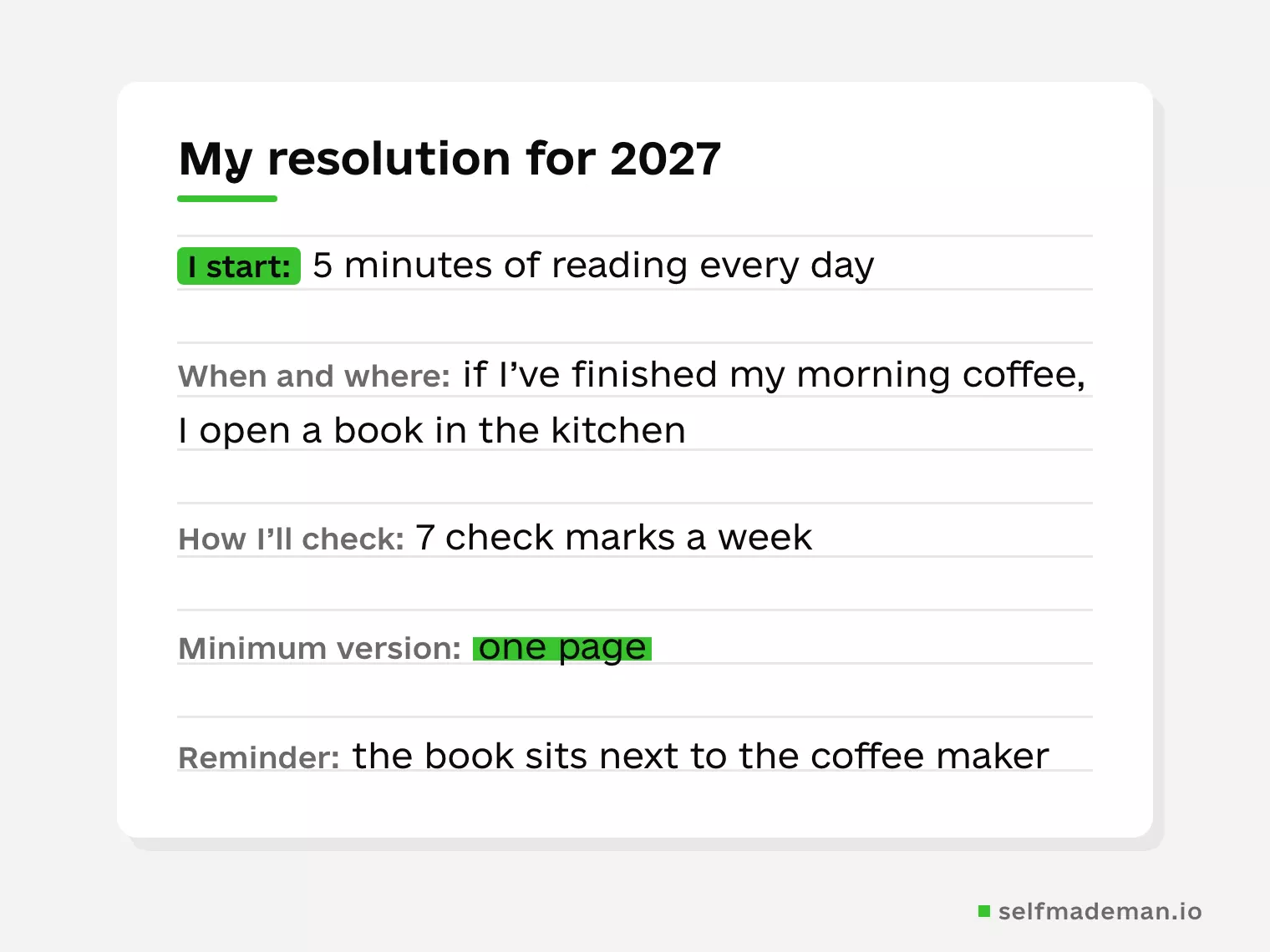
- Make it small and measurable within a week, not a year. Not “read 50 books,” but “I read for 5 minutes every day.” One of my rules says exactly that: “I read more than 5 minutes a day, no matter what.”
- Tie it to a time and place. “After my morning coffee, I open a book in the kitchen.” Without that, the action waits for a free minute, and the free minute never comes.
- Decide in advance what you’ll do on a bad day. A minimum version: one page, one squat, one line in a journal. More on it below.
Don’t throw away the rest of the list. Keep it on a separate “later” list. Once your resolution becomes a habit, which takes a couple of months or more5, pick the next one.
How it sounds vs. how it works
| How it sounds | How it works |
|---|---|
| Quit sugar | After lunch, I eat a piece of fruit |
| Exercise more | 10 minutes of exercise right after I get up |
| Spend less time on my phone | My phone charges in the hallway, not by the bed |
| Read more | 5 minutes of reading after my morning coffee |
| Start saving | On payday, 10% goes straight to a separate account |
| Learn a language | 15 minutes of practice on my lunch break |
| Get enough sleep | In bed by 11:00 p.m., phone away at 10:30 |
New Year’s resolution ideas: what to choose from
If you don’t know where to start, here are good New Year’s resolutions by area of life. Each is worded as “I start” and fits into a single day. Pick one.
Health and energy – 10 minutes of exercise right after getting up. – In bed by 11:00 p.m. – 7,000 steps a day: a walk after lunch, or walk part of your commute. – A glass of water before every meal.
Money – On payday, 10% goes straight to a separate account. – On Sundays, 10 minutes to log the week’s spending. – Once a month, review subscriptions and cancel the ones you don’t use.
Work and your own business – Start every morning with one main task, before email and messages. – One hour a week on a skill you’ll need a year from now. – On Fridays, 15 minutes to review the week.
Mindset and learning – 5 minutes of reading every day. – Three lines in a journal in the evening: what happened, what I learned, what’s next tomorrow. – Anything spinning in my head goes straight into one place.
People and family – Dinner without phones. – A call to your parents once a week. – Time with the kids, no screens. My version of this rule: “With my kids, I’m fully here.”
Not sure which area of your life has slipped the most? A wheel of life will show you.
Resolution builder
-
1Sphere. Where do you want a change most of all?
-
2Draft. Write the resolution the way it sounds in your head.
-
3I start… One small action you begin to do, not one you give up. Small enough to check within a week.
How it sounds → how it works
-
4When and where. Tie it to a situation that happens anyway. Without it, the action waits for a free minute that never comes.
Time and place: “on Tuesdays and Thursdays at 7:00”, “after lunch”, “when I come home”.
-
5On a bad day. The minimum version: a tenth of the resolution. On such a day the task is not progress, but not breaking the chain.
-
6Reminder. Who or what will remind you? Better something in the surroundings than willpower.
-
7At the end of the week. How will you know on Sunday that it is done? A number you can count.
One resolution, not ten. Answers are saved only in this browser.
Where it breaks
- A result instead of an action. “Lose 20 pounds” isn’t under your control on any given day; “dinner before 8 p.m.” is. The result follows the action, so promise the action.
- Too big at the start. An hour of exercise a day after a year of none lasts a week. Start with an amount that feels almost silly.
- Betting on willpower instead of your environment. It’s easier to keep sweets out of the house than to heroically not eat them every evening.
- Waiting for the perfect Monday. You can start before January 1. A week or two in November or December is a free rehearsal.
- Who this isn’t for. If you’re running on empty — burnout, illness, a hard stretch of life — recover first. A promise to “do more” in that state only adds guilt.
The minimum version
There will be bad days. The only question is what you do on them. The minimum version is a tenth of your resolution: one page instead of five minutes, one squat instead of a workout, one line instead of a journal entry. On a day like that, the goal isn’t progress. It’s not breaking the chain.
I have a rule for this: “Don’t plan the day as if I had unlimited energy.” A resolution for the year isn’t a plan for your ideal self either.
If you slip
A missed day isn’t failure. Failure is deciding that it’s all over after a slip.
Three things that help you get back on track:
- Adjust, don’t restart. My rule: “Don’t wreck the whole plan when something goes wrong — adjust and keep going.” No need to wait for next year. Pick it up again tomorrow.
- There’s always a new starting point. People are more likely to go after goals after “landmarks” in time: a Monday, the start of a month, a birthday6. Use this to come back, not to put things off.
- Change the wording, not yourself. If you slip for the third time in a row, the resolution is probably too big or not tied to a time. Shrink it and anchor it again.
FAQ
What is a New Year’s resolution?
A promise to yourself to start or change something, made at the turn of the year. It works better than a vague wish: in Norcross’s study, 46% of people who made a resolution were still keeping it after six months, versus 4% of those who wanted the same change without making one2.
How many resolutions should you make?
One. Once it becomes a habit, you can add a second. A list of ten almost guarantees that none of them happens.
What are the most common New Year’s resolutions?
In the Swedish experiment, physical health came first (33%), followed by weight loss (20%) and eating habits (13%)1. Most common doesn’t mean it’s what you need most.
What is the best New Year’s resolution?
The one that pulls the rest of your life along and fits into a single day. Sleep is a good example: when you get enough, it’s easier to get up for a workout and not snap at people. But the “best” one is the one you’ll actually do.
Should you start on January 1?
You can start earlier. If you begin in November or December, by January you’ll know where your resolution breaks and have time to fix it.
What if my resolution turns out to be wrong?
Rewrite it. A goal that no longer makes sense isn’t a reason to suffer proudly until December. My sleep rule changed from “in bed by 1:00 a.m.” to “asleep by 11:00 p.m.,” and that’s fine.
Do this today
Grab a sheet of paper and spend 10 minutes writing down everything you want to change next year. Circle the one item that will pull the others along. Rewrite it using the formula “if _, then _.” That’s it. Everything else goes on the “later” list.
Sources
- Oscarsson M., Carlbring P., Andersson G., Rozental A. A large-scale experiment on New Year’s resolutions: Approach-oriented goals are more successful than avoidance-oriented goals. PLOS ONE, 2020. 1,066 participants from Sweden; results are self-reported. ↩
- Norcross J. C., Mrykalo M. S., Blagys M. D. Auld lang syne: Success predictors, change processes, and self-reported outcomes of New Year’s resolvers and nonresolvers. Journal of Clinical Psychology, 2002. ↩
- Dalton A. N., Spiller S. A. Too Much of a Good Thing: The Benefits of Implementation Intentions Depend on the Number of Goals. Journal of Consumer Research, 2012. ↩
- Gollwitzer P. M., Sheeran P. Implementation intentions and goal achievement: A meta-analysis of effects and processes. Advances in Experimental Social Psychology, 2006. ↩
- Lally P., et al. How are habits formed: Modelling habit formation in the real world. European Journal of Social Psychology, 2010. 66 days on average, ranging from 18 to 254. ↩
- Dai H., Milkman K. L., Riis J. The Fresh Start Effect: Temporal Landmarks Motivate Aspirational Behavior. Management Science, 2014. ↩