
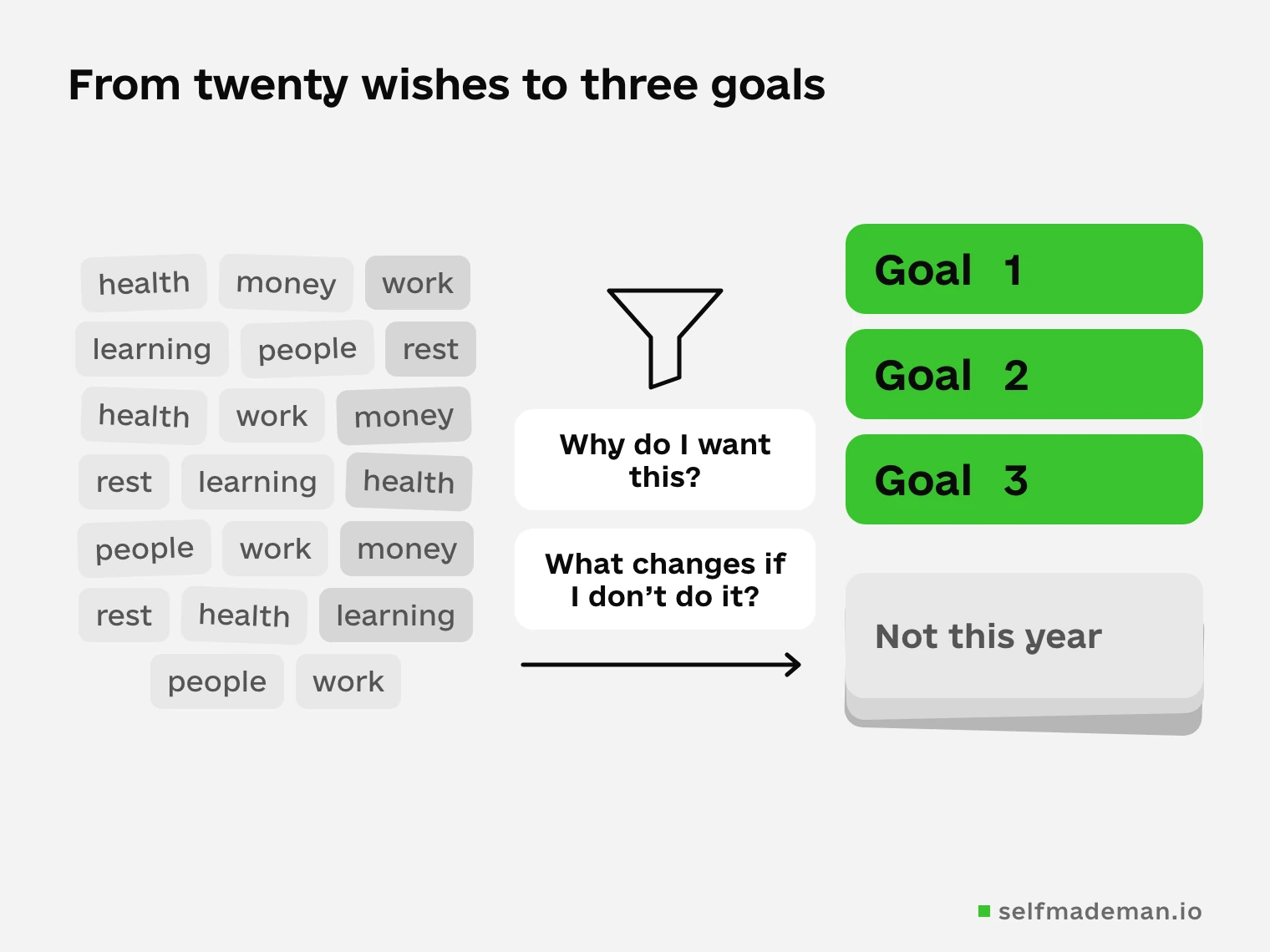
Good yearly goals start with a long list and end with a short one. Write down everything you want from the year, area by area. Pick the three goals that change the most for everything else, and move the rest to a “not this year” list. Make each one specific, then break it into quarters and one action per week. Put a review in your calendar right away — once a quarter. Three goals isn’t modesty. It’s how you actually hit them. When you juggle too many goals, even a good plan stops helping1.
- Three goals for the year. Everything else goes on the “not this year” list.
- A goal is specific and has a number, but it lives in a weekly action.
- Year → quarter → week. You don’t plan the year every day. You take the step.
- Review once a quarter. Changing a goal is fine. Quietly dropping it isn’t.
Table of contents
My experience
Two of my personal rules sum up this approach better than any theory:
I don’t choose by tasks — I choose by direction.
Every day, one small action for a long-term asset.
For me, a yearly goal is a direction. The tasks inside it change. The direction holds all year. Whatever doesn’t fit doesn’t disappear — it goes where my third rule sends it: “Everything else lives in the calendar or the backlog.”
My goals live in LifeBoard, next to my rules and my backlog. I review them once a month. If monthly feels like too much, start with quarterly reviews, as in the steps below.
Why three goals for the year, not twenty
Attention doesn’t stretch. In an experiment by Amy Dalton and Scott Spiller, planning helped people reach a single goal. With several goals, the same planning mostly showed how hard it was to fit everything in, and commitment dropped1. Twenty goals for the year means twenty reasons to feel behind.
Three means one per major area. Usually that’s something about health and energy, something about money or work, and something about people or yourself. It’s a guideline, not a law. But if all three of your goals are about work, the year may pass the rest of your life by.
A specific goal beats “I’ll try.” It’s one of the most solid findings in goal research: specific, hard goals lead to better performance than “do your best”2. So your three goals need a number and a deadline, not “make more money.”
How to set yearly goals in 7 steps
- Look back at last year. 20 minutes: what worked, what didn’t, what took more energy than it was worth. More on this in the guide to end of year reflection.
- Write down everything you want, area by area. Health, money, work, family and people, learning, rest. No filter. If you can’t tell where the gap is, try the wheel of life.
- Run each item through two questions. “Why do I want this?” and “What changes if I don’t do it?” If the honest answer is “nothing much,” the item crosses itself out.
- Pick three. The ones that pull the others along. Everything else goes on the “not this year” list. That’s not a no. It’s a queue.
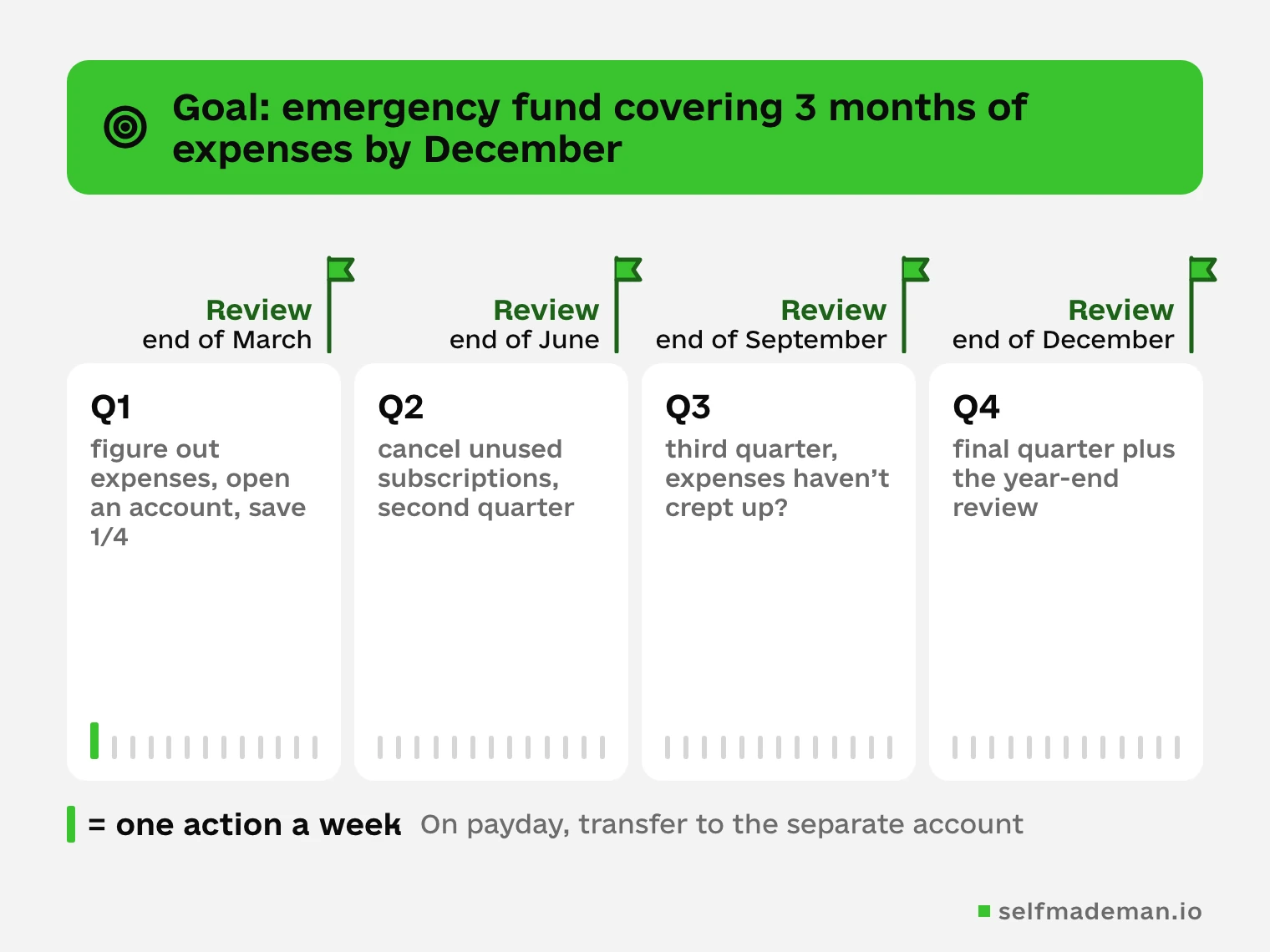
- Make each one specific. A number and a deadline. Not “save more,” but “an emergency fund covering 3 months of expenses by December.”
- Break it down: year → quarter → week. What has to be done by the end of each quarter, and what one action you take every week.
- Put the reviews in your calendar now. Four dates: end of March, June, September, and December. A review without a date doesn’t happen.
Yearly goals ideas by area
Ideas to get your list going in step 2. Not a menu to copy — rewrite each one with your own number and deadline.
| Area | Example goals for the year |
|---|---|
| Health | Run 10 km by September. Get to bed before 11 p.m. five nights a week |
| Money | An emergency fund covering 3 months of expenses. Track every expense for a full year |
| Work | Ship one project you’ve been putting off. Learn one skill your next role will need |
| People | One evening a week with family, no phone. Call your parents every Sunday |
| Learning | Read 12 books — one a month. Reach a working level in one language |
| Rest | Two real vacations with no laptop. One free weekend a month |
Yearly work goals follow the same rules as personal ones: a number, a deadline, and a weekly action. If your job has its own annual goals, keep them on a separate list — your three are about the whole year, not just the job.
How a goal turns into a week
Here’s one goal broken down. The numbers are placeholders — use your own.
| Level | Goal: “An emergency fund covering 3 months of expenses by December” |
|---|---|
| Year | Total = 3 months of expenses in a separate account |
| Q1 | Figure out average monthly expenses, open a separate account, save 1/4 of the total |
| Q2 | Cancel subscriptions you don’t use, save the second quarter |
| Q3 | Third quarter saved, check that expenses haven’t crept up |
| Q4 | Final quarter saved, plus the year-end review |
| Every week | On payday, transfer to the separate account. On Sundays, 10 minutes on expenses |
Day to day, you don’t think about the yearly goal. You do the weekly action, and the quarterly review checks that those actions still lead to the goal.
Stress-test your goal with WOOP
Psychologist Gabriele Oettingen came up with a simple four-step check: Wish, Outcome — the best result, Obstacle — your main inner obstacle, and Plan — an “if obstacle, then action” plan. In a meta-analysis of 21 studies (about 16,000 participants), its effect on reaching goals was small but consistent3.
Here’s what it looks like in practice:
- Wish: run 10 km by September.
- Outcome: more energy, and the feeling that I keep my word to myself.
- Obstacle: after work I have nothing left and want the couch.
- Plan: if I’m wiped out in the evening, I run 20 minutes in the morning before work instead of skipping.
The obstacle step is the most valuable one. Most plans don’t break on outside events. They break on our own evening couch.
Year planner
Build your plan step by step right here — it ends with a one-page “My year” you can print, which works as a yearly goals template.
20 minutes on the past year. Short, in lines: these are notes for you, not a report.
Everything you want from the year, by sphere of life. Without a filter: the big, the small and the “I should”.
Two questions for each item: “Why do I need it?” and “What changes if I do not do it?” The items where the answer is “nothing much” cross themselves out.
Pick the ones that pull the rest along. Everything else goes to the “not this year” list. That is not a refusal, it is a queue.
A number and a deadline for each goal: not “save more”, but “an emergency fund of 3 months of expenses by December”. Then a strength test: the best result, the main inner obstacle and a plan “if the obstacle, then the action”.
What has to be done by the end of each quarter and what one action you take every week. The numbers in the example are arbitrary: put in your own.
Four dates: the end of March, June, September and December. At a review you check that the actions lead to the goal. A goal can be changed there: that is not weakness, it is working with reality.
Where it breaks
- Goals without actions. “Learn Spanish” hangs there all year because nobody knows what to do on a Tuesday. No weekly action, no goal.
- Someone else’s goals. A “should” from your parents, coworkers, or your social feed lasts until the first hard month. The test is the “why do I want this?” question from step 3.
- A plan with no slack. The year is scheduled as if there will be no sick days, no vacations, no emergencies. One of my rules is “Add rest, travel time, exercise, and buffer time to the calendar.” It works for a year the same way it works for a day.
- No reviews. Without them, you remember the goal in December, when it’s too late.
- Stubbornness. If a goal stops making sense, you can change it at a review. That’s not weakness. That’s dealing with reality.
Minimum version
If three goals are too many for this year, keep one and one weekly action for it. That still beats twenty items you remember in December. For a single goal, the New Year’s resolution format works too.
If your plan goes off track
By March, something will go off plan. The question isn’t how to avoid that. It’s what you do next.
- Adjust, don’t reset. My rule: “Don’t scrap the whole plan when something goes wrong — adjust and keep going.” A missed month is a reason to move the quarterly target, not to cross out the year.
- Use fresh-start dates. The start of a quarter, a month, even a Monday — people are more likely to go after their goals right after these markers4. A quarterly review is exactly that kind of marker, built into the plan.
- Shrink the step. If you miss your weekly action three weeks in a row, it’s too big. Cut it in half and keep going.
FAQ
How many goals should I set for the year?
Three is a good benchmark. One is fine too. More than five almost always means none of them gets real attention.
What’s the difference between yearly goals and New Year’s resolutions?
A resolution is one action you start doing. Goals for the year are several directions with a result, quarters, and reviews. A resolution can be the weekly action for one of your goals.
Should I write my goals down?
Yes, if only for the reviews: three months later it’s hard to remember exactly what you meant. But the famous “Harvard study” about the 3% of graduates with written goals is a myth. That study never happened.
What if a goal stops making sense halfway through the year?
Swap it at a review. A goal is a tool, not an oath.
Today’s action
Take 15 minutes. Write down everything you want from next year and circle the three items that pull the rest along. Then open your calendar and set the first review for the end of March. Everything else can wait until later this week.
Sources
- Dalton A. N., Spiller S. A. Too Much of a Good Thing: The Benefits of Implementation Intentions Depend on the Number of Goals. Journal of Consumer Research, 2012. ↩
- Locke E. A., Latham G. P. Building a practically useful theory of goal setting and task motivation: A 35-year odyssey. American Psychologist, 2002, 57(9), 705–717. ↩
- Wang G., Wang Y., Gai X. A Meta-Analysis of the Effects of Mental Contrasting With Implementation Intentions on Goal Attainment. Frontiers in Psychology, 2021. 21 studies, 15,907 participants. ↩
- Dai H., Milkman K. L., Riis J. The Fresh Start Effect: Temporal Landmarks Motivate Aspirational Behavior. Management Science, 2014. ↩