A bucket list is everything you want to do, see, try, learn or experience, dumped onto paper. Below you’ll find 100+ bucket list ideas by area of life — but borrowed ideas are only a warm-up. Writing a hundred items isn’t about doing all hundred. It’s about getting past the obvious “new car and a vacation” and reaching what you actually want. Then comes the important part — filtering: what’s truly yours and what’s borrowed, what’s for now and what’s for later. Pick one to three items that are “mine + now” and turn them into goals with a first step and a date. The list itself makes nothing happen. Steps do.
- Write fast and don’t censor yourself: 100 items in two or three 20-minute sessions.
- Be specific: not “travel more,” but “see the northern lights in Norway.”
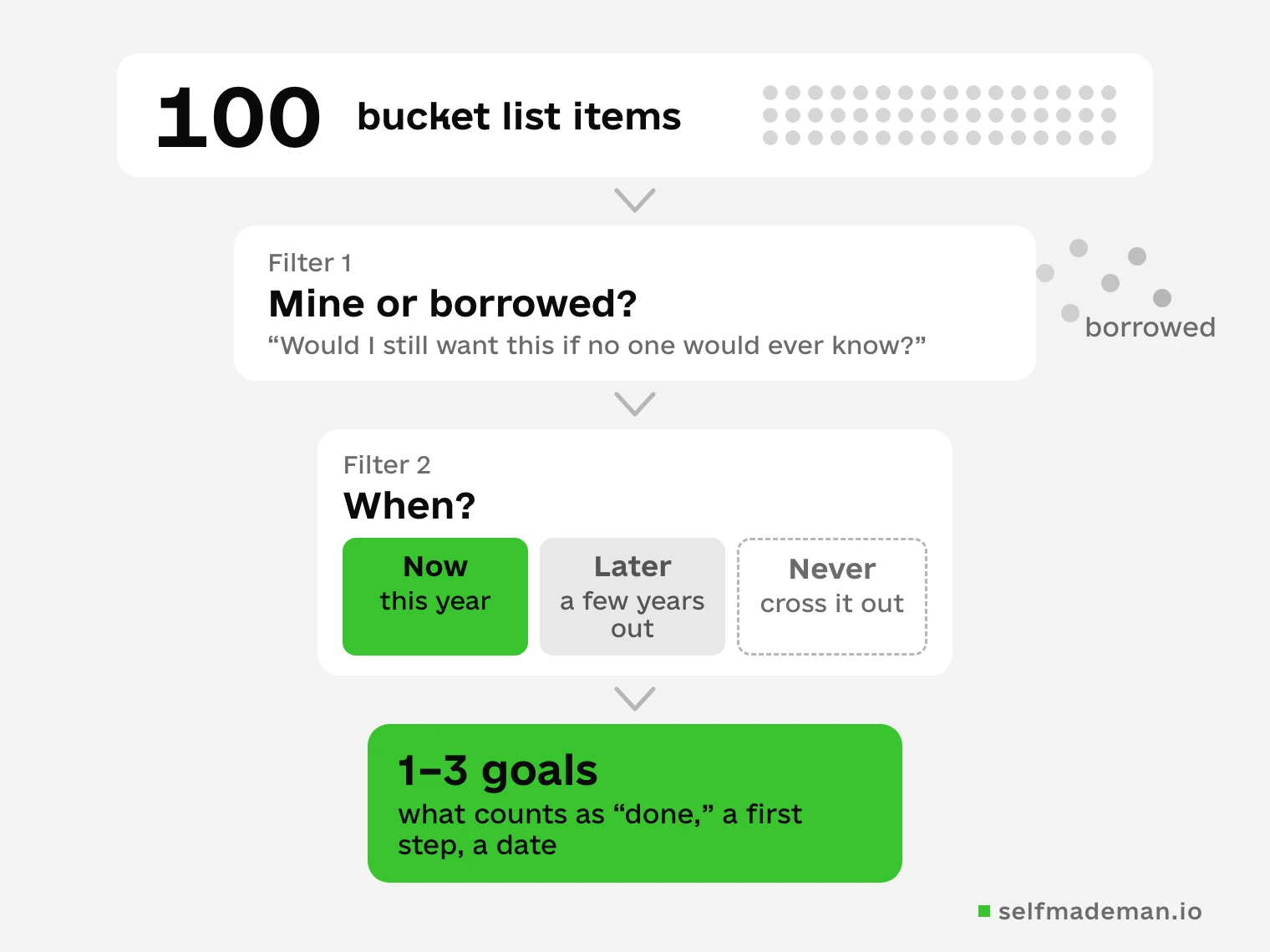
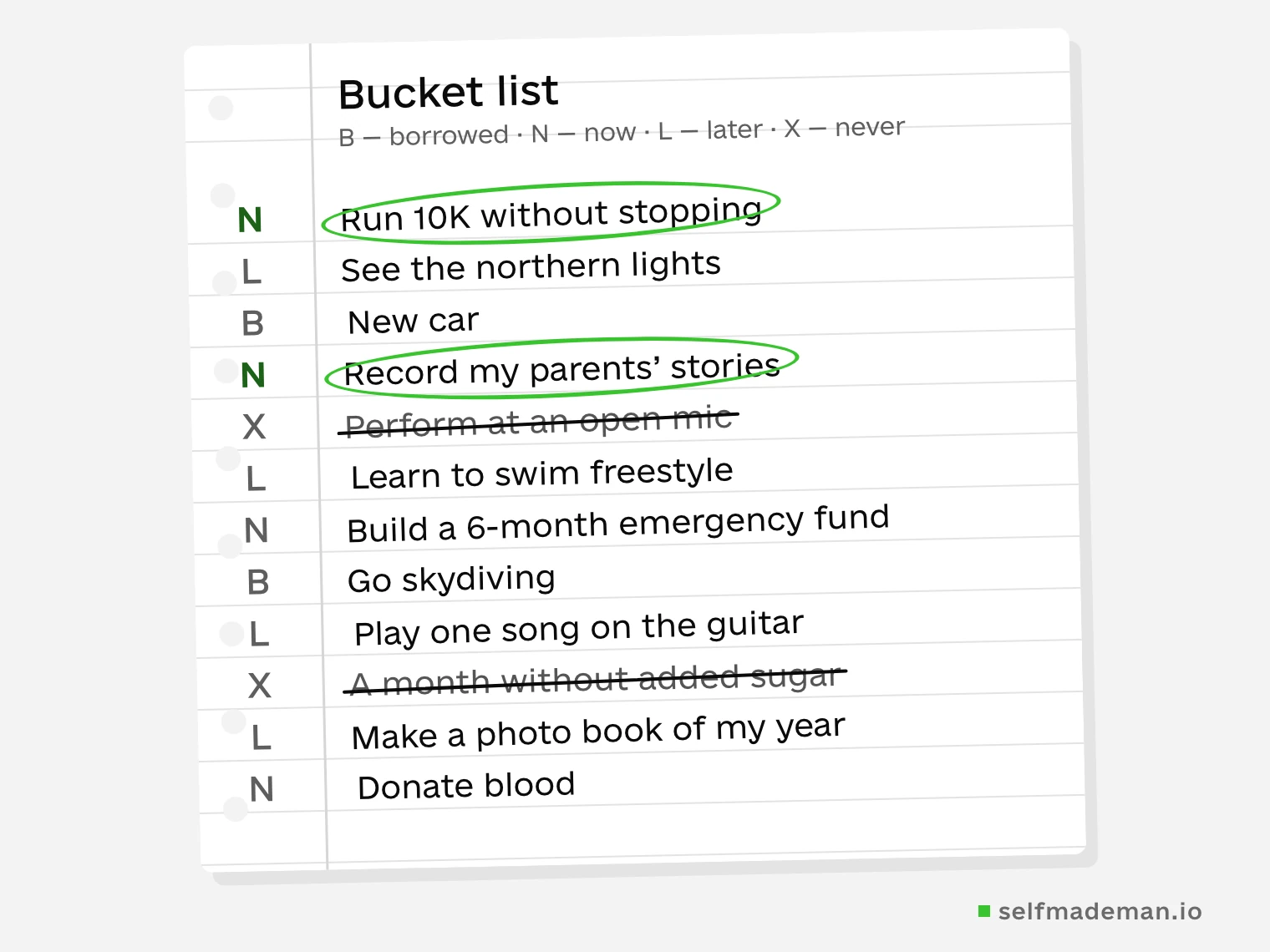
- Filter 1: mine or borrowed? Filter 2: now, later or never?
- From “mine + now,” turn 1–3 items into goals for the year.
- A list isn’t a spell. A dream without a plan relaxes you more than it moves you.
Table of contents
- What is a bucket list?
- Why bother making a bucket list
- No magic: why “making a wish” doesn’t work
- My experience
- How to make a bucket list: 6 steps
- 100+ bucket list ideas by area of life
- Bucket list builder
- How to turn a bucket list item into a real goal
- Where it breaks
- The minimum version
- If you’ve abandoned your list
- FAQ
- Your action for today
- Sources
What is a bucket list?
The phrase comes from the idiom “kick the bucket,” meaning to die. A bucket list is what you want to do before that. Merriam-Webster dates the first known use of the phrase to 20061. It went mainstream with the 2007 movie The Bucket List, starring Jack Nicholson and Morgan Freeman, in which two terminally ill men write down everything they want to do while they still can.
The meaning is simple: a list of what you want to live through, not what you’re supposed to get done.
Why bother making a bucket list
The reason isn’t romantic. In a 1995 review, psychologists Thomas Gilovich and Victoria Medvec described a pattern: in the short term, people regret what they did more; in the long term, they regret what they didn’t do2. A mistake you made fades or gets fixed over time. The thing you never did stays an open question.
A bucket list is a way to see in advance what you might regret — and start on at least some of it.
No magic: why “making a wish” doesn’t work
There’s a lot of mysticism around wish lists: “write it down and the universe will hear you,” “a vision board attracts what you want.” My position is simple: writing a wish down is useful. Waiting for it to come true on its own isn’t.
Psychologist Gabriele Oettingen tested this directly. In a 2002 study with Doris Mayer, she compared two ways of thinking about the future3. Participants included graduates looking for jobs, students with a crush on a classmate, students before an exam and patients awaiting hip replacement surgery. People who expected success — who soberly judged it as likely — went on to put in more effort and achieve more. People who indulged in pleasant fantasies about the future they wanted got the opposite: less effort and worse results. The effects were measured weeks and months later, in one study two years later.
A wish isn’t a goal. A goal is a wish with a first step and a date.
So in this article, the list is only the first half of the work. The second half is filtering and steps.
My experience
I’ve gone from “wishing” to “doing” myself. One of my old affirmations was “I always get what I want for myself.” Among the newer ones: “I choose what matters most and keep coming back to it” and “I don’t scatter myself — I strengthen my main direction.” The difference: the first one promises a result, the second tells me what to do with it.
One of my rules is “I don’t choose by tasks — I choose by direction.” For a bucket list, that means a hundred items aren’t a hundred tasks. They’re raw material that shows you a direction. If your list has ten items about mountains and travel and none about a new car, that says something about you.
I don’t have a bucket list. My roles do that job: they’re basically a list of who I want to be. Some of my “thought leader” role has already come true: speaking at conferences and getting published in Forbes Kazakhstan. A book is still ahead.
How to make a bucket list: 6 steps
- Start with areas of life. Health, money, work, relationships, family, growth, rest, travel, creativity, helping others. It’s handy to borrow the areas from the wheel of life so your list doesn’t tilt to one side.
- Write fast, no censoring. Three 20-minute sessions, on different days if you like. The first 20–30 items will be obvious. The interesting stuff usually starts after 50, once the obvious runs out.
- Be specific. Not “travel more,” but “road-trip through Georgia, the country.” Not “learn a language,” but “read a book in Spanish without a dictionary.” A specific wish is checkable: done or not.
- Filter: mine or borrowed? Next to each item, ask: “Would I still want this if no one would ever know?” If not, it’s probably someone else’s wish — from your feed, your parents, or “because everyone does it.”
- Filter by time. Split what’s left into three columns: now (this year), later (a few years out), never (you’ve stopped wanting it — that’s fine, cross it out).
- Pick 1–3 and take the first step. From the “mine + now” column. For each one: what counts as “done,” a first step this week, and a date. From here it’s a goal, and you work with it like any yearly goal.
The “mine or borrowed” filter is more than a nice phrase. In 1999, Kennon Sheldon and Andrew Elliot showed that goals people pick for their own reasons — not because of pressure or other people’s expectations — get pursued harder, get reached more often, and boost well-being more when reached4. And in a 1996 paper by Tim Kasser and Richard Ryan, people who put special weight on money, looks and fame reported, on average, less vitality and more physical symptoms than those who cared more about self-acceptance, close relationships, community and health5.
That doesn’t make “I want a house” a bad wish. It just means it’s worth checking whose wish it is.
100+ bucket list ideas by area of life
These ideas are a warm-up, not a list to copy. Take what resonates and rewrite it in your own words.
| Area | Bucket list ideas |
|---|---|
| Health and body | Run 10K without stopping · finish a half marathon · learn to swim freestyle · do 10 pull-ups · go a month without added sugar · hike a mountain over 10,000 feet · learn to do a handstand · take a yoga or martial arts class for a full year · sleep 8 hours every night for a month · get a full health checkup and act on it |
| Travel and places to visit | See the northern lights · road-trip through Georgia, the country · walk part of the Camino de Santiago · camp under the stars far from city lights · visit the place your grandparents came from · see the Grand Canyon at sunrise · ride a long-distance train across a country · visit a new continent · spend a week somewhere with no Wi-Fi · see a total solar eclipse |
| Adventure and courage | Go skydiving · perform at an open mic · travel solo to a country where you don’t speak the language · go scuba diving · try paragliding · sleep in a tent in the snow · go white-water rafting · say yes to the next thing that scares you a little · take an improv class · ask for something big you’ve been afraid to ask for |
| Skills | Learn a language well enough to read a book without a dictionary · cook five dishes without a recipe · play one song on the guitar · take a first aid course · learn to drive a stick shift · learn to touch-type · learn basic car maintenance · learn to dance one dance properly · learn to code a simple app · learn to sail |
| Work and business | Launch your own project · give a talk to a room of strangers · write a book or an article series · find a mentor · become a mentor · take a sabbatical · learn to negotiate a raise and do it · build something that earns its first dollar · change careers if the current one isn’t yours · teach a workshop on what you know best |
| Money | Build a 6-month emergency fund · pay off all your debt · invest your first $1,000 thoughtfully · track every expense for a year · set up automatic savings · buy something big with cash, no loan · write a will · give a meaningful donation · save up for a dream trip and pay for it in full before you go · understand exactly where your money goes |
| Relationships and family | Record your parents’ stories on audio · take a family trip with no phones · make peace with someone you haven’t talked to in years · write a letter to your future kids · host a dinner for everyone who matters to you · reconnect with an old friend · plan a surprise for someone you love · build a family tree · spend a full day with each child one-on-one · learn to say “I was wrong” |
| Creativity | Make a photo book of your year · paint a picture for your home · edit a movie out of family videos · write a short story · start a journal and keep it for a year · build a piece of furniture · grow your own vegetables · learn to take good photos · record a song · make a scrapbook of your travels |
| Learning and growth | Read 50 books in a year · read one classic you’ve always avoided · take a university course online · visit the world’s great museums · learn the basics of a science you know nothing about · spend a month without social media · go on a silent retreat · keep a gratitude log for a year · write your personal mission · learn about your family’s history |
| Helping others | Donate blood · help one nonprofit for a full year · teach someone what you know · volunteer during a disaster relief effort · plant a tree for every year of your life · mentor a young person · cook for people who need it · organize a fundraiser · help a neighbor without being asked · leave a place better than you found it |
Bucket list builder
Take the areas of life
So the list does not tilt to one side. Remove what is not about you, add your own.
Write fast, without censoring
Everything you want to do, see, try, learn or live through. Specifically: not “travel more”, but “drive across Georgia”. A specific wish can be checked: done or not.
Out of ideas? Prompts by area
Ideas are for warming up, not for copying. Take what resonates and rewrite it your way.
Would I want this if no one ever found out?
Ask it next to every item. If the answer is no, it is most likely someone else’s wish: from the feed, from parents, “because everyone does it”. Goals chosen for your own reasons are pursued more persistently and reached more often.
This does not mean “I want a house” is a bad wish. It means it is worth checking whose it is.
Now, later or never?
Only for what is yours. Now — this year. Later — in a few years. Never — you stopped wanting it, and that is fine: cross it out.
Pick 1–3 from “mine + now” and turn them into goals
A wish becomes a goal when it has three things: a sign of “done”, a first step this week and a date. The list itself makes nothing happen. Steps do.
How to choose the main goals and check them for obstacles → Check your wishes against your personal mission →
Once a year, ideally together with your year in review: cross out what is done and what you no longer want, add new wishes, choose one for the next year. Year in review →
Everything stays in this browser.
How to turn a bucket list item into a real goal
An item from the “mine + now” column becomes a goal once it has three things:
| The wish | What counts as “done” | First step this week | Date |
|---|---|---|---|
| Learn Spanish | Read one book without a dictionary | Sign up for a trial lesson | December next year |
| Run 10K | Cross the finish line at a race with a bib | Three 20-minute runs | A race in May |
| Record my parents’ stories | Five 30-minute recordings | Set up the first session | By New Year’s |
Don’t take on more than three. A hundred wishes for one year is a guaranteed way to miss all hundred. How to pick what matters and stress-test a goal is covered in the article on yearly goals. And if you want to check your wishes against what you live for, a personal mission helps.
Where it breaks
- A showcase list. Items that sound great on social media but don’t move you. The “would I want this if no one knew?” filter cuts them.
- Just shopping. If your list is mostly things, you’ve written a shopping list. That’s useful too, but it’s something else.
- A hundred items as a plan. The list is a map of the territory, not a route for the year. The route is 1–3 goals.
- A dream without a step. Beautifully written — and then you wait. As Oettingen’s research shows, pleasant fantasies on their own relax you more than they move you.
- A list nobody opens. Without a yearly review it goes stale: you change, and so do your wishes.
The minimum version
No evening for a hundred items? Ten wishes in ten minutes. Pick one, write down the first step and take it this week.
If you’ve abandoned your list
That’s normal. Most lists gather dust. Open yours once a year, ideally alongside your year in review: cross off what’s done, cross off what you no longer want, add what’s new. Pick one for the coming year. A list you actually revisit works better than a perfect one sitting in a drawer.
FAQ
What is a bucket list?
A list of things a person wants to do, see or experience in their lifetime. The name comes from the idiom “kick the bucket.” The 2007 movie The Bucket List made the phrase popular.
What are the most common bucket list items?
There’s no reliable ranking — but most lists online circle the same themes: travel (northern lights, a new continent), adventure (skydiving, scuba diving), physical challenges (a 10K or a marathon), skills (a language, an instrument) and time with family. Use them as a starting point, then run each through the “mine or borrowed” filter.
What should I put on my bucket list?
Anything you want to do, see, try or learn, across all areas of life: health, travel, skills, work, money, relationships, creativity, helping others. Make each item specific enough that you’ll know when it’s done.
Why 100 items?
The first 20–30 are usually obvious and often borrowed. A hundred forces you to dig deeper. But 100 isn’t a rule: ten honest wishes beat a hundred copied ones.
What’s the difference between a bucket list and goals?
A wish is something you want. A goal is a wish with a “done” marker, a first step and a deadline. Your bucket list is the raw material you pick 1–3 goals from.
Does a vision board work?
As a visual reminder of your direction, it can help. As a way to “attract” what you want, no. Oettingen’s research shows that pleasant fantasies without a plan tend to reduce effort.
How often should I update my bucket list?
Once a year, for example with your year in review. Cross off what’s done and what you’ve lost interest in, add new items, and pick one to three for the coming year.
Your action for today
Set a 20-minute timer and write down as many wishes as you can — no censoring. Then mark one that’s definitely yours and realistic this year, and write down a first step for this week. 25 minutes.
Sources
- Merriam-Webster. Bucket list. Dictionary entry: meaning, origin from “kick the bucket,” first known use — 2006. ↩
- Gilovich T., Medvec V. H. The experience of regret: What, when, and why. Psychological Review, 1995, 102(2), 379–395. ↩
- Oettingen G., Mayer D. The motivating function of thinking about the future: Expectations versus fantasies. Journal of Personality and Social Psychology, 2002, 83(5), 1198–1212. ↩
- Sheldon K. M., Elliot A. J. Goal striving, need satisfaction, and longitudinal well-being: The self-concordance model. Journal of Personality and Social Psychology, 1999, 76(3), 482–497. ↩
- Kasser T., Ryan R. M. Further examining the American dream: Differential correlates of intrinsic and extrinsic goals. Personality and Social Psychology Bulletin, 1996, 22(3), 280–287. ↩