A personal mission statement is one to three sentences about what you do, who you do it for, and what you stand on while doing it. You don’t find it after years on a mountaintop. You write it in one evening from three pieces: your values, your roles in life, and what you’re good at. Then you test it for a month against real decisions: “Does this move me toward what I wrote down, or away from it?” If your mission has never once helped you say “no,” it’s not a mission. It’s a nice quote on the wall.
- A mission statement is a filter for decisions, not a slogan.
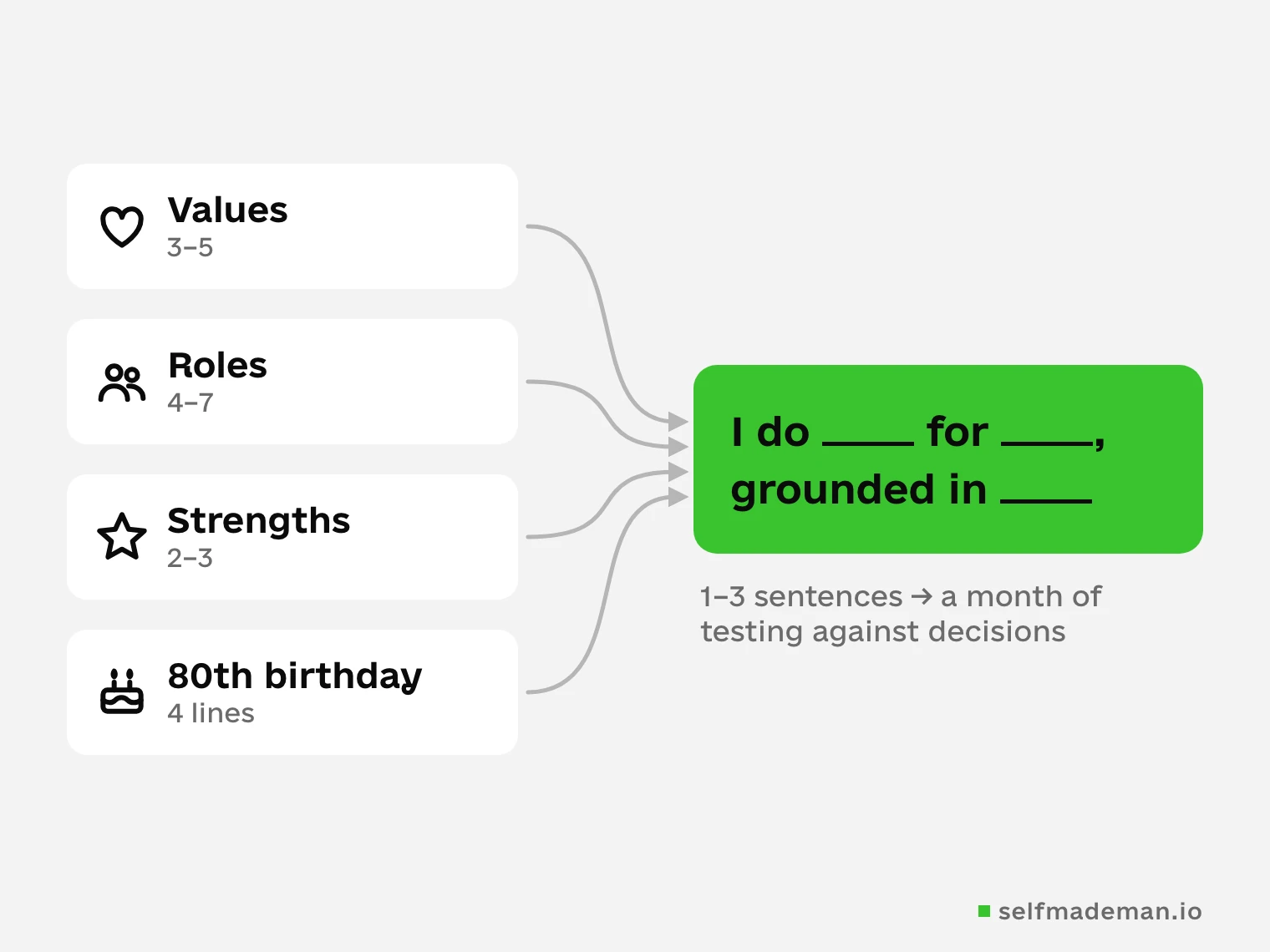
- Raw material: 3–5 values, 4–7 roles, 2–3 strengths.
- Format: “I do _ for _, grounded in _.” One to three sentences.
- Your first version is a draft. A month of real decisions will show what to cut.
- You can rewrite it. That’s not betraying yourself — it’s an update.
Table of contents
- Where the idea comes from: Covey and “begin with the end in mind”
- My experience
- Mission, values, goals: what each one does
- How to write a personal mission statement in one evening: 5 steps
- Personal mission statement examples
- How to use your mission to make decisions
- Personal mission statement builder
- Where it breaks down
- The minimum version
- If your mission stops feeling right
- Questions
- Your action for today
- Sources
Where the idea comes from: Covey and “begin with the end in mind”
Stephen Covey popularized the personal mission statement in The 7 Habits of Highly Effective People (1989). His second habit is “Begin with the End in Mind.” The chapter opens with a thought experiment: picture your own funeral, where four people speak about you — someone from your family, a friend, a colleague, and someone from a community you’re part of. What would you want them to say? Your answer becomes the raw material for a personal mission statement, a document Covey suggests you lean on when you make decisions1. FranklinCovey still runs a free online mission statement builder2.
A word on the science. I couldn’t find research that tests a written personal mission statement as such. What does exist is close work on goals. People pursue goals that match their interests and values with more persistence, reach them more often, and get a bigger boost in well-being when they do3. A mission statement is a way to keep your goals tied to your values. There’s no magic in it.
My experience
I have a written mission. It’s longer than what I recommend below — three paragraphs — and it’s built like this:
- What I’m after and how. Financial freedom, and helping people and businesses grow using what I know about digital marketing and personal effectiveness.
- How I share. Inspiring people to grow by sharing my experience, including through a blog. The site you’re reading right now is a direct continuation of this point.
- What I stand on. A healthy lifestyle and balance in every area of life, not just work.
That’s a paraphrase: I don’t publish the full text. But you can see the format: the work, the way, the foundation.
Mission, values, goals: what each one does
People mix these words up all the time. Each has its own job.
| What | Answers the question | Example |
|---|---|---|
| Values | What do I stand on? | Honesty, family, health |
| Mission | What do I do, for whom, and why? | I help small businesses grow through marketing that makes sense |
| Yearly goals | What result do I want this year? | Five long-term clients by December |
| Rules | How do I act in a situation that keeps coming up? | I don’t take a project I can’t explain in my own words |
The order matters. First your values, then your mission, then your yearly goals and personal rules. A mission without values ends up sounding like someone else’s. Goals without a mission end up scattered.
How to write a personal mission statement in one evening: 5 steps
You’ll need about an hour and a half, a sheet of paper, and your phone in another room.
- Values — 15 minutes. Write down 3–5 of your values. If you don’t have them yet, figure out your values first. That’s a separate evening.
- Roles — 15 minutes. List 4–7 roles: parent, partner, professional, manager, friend, student. For each one, write a single line: “who I want to be in this role.” I have sixteen roles, each with a line about who I want to be in it, but five is plenty for a first pass.
- Strengths — 15 minutes. What do you do better than most people around you? What do people ask you for most often? What do they thank you for? Write down 2–3 things.
- Covey’s exercise — 15 minutes. Covey uses a funeral, but there’s a gentler version: picture your 80th birthday. Four people stand up — someone from your family, a friend, a colleague, and someone you once helped. What does each of them say about you? Write one line for each. That’s what you want from life, without words like “success” or “fulfillment.”
- Draft — 20 minutes. Put it all into the formula: “I [what I do] so that [for whom and what result], grounded in [2–3 values].” Then cut it down to one to three sentences. Strike out anything that would fit anyone at all.
Done. It’s a draft, not something carved in stone. The next month will test it.
Personal mission statement examples
These aren’t real people. They’re examples of the format. Notice that each one has a specific kind of work, a specific audience, and something the person stands on.
- Professional: “I make complicated money decisions understandable for ordinary families, so they’re less afraid of money. I stay honest, even when the honest answer is ‘you don’t need this.'”
- Parent and business owner: “I’m building a business that feeds my family without eating it alive. My kids see a dad who works honestly and comes home on time.”
- Teacher: “I teach teenagers to think for themselves and not fear mistakes. I keep learning every year so they always have someone to argue with.”
- Manager: “I build teams where people aren’t afraid to tell the truth, and I get projects done without heroic all-nighters.”
- Student: “I’m learning to make things people actually need, not just to get grades. I try a lot of things, and I finish what I start.”
What’s missing: “make the world a better place,” “become my best self,” “achieve success.” Words like that fit everyone, so they filter nothing.
How to use your mission to make decisions
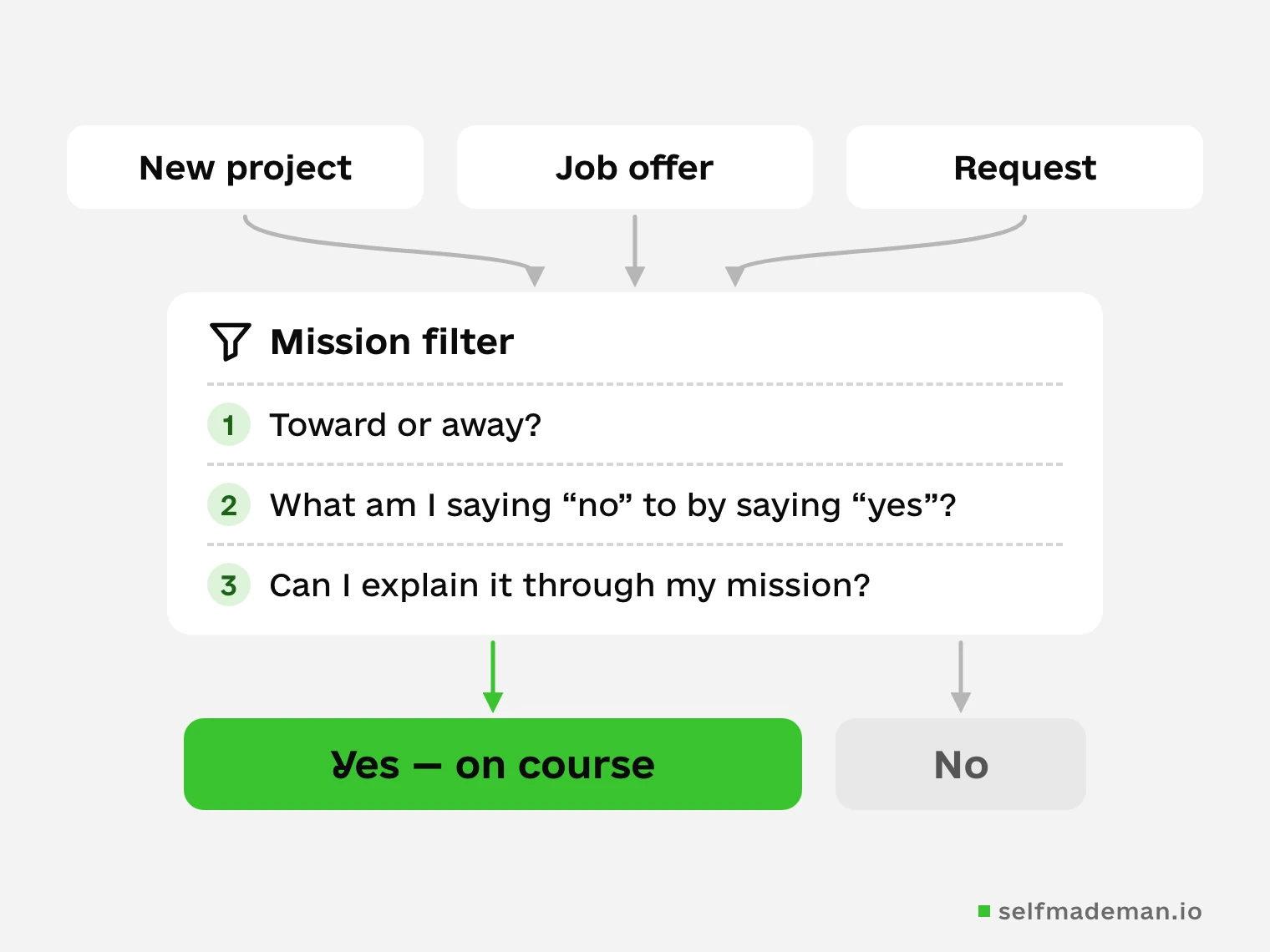
A mission statement does its work in moments of choice: a new project, a job offer, a request you want to say “yes” to just to be polite. Three questions:
- Toward or away? Does this decision move me toward what my mission says, or off to the side?
- What am I saying “no” to by saying “yes”? Every evening you give to one thing is taken from another. Taken from what, exactly?
- Can I explain it through my mission? If someone asks in six months, “Why did you take that on?”, will there be an answer other than “they offered money” and “it felt awkward to say no”?
One of my personal rules goes like this: “I don’t choose by tasks — I choose by direction.” A mission is that direction, put into words.
Once a month, it helps to check in reverse: write down the three biggest decisions of the month and see how many of them would have passed the three questions.
Personal mission statement builder
-
1Values: what do you stand on? Write down 3–5 of your values.From the article:
No list of values yet? Take the values test. Its result will appear here by itself.
-
2Roles: who are you in your life? List 4–7 roles. For each one, a phrase: what do I want to be like in this role.
-
3Strengths: what do you do well? Write down 2–3 things.
- What do you do better than most people around you?
- What are you asked for most often?
- What are you thanked for?
-
4Your 80th birthday. Four people stand up to speak. What will each of them say about you? One phrase each, without the words “success” and “fulfilment”.
Covey has a farewell here, but a birthday is gentler.
-
5The draft. Put it all together by the template, then cut it down to one to three sentences.
“I [what I do] for [whom], so that [result], standing on [2–3 values]”
Standing on 2–3 values from step 1. -
6A month of checking with decisions. The first version is a draft. Run new projects, offers and requests through three questions.
- Closer or away? Does this decision move me towards what my mission says, or to the side?
- What am I saying “no” to by saying “yes”? Every evening given to one thing is taken from another. From what exactly?
- Can I explain it through the mission? If in six months someone asks “why did you need this?”, will there be an answer other than “they offered money” and “it was awkward to refuse”?
Check a decision1. Closer or away?3. Can I explain it through the mission?Once a month, look at the biggest decisions in the list: how many of them passed the three questions?
The first review in a month, then once a year and after any big change: a new job, a move, a child, a loss.
Everything stays in this browser.
Where it breaks down
- Too vague. “I want to be useful to people” won’t help you choose between two projects. You need a specific kind of work and a specific audience.
- Too long. If you can’t recall your mission at the moment of decision, it doesn’t work. One to three sentences. Mine, for the record, is still longer — three paragraphs.
- Someone else’s words. A mission copied from a book or a celebrity sounds great and means nothing to you.
- Searching for your “purpose.” Waiting for a flash of insight is the best way to write nothing at all. A mission is a working tool. You build it and edit it. You don’t find it.
- Mission as a stick. If every step off course turns into beating yourself up, reread your mission. It probably says nothing about rest or people.
- Never revisited. You change, your work changes, your kids grow up. A statement from five years ago may describe a different person.
The minimum version
Don’t have an hour and a half? Finish one sentence: “I help _ with _, because _ matters to me.” Put it in the notes on your phone and reread it before your next big decision.
If your mission stops feeling right
Rewrite it. That’s not failure. It’s a sign that you’re changing. My personal rules went the same way: “in bed by 1 a.m.” eventually became “asleep by 11 p.m.,” and that was more honest, not weaker.
- Once a year — a planned review. It fits well with your year-end review: look at which decisions of the year would have passed through your mission and which wouldn’t.
- Unplanned — after a big change. A new job, a move, a new baby, a loss. Your mission before and after events like these may look different.
- Don’t start from scratch. Take the old text and ask: what here is still true? That’s the base for the new version.
Questions
What is a personal mission statement?
One to three sentences about what you do, who you do it for, and which values you stand on. Its job is to help you choose, not to decorate your profile.
What is my mission in life, and how is a mission different from a purpose?
A purpose is usually presented as something you have to find, as if it were written down somewhere in advance. A mission is something you write yourself, and you can rewrite it too. No mysticism.
How long should a personal mission statement be?
Shorter than you want it to be. One to three sentences you can recall at the moment of a decision.
What’s the difference between a personal vision and a mission statement?
A vision is a picture of the future: who you want to be and what your life looks like years from now. A mission is what you do every day to move toward that picture.
How often should you revisit your mission statement?
Once a year and after big changes in your life. Between reviews, just use it to check your decisions.
Your action for today
Grab a sheet of paper and spend 15 minutes on the 80th-birthday exercise: four people, one line from each. Circle the words that repeat. Tomorrow, turn them into the first sentence of your mission.
Sources
- Covey S. R. The 7 Habits of Highly Effective People. Free Press, 1989. Habit 2: Begin with the End in Mind. ↩
- FranklinCovey. Mission Statement Builder. A free online personal mission statement builder. ↩
- Sheldon K. M., Elliot A. J. Goal striving, need satisfaction, and longitudinal well-being: The self-concordance model. Journal of Personality and Social Psychology, 1999, 76(3), 482–497. ↩