A habit tracker is a grid where you mark, day by day, whether you did what you decided to do regularly. It works: in a meta-analysis of 138 experiments, people who tracked their progress reached their goals more often, especially when they wrote it down instead of keeping it in their heads1. A tracker starts to feel like pressure in three cases: you track too many habits, the check mark becomes more important than the action, and a missed day feels like failure. Below is how to use a habit tracker so it stays a tool and doesn’t turn into a supervisor. There’s also a free online tracker and a printable template.
- 3–4 habits, no more.
- Every habit needs a trigger. A tracker doesn’t replace the trigger. It only records the result.
- Three marks instead of two: done, minimum done, missed (with a reason).
- Mark it right after the action, and be honest: “almost” doesn’t count.
- One miss isn’t failure. Two in a row is a signal to figure out why.
- Once a habit is automatic, you can take it off the tracker.
Table of contents
Do habit trackers actually work?
Short answer: yes, but not on their own.
The strongest evidence is a 2016 meta-analysis by Benjamin Harkin and colleagues. They pooled 138 experiments with almost 20,000 participants, where some people were asked to monitor their progress and others weren’t. Monitoring raised the chance of reaching the goal. The effect was stronger when progress was written down and when it was shared with other people1. The goals were mostly about health: weight, diet, smoking, blood pressure.
In a review of weight-loss research, the link between self-monitoring — a food diary, regular weigh-ins — and results showed up consistently, study after study (there were 22 of them). The authors are upfront, though, that the quality of the evidence is weak2.
James Clear gives three reasons it works3:
- A tracker is a reminder. An empty square in plain sight says “not done yet today.”
- A tracker is motivating. You can see how far you’ve come, and you don’t want to break the chain.
- A check mark is a small reward. Ticking the box right after the action gives you the satisfaction that habits with delayed results are missing.
And a fourth one, about honesty, which matters most to me: a tracker doesn’t let you fool yourself. “I read almost every day,” and then the grid shows nine marks for the month.
My experience
One of my rules says: “I log my calories and water accurately and correctly.” The key word is “correctly.” A mark only makes sense if it matches reality. An inaccurate mark gives you a feeling of control you don’t actually have.
Next to it is the rule I consider the most important for any tracker: “Don’t mark a task as done if it isn’t really finished.” I have an affirmation about the same thing: do it honestly and mark it just as honestly. For me a tracker is a way to be honest with myself, not a way to collect pretty stats.
I keep my check-ins in LifeBoard, the same place where my rules and goals live. I log calories, water and tasks.
How to use a habit tracker: 7 rules
- Track 3–4 habits. Clear recommends tracking only the most important ones by hand, three or four3. Ten rows in a tracker isn’t ambition. It’s a guarantee you’ll stop opening it by week three.
- For every habit, the trigger comes first, the square second. In a study of habit apps, reminders helped people repeat an action but got in the way of it becoming automatic. Automaticity grew for people who tied the action to an event in their day: “after breakfast,” “after my shower”4.
- Define what counts as done. “Read” — how much? Write down a full version and a minimum one: “30 minutes” and “one page.” Without that, you’ll be bargaining with yourself every evening.
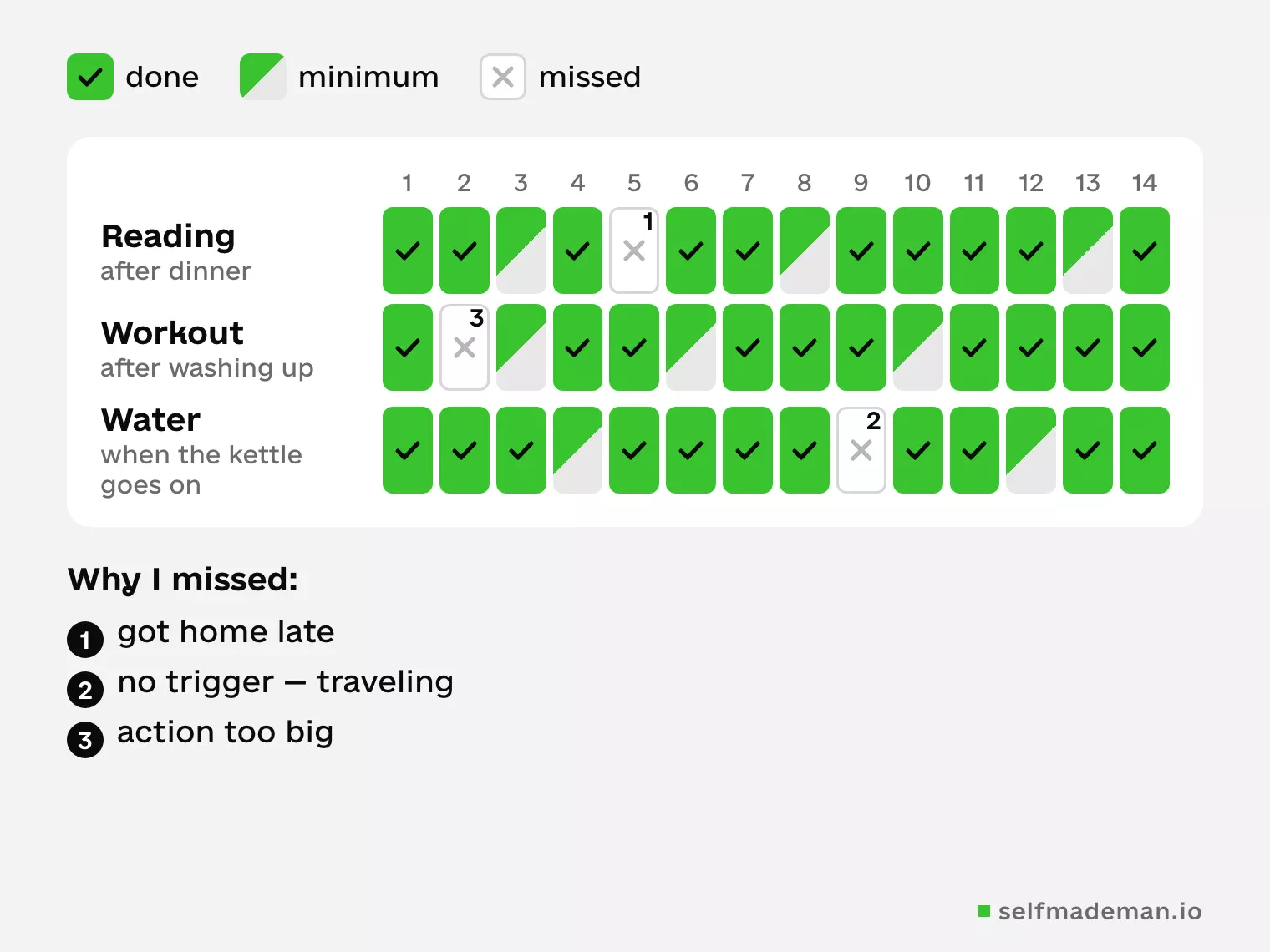
- Use three marks, not two. ✓ means fully done. ½ means the minimum version is done. ✕ means missed. The minimum version still counts: it keeps the “trigger → action” link alive.
- Mark it right after the action. Not in the evening “from memory.” Done means marked. In the evening you’ll mark what you planned, not what you did.
- Don’t mark “almost.” Started and dropped halfway is a ½ if you hit the minimum, or an ✕ if you didn’t. An honest tracker with gaps is more useful than a perfect but made-up one.
- Once a week, a 10-minute review. Don’t look at the percentage. Look at the reasons for misses: no trigger, no time, the action was too big, you just didn’t feel like it. Each reason has a different fix.
Habit tracker ideas: what to track
A good candidate for a tracker is something you want to do regularly but only do every other time. A bad one is something you already do automatically, or something you enjoy doing without any tracking.
| What | How to mark it | Minimum version |
|---|---|---|
| Reading | Yes / no | One page |
| Morning workout | Yes / no | Two minutes |
| Gratitude | Yes / no | One line |
| Water | Number of glasses | One glass in the morning |
| Steps | The number from your phone | A short walk after lunch |
| In bed by 11 p.m. | Lights-out time | Phone put away at 10:30 p.m. |
| No phone in bed | Yes / no (“don’t” habit) | Phone charges away from the bed |
Clear splits what’s worth tracking into daily habits, weekly tasks, counts and “don’t” habits3. Trackers work worse for the “don’t” kind: “didn’t eat sweets” doesn’t feel as satisfying as “workout done.” It’s better to turn it into an action: not “no sweets” but “fruit after lunch.”
Paper, spreadsheet or app
| Format | Pros | Cons | Who it’s for |
|---|---|---|---|
| Paper (a sheet on the fridge, a bullet journal) | Always in sight, marking is a physical action | No stats, easy to lose | People starting with 1–2 habits |
| Spreadsheet (Google Sheets, Excel, Notion) | Flexible, shows trends over months | You have to open it, it’s not in sight | People who like numbers |
| App | Always at hand, reminders, charts | Reminders replace triggers, easy to add 15 habits | People who already keep 2–3 habits |
| The online tracker below | No sign-up, three marks, review of reasons, printing | Data lives in one browser (you can download a copy) | People who want to try it without installing anything |
The format matters less than you’d think. What matters is that marking takes seconds and happens right away.
Online habit tracker
Add 3–4 habits or use the ready-made ones: reading, workout, gratitude, water. Each one gets a trigger and a minimum version. Tap the square right after the action, and when you miss, pick a reason: by the end of the week they show what’s really getting in your way.
Trigger: the event of the day after which you do it. Minimum: what counts on a bad day.
The tracker needs JavaScript. You can still draw it by hand: habits on the left, dates on top.
Tap a cell: ✓ → ½ → ✕ → empty. Mark right after the action. Future days are locked.
No streak counter here: look at the reasons for misses, not at the percentage.
The template opens in a new window; in the print dialog you can also save it as PDF.
A copy of your dataMarks live only in this browser. A copy lets you move them to another device or keep them safe.
Prefer paper? Print the monthly or weekly habit tracker template with the button under the tracker. In the print dialog you can also save it as a PDF.
When a tracker nags instead of helping
- The mark matters more than the action. You read to tick the box, not to read. In Jordan Etkin’s experiments, measuring made people walk more and read more, but they enjoyed it less and wanted to keep going less: the activity started to feel like work5. Don’t track what you do for fun and what already holds on its own.
- A tracker instead of a habit. Trackers and reminders help you repeat an action, but they don’t make it automatic if there’s no trigger4. If everything falls apart three months later without the tracker, the tracker isn’t the problem. The habit just has nothing to hang on.
- The streak cult. “Don’t break the chain” is motivating until the chain breaks. Then a 47-day streak drops to zero and you want to quit everything. That’s why the tracker above has no streak counter.
- Too many rows. Twelve habits give you twelve chances to feel like a failure every evening. Cut it to three.
- Empty squares as a verdict. A miss is data, not a judgment of you as a person. Treat it as a hint about what exactly got in the way.
A tracker isn’t a judge. It’s a mirror: it shows what is, and you make the decisions.
The minimum version
One habit. A sheet of paper somewhere you’ll see it. A mark right after the action. In a month, look at where the gaps are and why.
If you slip or drop the tracker
Missing one day doesn’t break a habit. In Phillippa Lally’s study, a single miss didn’t noticeably affect habit formation6. What breaks it is something else: “missed it → it’s all ruined → I’m quitting.” That’s why Clear’s rule is never miss twice3. Once is an accident. Twice in a row is a reason to look into it.
If you’ve abandoned your tracker for weeks, don’t fill in the gaps after the fact, and don’t wait for “Monday, the first of the month.” Open it today, cut it down to one or two habits, and mark the first thing you actually do. The old empty squares are just history, not debt.
FAQ
What is a habit tracker?
A grid or an app where you mark, day by day, whether you did a regular action: reading, a workout, water. It shows how consistent you are and where the habit breaks.
How do you use a habit tracker?
Pick 3–4 habits, give each a trigger and a minimum version, mark right after the action, and once a week review the reasons for your misses.
Do habit trackers actually work?
Monitoring your progress raises the chance of reaching your goal: a meta-analysis of 138 experiments showed that. But a tracker doesn’t replace a trigger. Without a link to an event in your day, the action won’t become automatic.
What is the best habit tracker?
The one you’ll actually use every day. Paper is always in sight, an app is always at hand. It’s easiest to start with paper or an online tracker that needs no installation, like the free one on this page.
How many habits should you track at once?
Three or four. More than that and the tracker starts to feel like pressure, and checking boxes turns into a chore.
What if I miss a day?
No big deal. Come back at the next trigger and don’t miss a second time in a row. There’s no need to fill in the gap after the fact.
When should you take a habit off the tracker?
When the action has become automatic and you do it without thinking. That usually takes months, not weeks. Give the free row to the next habit.
Your action for today
Add three habits to the tracker above, each with a trigger and a minimum version. Prefer paper? Print the monthly template and hang it where you’ll see it every day. Make your first mark this evening. 10 minutes.
If you don’t know which habits to pick, start with one New Year’s resolution or your main goals for the year: every goal breaks down into one regular action, and that’s what goes on the tracker. And in “Atomic Habits,” tracking is one of the main tools.
Sources
- Harkin B., Webb T. L., Chang B. P. I., et al. Does monitoring goal progress promote goal attainment? A meta-analysis of the experimental evidence. Psychological Bulletin, 2016, 142(2): 198–229. ↩
- Burke L. E., Wang J., Sevick M. A. Self-monitoring in weight loss: a systematic review of the literature. Journal of the American Dietetic Association, 2011, 111(1): 92–102. ↩
- Clear J. The Ultimate Habit Tracker Guide: Why and How to Track Your Habits. jamesclear.com. ↩
- Stawarz K., Cox A. L., Blandford A. Beyond Self-Tracking and Reminders: Designing Smartphone Apps That Support Habit Formation. CHI 2015: 2653–2662. ↩
- Etkin J. The Hidden Cost of Personal Quantification. Journal of Consumer Research, 2016, 42(6): 967–984. ↩
- Lally P., van Jaarsveld C. H. M., Potts H. W. W., Wardle J. How are habits formed: Modelling habit formation in the real world. European Journal of Social Psychology, 2010, 40(6): 998–1009. ↩