
How to build discipline without motivation: stop trying to force yourself. Build a system where the decision is made in advance and the bar on a bad day is so low you can’t fail to clear it. Every goal gets a minimum commitment: one page, two minutes of exercise, one line in your project file. On a good day you do more. On a bad day you do the minimum, and it counts. The people we think of as having iron self-discipline don’t run on constant inner struggle. They run on habits that make the struggle unnecessary1. Below is what we know about this and how to build a system like it.
- Self-discipline means less struggle, not more willpower.
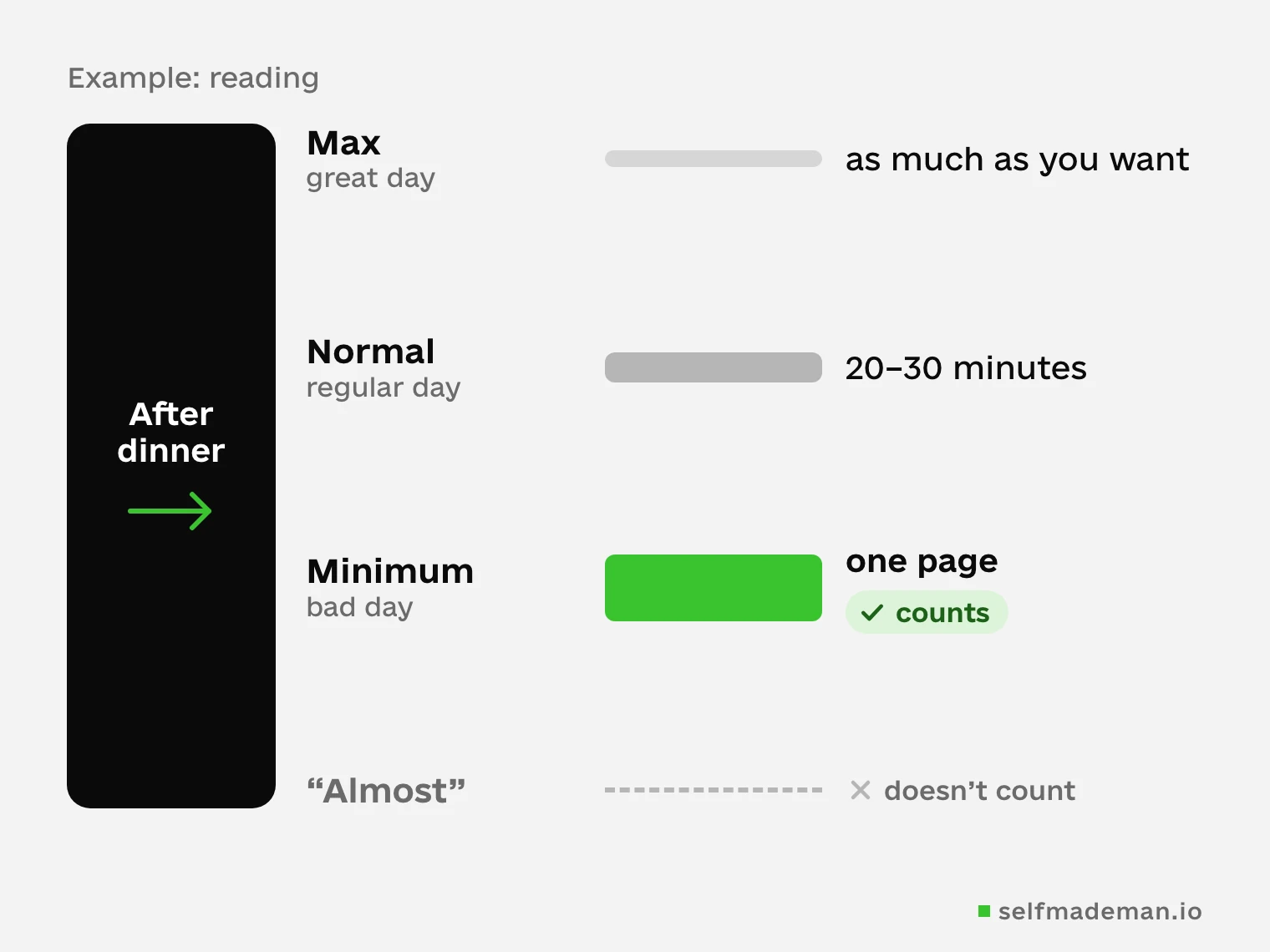
- Every goal gets three bars: max, normal, minimum.
- The minimum is a 2–5 minute action you can really do on your worst day.
- The minimum counts. “Almost” doesn’t.
- One to three commitments at a time. Not ten.
- If “no energy for anything” lasts for weeks, the problem may not be discipline.
Table of contents
What self-discipline really is
The usual picture: a disciplined person beats laziness every single day, and everyone else just lacks willpower. Research paints a different picture.
People with high self-control resist less often. In a study by Wilhelm Hofmann, 205 adults got prompts on their phones for a week and reported what they wanted right then and whether they were trying to resist it. That added up to 7,827 reports2. People with high self-control reported fewer daily conflicts between their desires and their goals3 and less often tried to suppress a temptation1.
Habits do the heavy lifting. Brian Galla and Angela Duckworth ran six studies with 2,274 participants. People with high self-control more often had stable habits — exercise, healthy snacking, consistent sleep, studying. Those habits largely explained why self-control is linked to good outcomes, all the way down to school grades and whether students stayed in college after their first year1.
What matters is how often you’re tempted, not how heroically you hold out. 159 students spent a week logging temptations and the effort they spent resisting them. Later, the researchers checked who had made progress on their goals. The ones who progressed were the ones tempted less often. How much effort people put into resisting wasn’t linked to success4.
“Willpower as a battery” is in doubt. The idea that self-control gets used up like a charge was a popular theory. Two large preregistered tests didn’t confirm it: 23 labs and 2,141 participants found an effect close to zero5, and 36 labs and 3,531 participants found a non-significant effect6. The debate goes on, but building a system on your “willpower charge” is clearly a bad bet.
Discipline isn’t beating yourself every day. Discipline is a day where you don’t have to.
My experience
Two rules on my list read almost like the definition of this article. “Every day — a small action toward a long-term asset.” And “Build a system, not just bursts.” The word “small” is there on purpose: I don’t promise myself something big every day. I promise that every day there’ll be at least something.
Next to them is a rule that came later: don’t plan the day as if I had unlimited energy. And one of my more recent affirmations: I don’t have to do everything today; I have to move honestly and consistently. To me, that’s discipline without motivation. Not “squeeze out the max at any cost,” but don’t drop out of motion.
My minimums are written right into my rules. Reading: more than 5 minutes a day, no exceptions. Not a chapter, not an hour — five minutes. But to be honest, it doesn’t hold everywhere. I skip meditation, and getting myself to do morning exercise and workouts is really hard.
How to be more disciplined: a minimum-commitment system in 6 steps
- Pick one to three goals. Not everything you want to change — just what matters for the next few months. More than three commitments, and the minimum stops being a minimum.
- Turn each goal into an action. “Learn Spanish” isn’t an action. “One lesson in the app” is. A commitment is always something you can do and check off today.
- Set three bars. Max — for a great day. Normal — for a regular day. Minimum — what you’ll do even when you’re sick, drained or traveling: 2–5 minutes, no prep. BJ Fogg built a whole method on the same idea: start with a version so small it doesn’t need motivation7.
- Tie it to a trigger. “After I [something that happens every day], I do [the minimum or more].” These if-then plans noticeably raise the odds of following through: in a meta-analysis of 94 experiments, the effect was medium to large8.
- Agree on honest tracking. The minimum counts as done — that’s the main rule of the system. “Almost done,” on the other hand, doesn’t count at all. Three marks work well: full, minimum, skipped. More on this in the habit tracker.
- Once a week — a five-minute review. How many days were minimum, how many normal? If it’s been the minimum every day for two weeks straight, the reason isn’t laziness. The normal bar is too high, or the trigger is wrong, or something in your life needs attention.
Examples: full and minimum versions
| Goal | Normal | Minimum for a bad day |
|---|---|---|
| Read every day | 20–30 minutes of a book | One page |
| Morning workout | A 10-minute routine | One exercise, two minutes |
| Your own project | An hour of deep work | Open the file and write one line |
| A new language | A 20-minute lesson | Five words in the app |
| Money | Review the week’s spending | Log today’s spending |
| Tidiness | Clean up your workspace | Clear one thing off your desk |
The minimum looks ridiculous. That’s its strength: something ridiculously small can’t be put off “until I have the energy.” And once you start, you often do more. Often — not always, and that’s fine.
Minimum version calculator
-
1Goal and action. Not everything you want to change, but what matters for the next few months. Then turn it into an action you can do and mark today: “Learn English” is not an action, “a lesson in the app” is.Take a row from the table above and adjust it to yourself:
-
2Three levels. The maximum is for a great day, the norm for an ordinary one. The minimum is what you will do even when you are ill, exhausted or on the road: 2–5 minutes, no preparation.
- Open open the file and write one line
- One unit one page, one exercise, five words
- First step write down today’s spending, put away one thing from the desk
How many minutes does the minimum take?The minimum seems ridiculous. That is its strength: something ridiculously small can’t be put off “until I have the energy”.
-
3Trigger. After an action that happens every day, you do the minimum or more. The minimum needs a trigger too.
The tracker has the same three marks: done, minimum, skip. Each commitment goes there with its trigger and minimum.
Everything stays in this browser.
Discipline vs. motivation
They’re not rivals. Motivation is good for getting started and choosing a direction. The only problem is building your daily action on it. Motivation depends on sleep, the weather, the news and how your last client call went. A commitment doesn’t — it was made in advance, in a calm state.
And one more thing: discipline isn’t harshness. My rule “in the evening, recover; don’t push through tasks at any cost” sits on the same list as “every day — a small action.” One doesn’t work without the other: without rest, a system falls apart just as reliably as without action.
Where it breaks
- The minimum becomes the ceiling. A month of nothing but minimums is a signal, not a success. Figure out what’s blocking the normal bar.
- A minimum without a trigger. “I’ll do one page sometime today” turns into “I’ll do two tomorrow.” The minimum needs to be tied to an action too.
- Ten commitments. Ten minimums aren’t a minimum anymore — they’re a full workday.
- Discipline as punishment. “Missed it, so tomorrow it’s double” is a straight road to quitting. The system has no debts.
- Fighting instead of designing. If every evening you heroically don’t open social media, it’s easier to take your phone out of the room.
- It’s not about discipline. If “no energy for anything” lasts for weeks and that’s new for you, the cause may be your health, exhaustion or mood. Pushing yourself harder won’t help here — talk to a doctor or a therapist.
Minimum version
One goal. One two-minute minimum action. One trigger. Done — checked off.
If you slip
Missed a day? Do the minimum today. Don’t make up for yesterday, and don’t wait for Monday. A minimum-commitment system exists precisely so it’s easy to come back to: the bar is already on the floor.
FAQ
How do I build discipline when I have no motivation?
Don’t wait for motivation. Give each goal a 2–5 minute minimum action, tie it to a daily trigger and count the minimum as done. Motivation often shows up once you’re moving, but the system doesn’t depend on it.
Which matters more: discipline or motivation?
For daily action, discipline — in the form of decisions made in advance and habits. Motivation helps you pick a direction and get started, but it’s too changeable to carry every day.
How do I train myself to be disciplined?
Rely less on in-the-moment willpower and more on habits and your environment. Research shows that people with high self-control face temptation less often and lean more on stable habits.
What are the steps to self-discipline?
There’s no official list of “5 steps” or “7 pillars” with research behind it. The system above has six: pick one to three goals, turn them into actions, set three bars, tie them to a trigger, track honestly and review weekly.
Can you train willpower?
The popular idea that willpower runs down like a battery and can be “leveled up” didn’t hold up clearly in large-scale tests. Building habits and removing temptations from your environment is more reliable.
What is a minimum version of a habit?
A 2–5 minute action you’ll do even on your worst day: one page instead of a chapter, one exercise instead of a whole routine. It keeps the “trigger → action” link alive until you have energy for more.
How many commitments should I take on at once?
One to three. More than that, and even the minimum versions start eating up half your day.
Do this today
Take one goal you’ve been putting off for a while. Write three lines: max, normal, minimum. The minimum should take no more than five minutes. Add an “after I…” trigger and do the minimum today. 10 minutes.
Sources
- Galla B. M., Duckworth A. L. More than resisting temptation: Beneficial habits mediate the relationship between self-control and positive life outcomes. Journal of Personality and Social Psychology, 2015, 109(3): 508–525. ↩
- Hofmann W., Baumeister R. F., Förster G., Vohs K. D. Everyday temptations: An experience sampling study of desire, conflict, and self-control. Journal of Personality and Social Psychology, 2012, 102(6): 1318–1335. ↩
- Desire Dilemmas. Chicago Booth Review — a summary of Hofmann et al. 2012. ↩
- Milyavskaya M., Inzlicht M. What’s so great about self-control? Examining the importance of effortful self-control and temptation in predicting real-life depletion and goal attainment. Social Psychological and Personality Science, 2017, 8(6): 603–611. ↩
- Hagger M. S., Chatzisarantis N. L. D. et al. A Multilab Preregistered Replication of the Ego-Depletion Effect. Perspectives on Psychological Science, 2016, 11(4): 546–573. ↩
- Vohs K. D., Schmeichel B. J. et al. A Multisite Preregistered Paradigmatic Test of the Ego-Depletion Effect. Psychological Science, 2021, 32(10): 1566–1581. ↩
- Fogg B. J. Tiny Habits: The Small Changes That Change Everything. Houghton Mifflin Harcourt, 2020 (ISBN 9780358003328). ↩
- Gollwitzer P. M., Sheeran P. Implementation intentions and goal achievement: A meta-analysis of effects and processes. Advances in Experimental Social Psychology, 2006, 38: 69–119. ↩