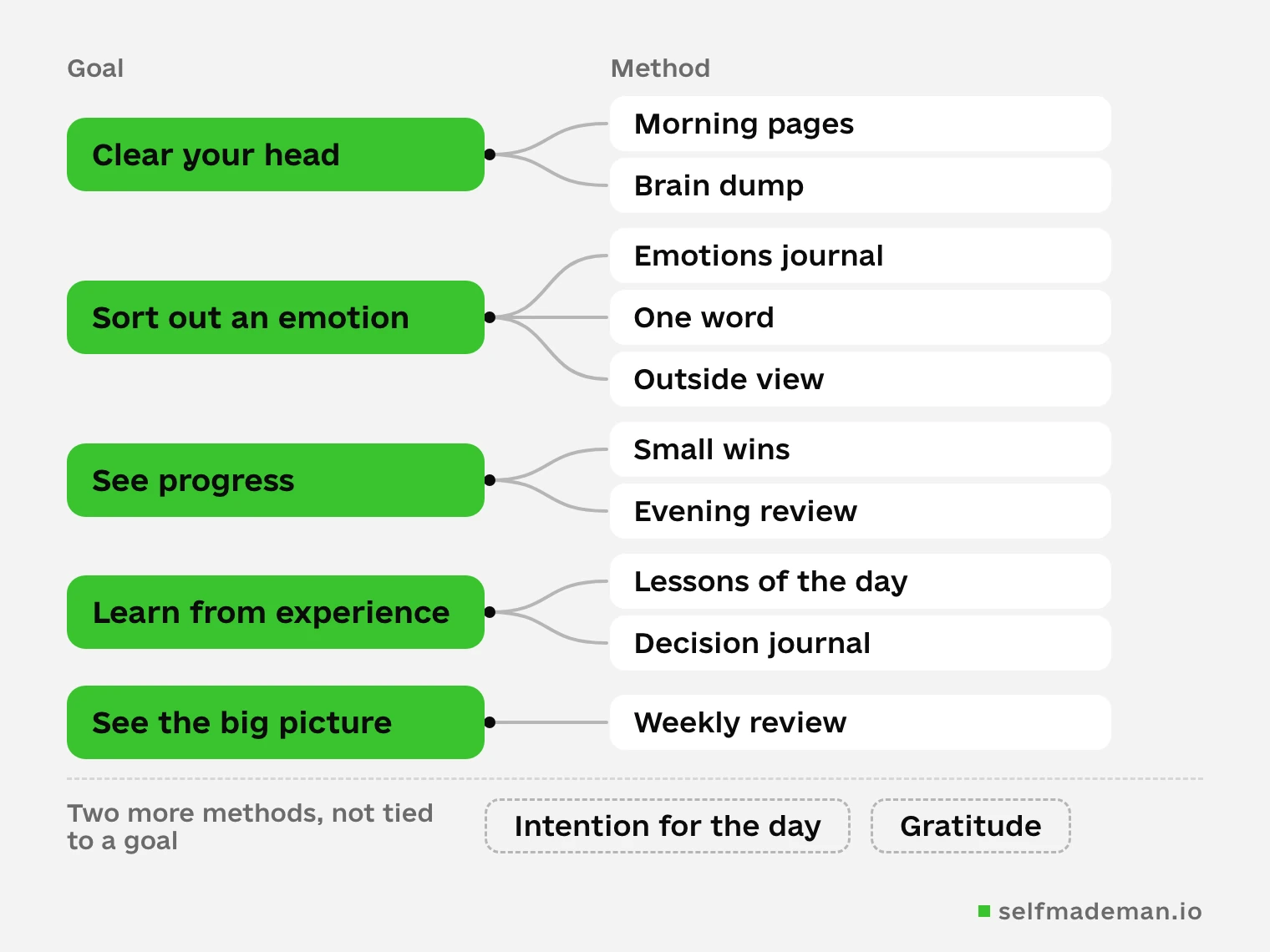
Journaling prompts are questions that get you writing when the page is blank. For self-improvement, they work best tied to a specific job: clear your head, sort out an emotion, see your progress, learn from a decision. Here’s how to make journaling stick: pick one method for your goal, write for 5–15 minutes at the same time each day, and reread once a week. Below are 12 types of journaling — from morning pages to a decision journal — with prompts for each. Your journal doesn’t have to be pretty. It has to be honest.
This is my experience plus what’s known from research. Journaling helps you understand yourself, but it doesn’t treat anything. If heavy thoughts don’t let go for weeks, or you’re writing about trauma and it makes you feel worse, talk to a professional.
- One method for one goal. Not all 12 at once.
- 5–15 minutes, a fixed time, tied to something you already do.
- Write without censoring yourself and without fixing spelling. Nobody’s publishing this.
- Reread once a week: the value of a journal is in the conclusions, not the word count.
- In research, the effect of writing about feelings is real but small.
Table of contents
- My experience
- Benefits of journaling: what research says
- How to start journaling: 5 rules
- Types of journaling: 12 methods and prompts for each
- Journal prompts for self-discovery and growth
- Daily journal prompt and templates
- Where it breaks down
- The minimum version
- If you’ve dropped it
- FAQ
- Your action for today
- Sources
My experience
One of my rules goes like this: “Emotions go into the journal, not into conversations.” It’s not about hiding feelings. It’s about order. First, anger, resentment, or anxiety go onto the page. Then, once they’re named and sorted out, you can talk. Next to it is another rule: talk from a place of calm, not from anxiety or fatigue. The journal is what helps me get to that calm.
The second thing I do in writing is dump everything that’s overloading my head. My rule is: don’t keep tasks in your head if you can write them down. Tasks go into the system, worries go into the journal. Don’t mix them.
And third. My roles, values, rules, gratitude lists — those are writing too. You can see in them how I’ve changed. For example, my rule “in bed by 1:00 a.m.” eventually became “asleep by 11:00 p.m.”
The journal itself lives in an app, and I write in it every day.
Benefits of journaling: what research says
Writing about difficult experiences. The classic study is an experiment by James Pennebaker and Sandra Beall (1986). Forty-six students wrote for four days in a row, either about a hard event from their lives or about something neutral. Those who wrote about both the facts and their feelings felt worse right after writing: higher blood pressure, worse mood. But over the next six months, they visited the campus health center less often1. The authors called the results preliminary.
What dozens of replications showed. Joanne Frattaroli pooled 146 randomized studies of this kind of expressive writing. The effect held up, but it was small: an average r of 0.0752. Not a miracle method — a modest but real benefit.
Naming the feeling. In an experiment by Matthew Lieberman and colleagues, people looked at unpleasant photos. When they picked a word for the emotion, the response in the amygdala — the brain area linked to anxiety and fear — was weaker than during other tasks3. It’s a lab effect, but it explains well why “wrote it down and it let go.”
Reflection at work. In a field experiment by Giada Di Stefano, Francesca Gino, and colleagues, new call center employees spent 15 minutes at the end of the day writing about what they’d learned. On the final training test, they did about 23% better than those who didn’t4. It’s a working paper, not a journal publication — keep that in mind.
Bottom line: a journal doesn’t change your life by itself. It helps you notice it.
How to start journaling: 5 rules
- One goal, one method. Want to snap at people less? Emotions journal. Want to see progress? Small wins. You don’t need all twelve.
- A time and an anchor. Tie writing to something you already do every day: after your morning coffee, before bed, after your last work call.
- Keep it short. 5–15 minutes. If you write for an hour, you’ll quit within a week.
- No censoring. Don’t edit, don’t reread as you go, don’t think about style. If you’re worried someone will read it, keep it where they can’t, or throw the pages away.
- Reread once a week. What keeps coming up? What have you been writing about for three weeks straight? That’s your raw material for decisions.
Types of journaling: 12 methods and prompts for each
| Method | What for | When | Time |
|---|---|---|---|
| 1. Morning pages | Clear your head | Morning | 15–30 min |
| 2. Intention for the day | Set a direction | Morning | 3 min |
| 3. Evening review | Close out the day | Evening | 5 min |
| 4. Emotions journal | Work through a strong feeling | As needed | 10–15 min |
| 5. One word | Name the feeling | Several times a day | 30 sec |
| 6. Outside view | Cool down and see the situation | As needed | 10 min |
| 7. Decision journal | Learn from your decisions | When deciding, and 3–6 months later | 10 min |
| 8. Small wins | See progress | Evening | 3 min |
| 9. Lessons of the day | Learn from experience | End of the workday | 10–15 min |
| 10. Brain dump | Free up attention | When overloaded | 10 min |
| 11. Gratitude | Notice the good | 1–3 times a week | 5 min |
| 12. Weekly review | See the big picture | Once a week | 20–30 min |
1. Morning pages
Julia Cameron’s method from *The Artist’s Way* (1992): three handwritten pages right after you wake up, whatever comes to mind, without stopping5. Nobody reads them, not even you — at least for the first few weeks. Good for when there’s noise in your head that keeps you from starting the day.
2. Intention for the day: morning journal prompts
- What matters most today — one or two things?
- How do I want to show up today, at work and with people?
- What could get in the way, and what will I do if it does?
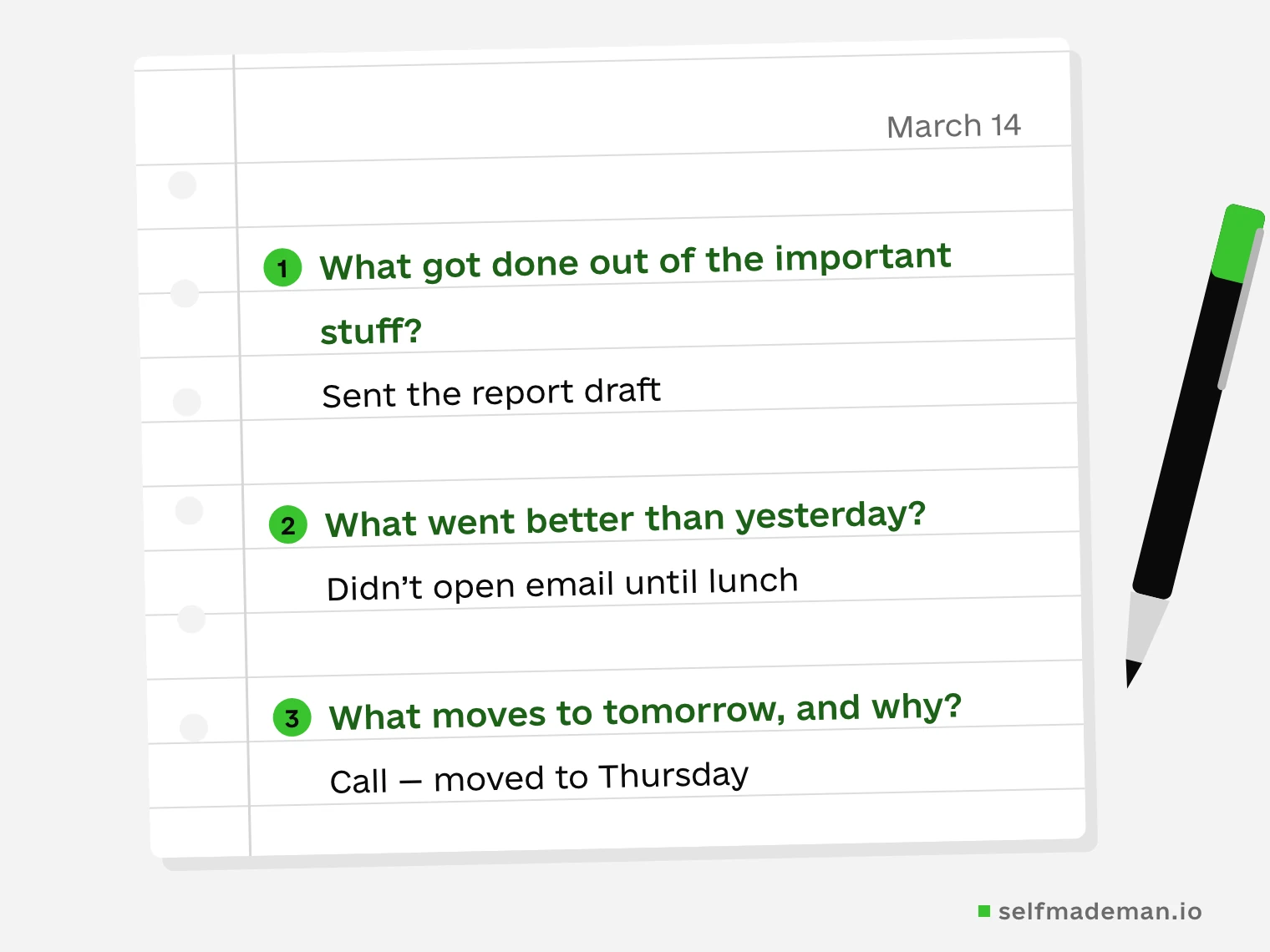
3. Evening review: evening journal prompts
- What got done out of the important stuff?
- What went better today than yesterday?
- What am I moving to tomorrow, and why?
4. Emotions journal (expressive writing)
Pennebaker’s method in an everyday version. When something hits you hard, write for 10–15 minutes about what happened and what you feel. Not to send, not to say out loud.
- What happened — just the facts?
- What am I feeling? Where is it in my body?
- What matters to me here? Which of my needs got stepped on?
- What do I want to do — and which of those things won’t I be ashamed of later?
5. One word
The shortest version. Several times a day, one or two words for what you’re feeling right now: “irritated,” “anxious before the call,” “calm.” It works on the same mechanism as Lieberman’s experiment: a named feeling has less control over you.
6. Outside view
Write about the situation in the third person, using your name: “[Your name] is angry because…” In studies by Ethan Kross and colleagues, people who thought about themselves in the third person or by name found it easier to step back from the situation and did better on stressful tasks, like giving a public speech6. Helps when you’re too far inside it.
- What does someone watching this situation from the outside see?
- What would I tell a friend in this spot?
7. Decision journal
You write down an important decision at the moment you make it, and a few months later you check it against what happened. That shows you where the decision itself was wrong and where you just had bad luck.
- What am I deciding, and what are the options on the table?
- Why this choice? What do I expect in 3 and 6 months?
- What doubts do I have right now?
8. Small wins
Teresa Amabile and Steven Kramer analyzed about 12,000 diary entries from 238 employees. What lifted people’s mood at work most was a sense of progress, even small progress7. Write down one to three things that moved forward today.
- What moved forward today, even by one step?
- What did I get done even though I didn’t feel like it?
9. Lessons of the day: self-reflection journal prompts
A version of the Di Stefano experiment. At the end of the workday, 10–15 minutes:
- What worked today, and why?
- What will I do differently next time?
- What’s the one lesson I’m taking from today?
10. Brain dump
You write out everything spinning in your head: tasks, ideas, worries. Then tasks go to your to-do list and worries go to the emotions journal. The method is covered in detail in the article on the brain dump.
11. Gratitude
A few specific points about what you’re grateful for and why. This method is different enough from the rest to get its own article: how to keep a gratitude journal so it doesn’t turn into an empty ritual.
12. Weekly review
Once a week, reread your entries and answer:
- What kept coming up in my entries all week?
- What did I learn about myself?
- What’s one thing I’ll change next week?
Once a year, this review becomes a year in review.
Journal prompts for self-discovery and growth
If you don’t know where to start, take one prompt and write for 10 minutes.
About yourself – What do I do when nobody’s watching or judging? – Which of my qualities have I been underrating lately? – What am I avoiding — and what is it costing me?
About goals and direction – If everything goes well a year from now, what will be different? – What one action this week will move me closer to what matters most? – What am I willing to give up for my goal?
About work – When this week was I truly absorbed in a task? – What work do I do out of habit that I could delegate or automate? – What new thing have I learned in the past month?
About people – Who leaves me with more energy after we meet, and who with less? – Who have I been meaning to thank for a while? – Where was my “yes” actually a “no”?
About fears and doubts – What exactly am I afraid of in this situation? – What’s the worst that could happen, and what would I do then? – What decision am I putting off, and why?
Daily journal prompt and templates
This is an example from the article. Your entries are not touched, and changes here are not saved.
Reread the week: what repeats? What have you been writing for the third week in a row? That is the material for decisions.
If paper is closer to you, print the templates of the methods you need. One task, one method: twelve at once are not needed.
Entries stay in this browser only: nothing is sent anywhere. If someone else uses this device, download the entries and delete them here.
Where it breaks down
- Ruminating instead of processing. If you’ve been writing the same thing for three weeks and it’s only getting worse, the journal has turned into a loop. Switch methods: move from “what am I feeling” to “what will I do,” or to the outside view.
- Heavy topics. Writing about trauma can make you feel worse at first — you can see it even in Pennebaker’s first experiment. If you consistently feel worse after writing, stop and talk to a professional.
- Journaling instead of acting. Writing down a problem doesn’t solve it. Every weekly review should end with one action.
- The pretty journal. Stickers, fonts, perfect handwriting — and a week later you’re afraid to ruin the notebook. Perfectionism kills journals the same way it kills any other work.
- Privacy. If you’re afraid someone will read your entries, you’ll start censoring yourself. Keep the journal somewhere only you can get to, or destroy the pages after writing — it doesn’t matter for the benefits of writing.
The minimum version
One line before bed: “Today the main thing was… I feel…” Thirty seconds. On a bad day, that’s enough.
If you’ve dropped it
Don’t fill in the missed days, and don’t start a new “proper” notebook. Open the same one, write today’s date and one line. Missing a week doesn’t break anything: a journal isn’t a streak you have to protect, it’s a tool that sits within reach.
FAQ
How do I start journaling as a beginner?
Pick one method for your goal, like an evening review with three prompts. Write for 5 minutes at the same time each day. After a week, read it all back.
What do you write in a self-improvement journal?
What mattered today, what you’re feeling, what decisions you made, and what you learned. If your mind is blank, take one prompt from the list above.
What are good journal prompts for tracking progress?
“What moved forward today, even by one step?”, “What did I get done even though I didn’t feel like it?”, and once a week, “What’s one thing I’ll change next week?” That’s the small wins method plus the weekly review.
How long should I journal each day?
5–15 minutes. In Pennebaker’s classic experiment, people wrote for about 15 minutes four days in a row1.
Paper or an app?
Whichever you’ll actually open. Paper is slower and less distracting; an app is always at hand. I haven’t found research that clearly shows one is better.
What is journaling?
Keeping a journal regularly with a specific purpose: to work through emotions, plan your day, see your progress. Not a diary of events, but a tool for thinking.
Does journaling help with anxiety?
Writing about difficult experiences has a small but real effect, on average, across many studies. It’s not treatment. If anxiety gets in the way of your life, journaling is an addition to working with a professional, not a replacement.
Your action for today
Tonight, grab a sheet of paper or your notes app and answer three questions: what got done out of the important stuff, what went better than yesterday, what am I moving to tomorrow. Five minutes. Tomorrow, the same thing at the same time.
Sources
- Pennebaker J. W., Beall S. K. Confronting a traumatic event: Toward an understanding of inhibition and disease. Journal of Abnormal Psychology, 1986, 95(3), 274–281. ↩
- Frattaroli J. Experimental disclosure and its moderators: A meta-analysis. Psychological Bulletin, 2006, 132(6), 823–865. ↩
- Lieberman M. D., Eisenberger N. I., Crockett M. J., Tom S. M., Pfeifer J. H., Way B. M. Putting feelings into words: Affect labeling disrupts amygdala activity in response to affective stimuli. Psychological Science, 2007, 18(5), 421–428. ↩
- Di Stefano G., Gino F., Pisano G. P., Staats B. R. Learning by Thinking: How Reflection Aids Performance. Harvard Business School Working Paper 14-093, 2014. ↩
- Cameron J. The Artist’s Way: A Spiritual Path to Higher Creativity. Jeremy P. Tarcher/Putnam, 1992. ↩
- Kross E., Bruehlman-Senecal E., Park J. et al. Self-talk as a regulatory mechanism: How you do it matters. Journal of Personality and Social Psychology, 2014, 106(2), 304–324. ↩
- Amabile T. M., Kramer S. J. The Power of Small Wins. Harvard Business Review, May 2011. ↩