A brain dump is getting everything that’s swirling in your head onto paper or into a note in one sitting. Tasks, promises, ideas, errands, worries — all of it, unsorted, in 10–15 minutes. But the list is only half the job. The other half is sorting it: what to do, what to put on a date, what to hand off, what to cross out. Skip the second step and your brain dump turns into one more long list you have to keep in your head.
- Dump everything first, sort second. Not at the same time.
- Your brain can’t hold more than a few things at once. A list can hold as many as you like.
- Writing it down isn’t what clears your head. A plan does: every task needs a date or a next step.
- Everything moves into one system: a calendar and a to-do list. Once the sheet is sorted, you can toss it.
- A full brain dump once a week. A quick one in the evening, 5 minutes.
Table of contents
What is a brain dump, and why bother?
The meaning is right in the name: you dump out of your head everything that needs your attention. In David Allen’s Getting Things Done, the same step is called capture: everything that’s hanging over you goes into one place so you can process it later1. In interviews, Allen likes to repeat the idea that became his calling card: your mind is for having ideas, not for holding them.
Two facts explain why it works.
Working memory is small. After pulling together a large body of experiments, psychologist Nelson Cowan put its capacity at about four chunks of meaning2. Four. Meanwhile, most of us have dozens of things open in our heads.
Unfinished tasks pull at your attention, but you can let them go. E. J. Masicampo and Roy Baumeister showed that an unfinished goal keeps popping into your thoughts and gets in the way of other work. But the effect disappeared once participants made a specific plan: when, where, and how they would do it3. The key word is plan, not just writing it down.
That’s the core idea of this article. A brain dump clears your head only when every task gets a next step or a date.
You may have heard that unfinished tasks are “remembered better” — the Zeigarnik effect. A 2025 meta-analysis didn’t back that up: interrupted tasks show no general memory advantage. What did hold up is something else — the urge to go back to an unfinished task4. The practical takeaway is the same: open loops keep pulling. Close them with a plan.
My experience
Two of my rules: “Whatever overloads my head goes into the system” and “Don’t keep tasks in my head if I can write them down.” A third tells me where exactly: anything I’m not doing today lives in my calendar or my backlog.
For me this isn’t about being tidy. It’s about calm. A task in your head keeps going off like a notification you never turned off. A task in the system stays quiet until its date.
Your head is for thinking. The system is for storage.
One more rule helps me keep things separate: “Emotions go in the journal, not into conversations.” When you brain dump, worries and feelings end up on the page too. That’s normal. But they belong in a separate note, not on your to-do list.
The backlog itself lives in LifeBoard, next to my rules and goals. The important stuff from a dump gets a date on the calendar; everything else goes there.
How to do a brain dump: 7 steps
- Pick one place. One sheet of paper or one new note. Not three apps at once.
- Set a timer for 10–15 minutes. The limit keeps you from getting stuck and from turning the dump into planning.
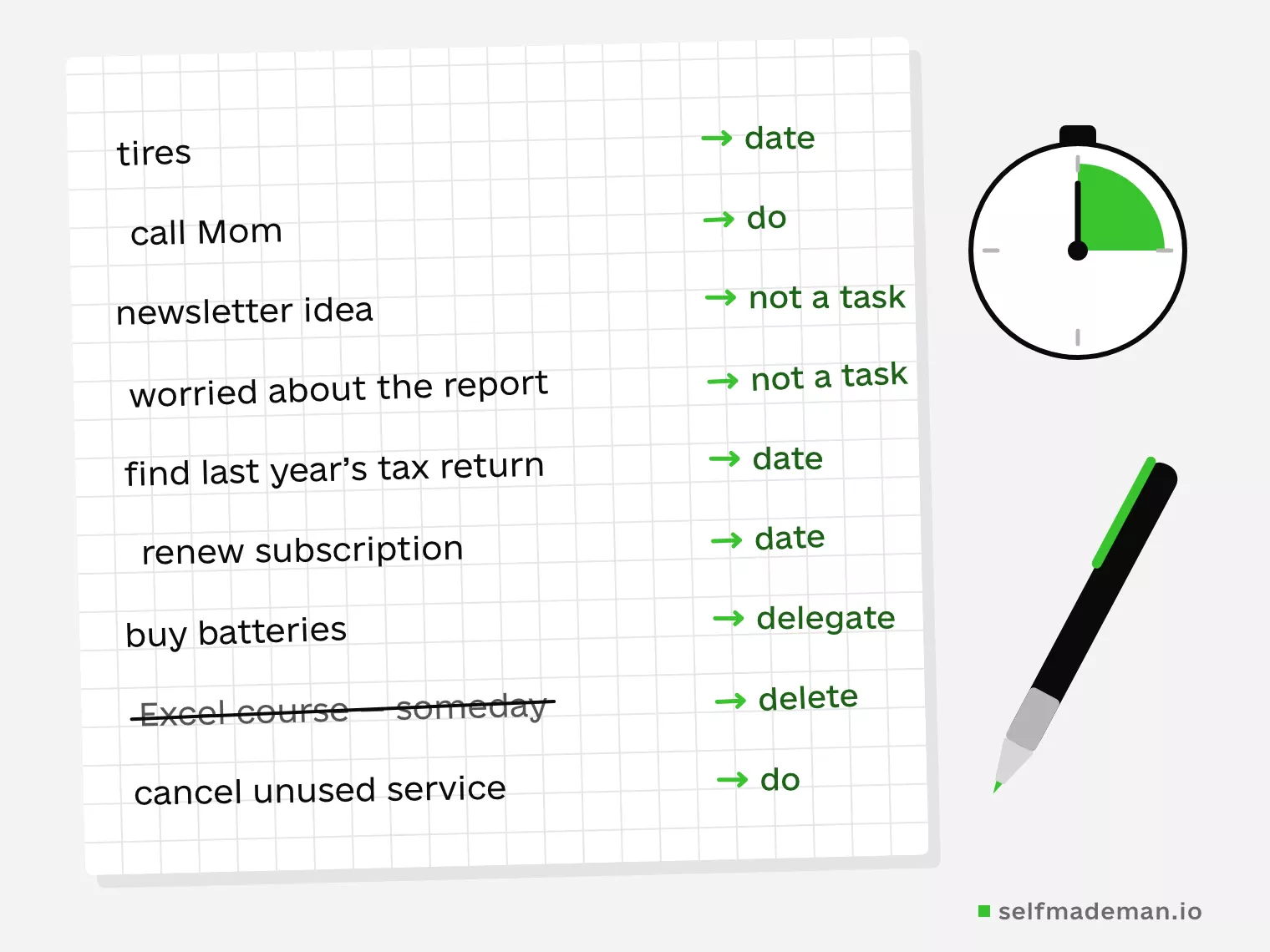
- Write down everything. One thought per line. Don’t sort, don’t judge, don’t polish. “Tires,” “call Mom,” “newsletter idea,” “worried about the report” — all fine.
- Run through the prompts. When you run dry, check the areas in the list below. Almost always another 10–20 items show up.
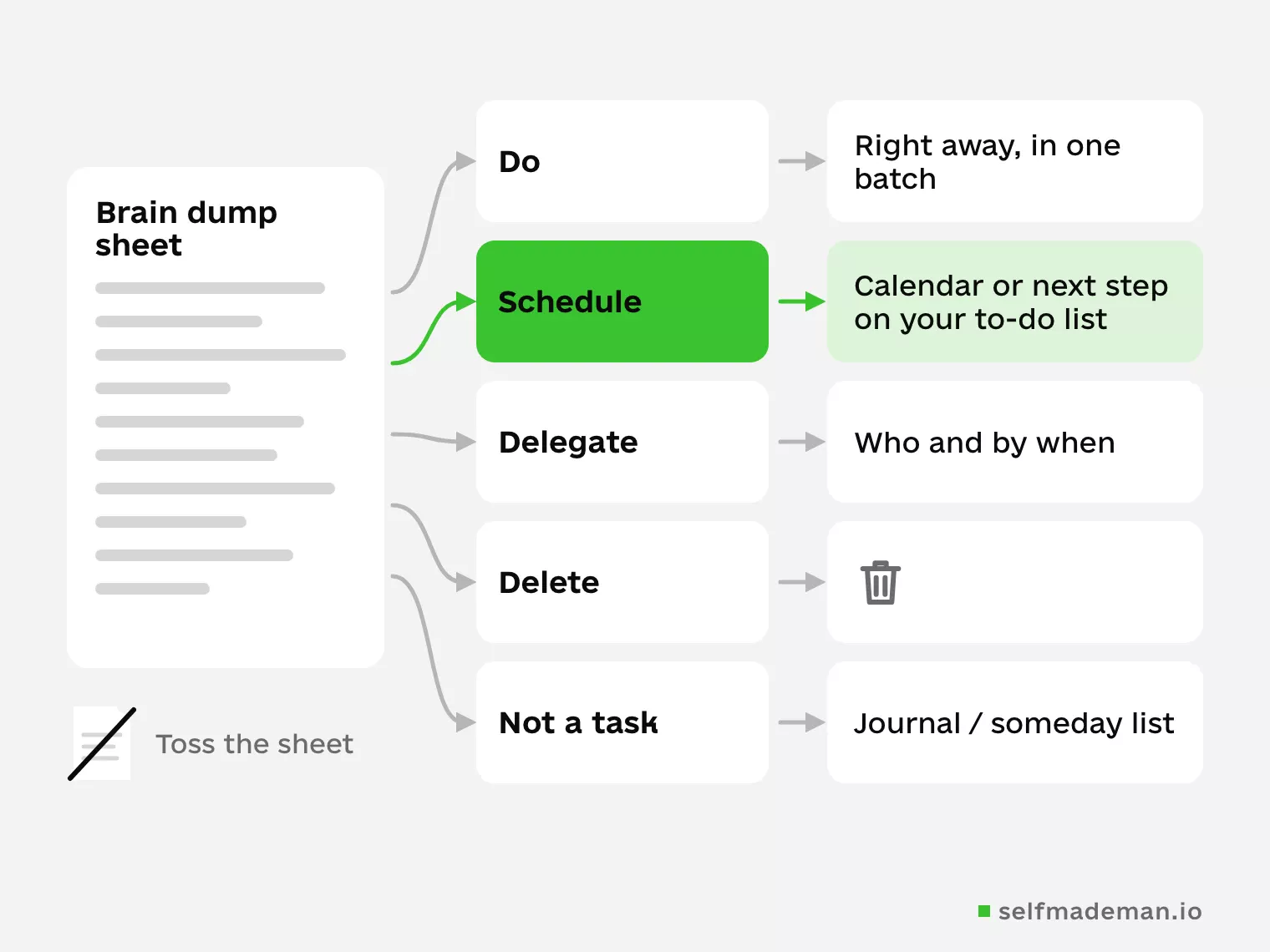
- Sort every line into one of five piles. Do, schedule, delegate, delete, not a task. Details in the table below.
- Give everything left a plan. Every task gets a date in your calendar or a concrete next step. Skip this and your head keeps holding on to it.
- Move it into your system and toss the sheet. Calendar for anything with a date, to-do list for the rest. A sheet left lying on your desk isn’t a brain dump anymore — it’s one more place to store things.
Brain dump ideas: prompts so nothing slips
- Work: projects, promises to coworkers and clients, unanswered emails, reports, meetings, things to learn.
- Home: repairs, shopping, paperwork, bills, appliances, car.
- People: who to call, who to congratulate, what you promised to whom.
- Money: payments, taxes, subscriptions, refunds.
- Health: doctor visits, lab tests, exercise, medications.
- Kids and family: school, activities, trips, conversations you’ve been meaning to have.
- Ideas and “someday”: books, courses, trips, projects.
- What’s bugging you: anything that isn’t a task but keeps circling in your head.
How to sort the list: five piles
| Pile | What goes here | What to do with it |
|---|---|---|
| Do | 2–5 minute tasks | Do them right after sorting, in one batch |
| Schedule | Anything that takes real time | A date and time in your calendar, or a next step on your to-do list |
| Delegate | Things someone else can do | Write down who and by when, then send it |
| Delete | Things that lost their point, “should probably” with no reason | Cross them out, no regrets |
| Not a task | Worries, ideas, observations | Worries go in a journal, ideas go on a separate “someday” list |
If the “schedule” pile gets too big, sort it by importance and urgency with the Eisenhower matrix. And to spread tasks across specific days without overloading them, use a realistic daily plan with some slack built in.
Do a brain dump right now
Enter adds a line. You can paste a whole list: every line becomes a separate item.
- Do Tasks for 2–5 minutes: do them right after sorting, in one batch
- Schedule Everything that takes time: a date in the calendar or the next step in the to-do list
- Hand over What someone else can do: to whom and by when
- Delete Lost its meaning, “I should” without a reason: cross it out without regret
- Not a task Worries go to the journal, ideas to the “someday” list
Move everything into one system: the calendar for dated tasks, the to-do list for the rest. After that the sheet can go.
The blank worksheet is one A4 page with the area prompts and five piles: for paper and a pen. In the print dialog choose “Save as PDF”.
A full dump once a week, a short one in the evening for 5 minutes. 15 minutes is the ceiling: a daily hour-long dump is another way not to start. The list stays in this browser.
You can paste a ready-made list from your notes — it will split into lines. If you’d rather use paper, print a blank brain dump template with the prompts and piles: the steps above work for it too.
A brain dump before bed
A short evening brain dump is a handy trick of its own. In an experiment by Michael Scullin and colleagues, 57 young adults with no sleep problems spent five minutes before lights-out writing either a to-do list for the next few days or a list of things they’d already done. The to-do list group fell asleep faster — about 15 minutes versus 25, according to a summary of the study. And the more detailed the list, the faster sleep came5.
The honest limits: one night, a sleep lab, healthy students. This is not a treatment for insomnia. But as a 5-minute evening habit, it’s a cheap experiment.
Where it breaks
- Dumping without sorting. A list of 60 items with no dates is scarier than the chaos in your head. Sorting is a must, even if it happens the next day.
- Three systems at once. Some tasks in a notebook, some in a “note to self” chat, some in an app. Now your head has to remember where everything is. One system for tasks and a calendar for dates is enough.
- Tasks with no next step. “Deal with taxes” isn’t a task, it’s a topic. A task is “find last year’s tax return, Monday, 15 minutes.”
- Dumping instead of doing. An hour-long, beautifully formatted daily brain dump is just another way not to start. 15 minutes is the ceiling.
- Worries on your to-do list. You can’t check off “I’m afraid the project will fail.” Keep feelings separate from tasks, or the list will weigh on you.
- No routine. A brain dump twice a year takes the pressure off for a week. For your head to stop holding tasks, you need a habit.
The minimum version
Bad day, head buzzing — three minutes. Write down everything that’s bugging you right now, and next to each line put one word: “today,” “date,” or “drop.” For “date,” open your calendar and set it right away. That’s it.
If you’ve stopped doing it
The list has grown wild, and the system has moved back into your head. Don’t start with a perfect cleanup of everything. Do one full 15-minute brain dump and sort only the “schedule” pile. The rest can wait. To make the evening dump stick, log it in a habit tracker — the minimum check, “wrote down at least three lines,” counts.
FAQ
What is a brain dump?
Getting every thought and task out of your head and onto paper in one sitting, then sorting it: what to do, what to schedule, what to delegate, what to delete.
What does “brain dump” mean in slang?
Outside productivity, people use it for unloading everything you know about a topic in one go — say, writing down all the formulas right before an exam starts. Same idea: get it out of your head and onto paper.
How do you do a daily brain dump?
Keep it short: 5 minutes in the evening. Write down whatever’s on your mind, give each line a date or a next step, and move tomorrow’s tasks into your plan. Save the full brain dump for once a week or whenever you feel overloaded.
How is a brain dump different from a to-do list?
A to-do list is tasks that are already sorted. A brain dump is raw material: tasks mixed with ideas and worries. Your actual to-do list comes out of it.
Should I brain dump on paper or in an app?
Wherever you write faster. Paper is great for the dump itself; an app and a calendar are better for storage after sorting. What matters is that everything ends up in one system.
Is a brain dump the same as journaling?
No. Journaling is about thoughts and feelings; a brain dump is about clearing your head of tasks. But feelings do come up during a dump, so it helps to keep a separate journal for them.
Does a brain dump help you fall asleep?
In one lab study, writing a to-do list before bed helped healthy young adults fall asleep faster. It’s not a treatment for insomnia: if you have regular sleep problems, talk to a doctor.
Your action for today
Start the brain dump above for 10 minutes and write down everything that’s hanging over you right now. Then tag each line with one word: “do,” “date,” “delegate,” “delete.” Move three “date” tasks into your calendar right away.
Sources
- Allen D. Getting Things Done: The Art of Stress-Free Productivity. Viking, 2001. ↩
- Cowan N. The magical number 4 in short-term memory: A reconsideration of mental storage capacity. Behavioral and Brain Sciences, 2001, 24(1), 87–114. ↩
- Masicampo E. J., Baumeister R. F. Consider it done! Plan making can eliminate the cognitive effects of unfulfilled goals. Journal of Personality and Social Psychology, 2011, 101(4), 667–683. ↩
- Ghibellini R., Meier B. Interruption, recall and resumption: a meta-analysis of the Zeigarnik and Ovsiankina effects. Humanities and Social Sciences Communications, 2025, 12. ↩
- Scullin M. K., Krueger M. L., Ballard H. K., Pruett N., Bliwise D. L. The effects of bedtime writing on difficulty falling asleep: A polysomnographic study comparing to-do lists and completed activity lists. Journal of Experimental Psychology: General, 2018, 147(1), 139–146. The 15 and 25 minute figures are from the BPS Research Digest summary of the study. ↩