How to say no without over-explaining: say it in your first sentence, give one reason or none, and offer an alternative if you want to. That’s it. A long explanation doesn’t soften a no. It turns it into a negotiation. You’ll still feel guilty afterward, especially the first few times. But the guilt is almost always bigger than the real fallout: people noticeably overestimate how much their no will upset the other person1.
- “No” goes in the first sentence. One reason, or none.
- You don’t have to answer on the spot. “I’ll get back to you tomorrow” is an answer too.
- “I don’t” sounds like a rule. “I can’t” sounds like an invitation to bargain.
- Guilt after saying no is a normal signal, not proof that you’re a bad person.
- If you already said yes and shouldn’t have, you can walk it back. The sooner, the easier.
Table of contents
Why saying no is so hard
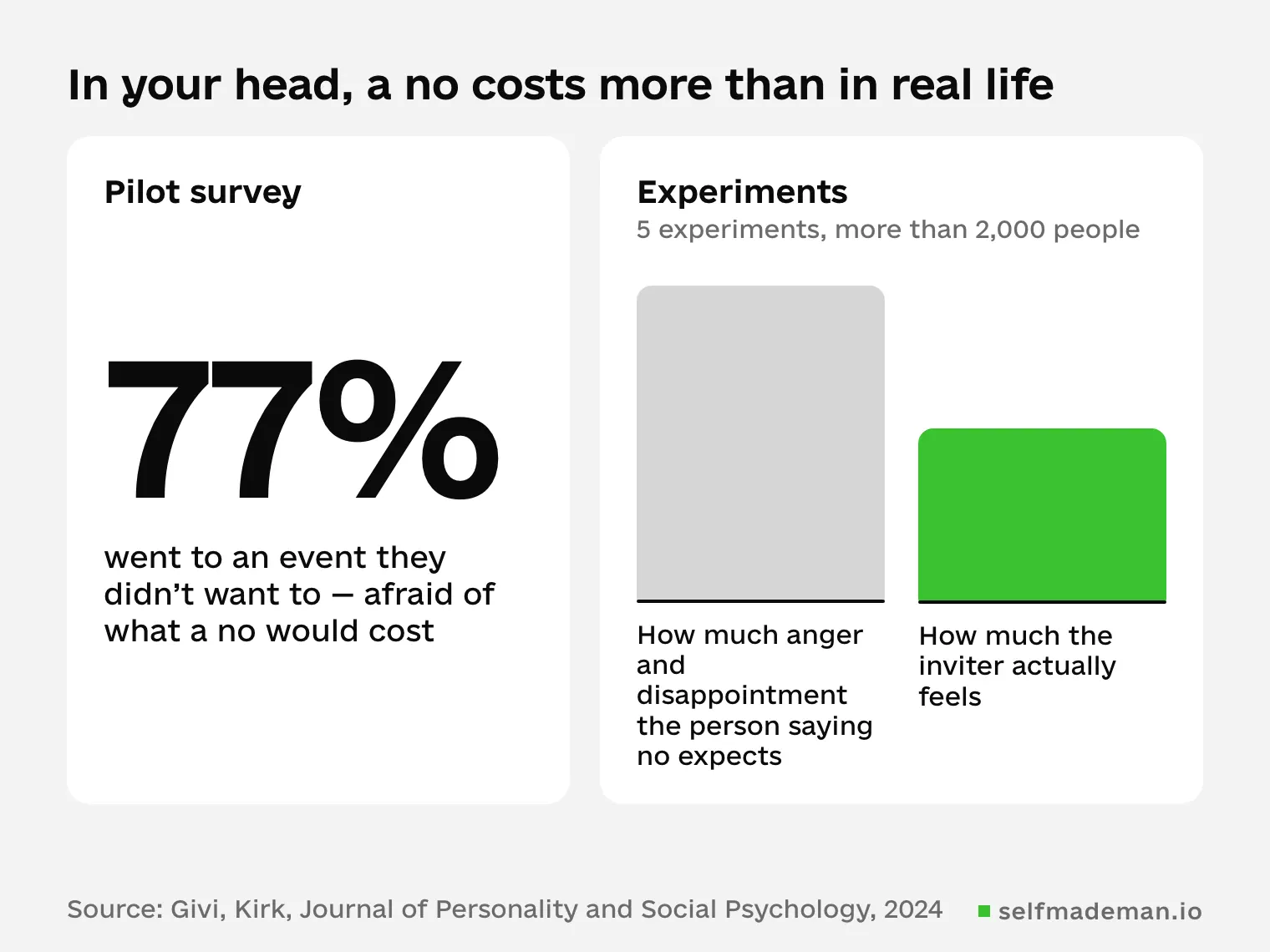
Because in your head, a no costs more than it does in real life. In 2024, Julian Givi and Colleen Kirk ran five experiments with more than 2,000 people1. In a pilot survey, 77% admitted they’d gone to an event they didn’t want to attend, simply because they feared what would happen if they declined. And in the experiments, the people saying no expected far more anger and disappointment than the person who invited them actually felt.
The study has limits: some situations were imagined, and cultural differences weren’t examined. But the mechanism is familiar. We invent a reaction for the other person that may never come, and we pay for that fear with our own time.
Guilt after a no isn’t evidence. It’s just lack of practice.
My experience
I keep a list of personal rules, and one of them goes: “I don’t wait for warmth where there isn’t any.” Next to it are a few more: don’t accept anything in a relationship that destroys my calm and confidence; don’t put my emotional state in someone else’s hands; talk from calm, not from anxiety or exhaustion. Really, they’re all about one thing: the right to say no and not apologize for it.
A separate rule is about energy: I save it for myself and my kids. It works as a filter for any request. If a yes takes energy from the people it’s promised to, that’s a reason to stop and think.
I used to put up with things and stay quiet far more often than I said no. So these rules aren’t theory for me.
How to say no in 6 steps
- Take a pause. You don’t have to answer a request that second. “Let me think about it, I’ll let you know by tonight” takes the pressure off and gives you time to decide honestly.
- Check it against your priorities. The question isn’t “can I,” it’s “do I want to spend my evening or my week on this.” Your personal rules help here, and so does sorting tasks with the Eisenhower matrix: someone else’s urgency doesn’t make a task important to you.
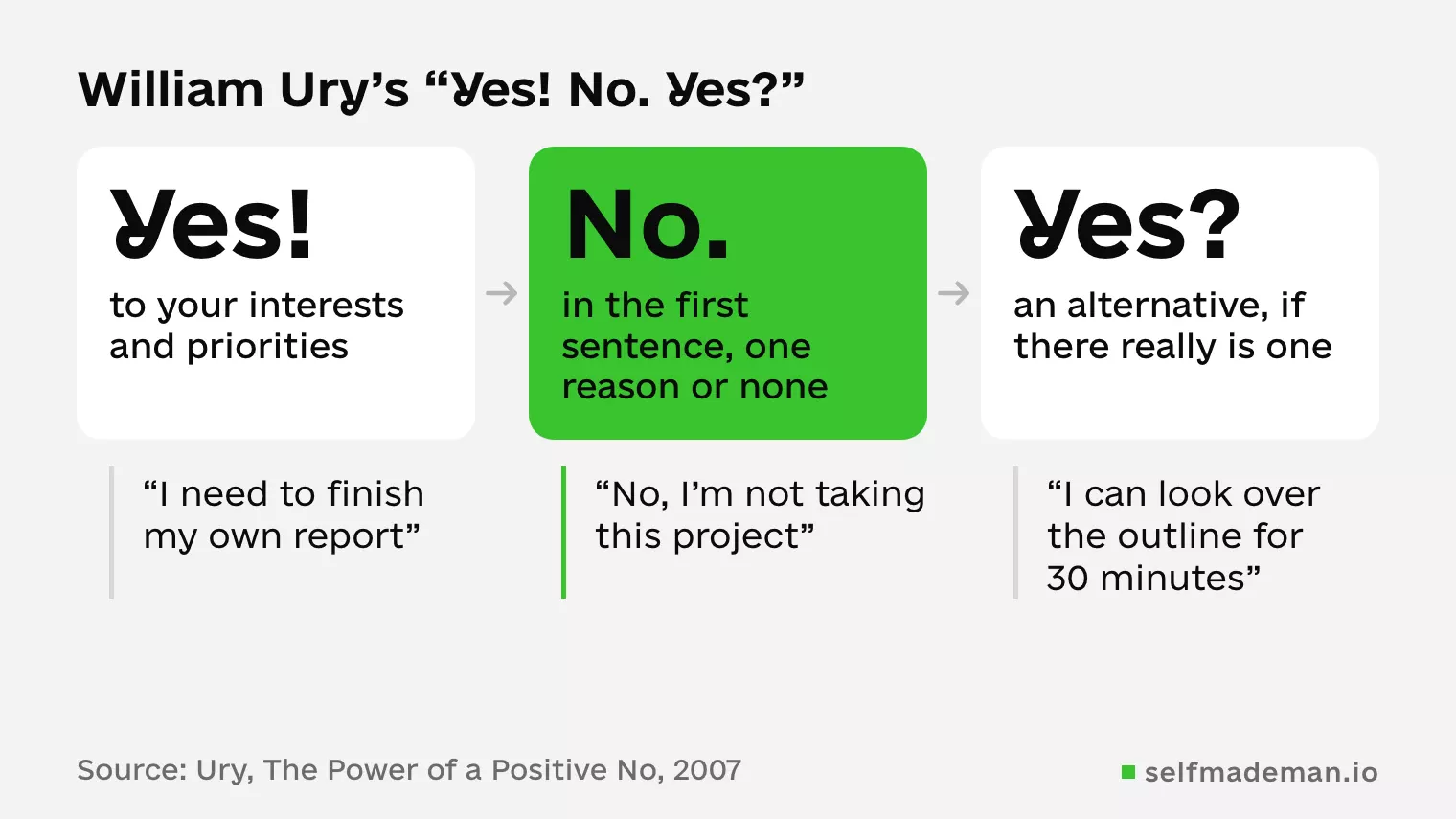
- Say no in the first sentence. “No, I’m not going to take on this project.” Not “well, you see, here’s the thing…” for three paragraphs.
- One reason — or none. An explanation and an excuse differ in quantity. One sentence is an explanation. Five is an excuse, and every point in it can be picked apart.
- Offer an alternative if there really is one. Not out of obligation, but because you want to keep working together: “I won’t take the whole thing, but I can look over the outline for 30 minutes.”
- Repeat if they push. Don’t add new arguments. Say the same thing, shorter. This is known as the “broken record” technique2. Every new argument is a new thing to argue about.
Steps 3–5 follow negotiator William Ury’s “Yes! No. Yes?” model: first a yes to your own interests, then a calm no, then a yes to a counteroffer3. Ury built it for negotiations, but it works the same way in everyday life.
“I don’t” instead of “I can’t”
A small difference that people notice. “I can’t on Saturday” sounds like a temporary obstacle, so the other person starts looking for a way around it. “I don’t work Saturdays” sounds like a rule. Nobody argues with a rule.
Vanessa Patrick and Henrik Hagtvedt published a study in 2012 on exactly these two phrasings4. To be upfront: it’s not about saying no to people. It’s about saying no to yourself — to sweets, to skipping a workout. Participants who repeated “I don’t eat X” later picked a granola bar over a chocolate bar more often: 64% versus 39% among those who said “I can’t.” In a ten-day field experiment, 8 out of 10 people in the “I don’t” group stuck with it to the end, compared with 1 out of 10 in the “I can’t” group. The samples are small. And one important detail: “I don’t” worked when the goal was the person’s own. When the reason came from outside, “I can’t” was stronger.
Applying this to conversations with other people is my conclusion, not the study’s. But the logic holds: “I don’t” rests on you, while “I can’t” rests on circumstances that can be moved.
How to say no politely: ready-made phrases
| Situation | What to say |
|---|---|
| A short no | “Thanks for the invite. I’m not going to make it.” |
| A no with an alternative | “I won’t take the whole thing. I can look at the draft on Thursday for 20 minutes.” |
| A delayed answer | “I can’t answer right away. I’ll get back to you by 6 p.m.” |
| Leaning on a rule | “I’m not taking on new projects until the end of the quarter.” |
| Holding the line | “I hear you. And my answer is still no.” |
| Your boss or a client | “I can take it. Then the report moves to Friday. Which matters more?” |
| A friend asks for help | “I can’t this weekend. If next weekend works, I’m in.” |
| Family | “I love you, and I’m not coming this Sunday. Let’s talk on the phone tonight.” |
Notice what’s missing from the table: “I’m so sorry,” “I feel terrible about this,” “I’d love to, but…”. One “thanks” or “sorry” is politeness. Three is asking to be forgiven for your own decision.
Build your own no
-
1Who. Who are you saying no to?
-
2How. Pick the kind of no.
-
3Details. Only the point, no explanations. The builder puts the rest together.
-
4Tone. Softer: with one “thank you”. Shorter: without it.
Check your own draft: what to cut
Everything stays in this browser.
How to say no at work
At work, no sounds different than at home: there’s almost always a power imbalance. So the best way to say no to your boss isn’t “no.” It’s a question about priorities. “I can take this on. Then X slips by a week. Which is more important?” The decision stays with the person assigning the work, and you stop silently carrying everything at once.
With clients, the same thing works through scope. Not “we can’t,” but “that’s outside our scope of work. I can quote it separately.” That’s how to say no politely and professionally without closing the door.
Where it breaks
- Commitments. A no doesn’t cancel what you’ve already promised or what you’re responsible for: a child, a contract, a job you’re paid for. There the question isn’t “refuse” but “renegotiate.”
- No as armor. If you turn everything down, relationships stop growing. Even the authors of the study on declining invitations advise against rejecting every one1.
- Unequal power. A boss who controls your paycheck isn’t a friend. A question about priorities works there; a bare no doesn’t.
- Manipulation and pressure. If a no gets met with yelling, threats, or weeks of sulking, it’s not about wording anymore. A phrase won’t fix that. You need distance.
- Strong anxiety. If any refusal triggers panic or sleepless nights, or you can’t say no even to small things, that’s a reason to talk to a therapist. An article can’t replace a professional.
The minimum version
One sentence for a bad day: “Let me think about it, I’ll get back to you tomorrow.” It promises nothing and buys you time. Tomorrow you’ll answer more calmly than you would right now.
If you already said yes
It happens. The yes came out on autopilot, and an hour later it was clear it was a mistake. You can walk it back, and the sooner you do, the less it costs both of you:
“I answered too fast. With my schedule it isn’t going to work, so I’m going to pass. Better to tell you now than let you down later.”
No five explanations. Taking back a yes once is more honest than spending a week doing something you resent.
FAQ
How do you nicely say no?
Thank them for the offer, say no in one sentence, and offer an alternative if you want to. Skip the long apologies: politeness lives in your tone, not in the number of words.
Why do I struggle with saying no?
Mostly fear of the consequences. In Givi and Kirk’s experiments, people noticeably overestimated how much their no would upset the other person1.
Do I have to explain why I’m saying no?
No. One short reason is fine if you want to give it. The more reasons you list, the more there is to argue with.
How do I say no to my boss?
Through priorities: “I can take it, but then another task slips. Which matters more?” The decision stays with your manager, and your workload becomes visible.
What is a better way to say no?
“I don’t” instead of “I can’t.” “I don’t take on new projects this quarter” sounds like a rule; “I can’t right now” sounds like something to work around.
What if the person gets upset when I say no?
Restate your position calmly and briefly, without adding new arguments. Being upset is their right. Your decision is yours.
Today’s action
Think of one request you recently agreed to against your will, or one still waiting for an answer. Write a reply using the formula: no in the first sentence, one reason or none, an alternative if you want. Send it or say it today. Ten minutes.
Sources
- Givi J., Kirk C. P. Saying no: The negative ramifications from invitation declines are less severe than we think. Journal of Personality and Social Psychology, 2024, 126(6), 1103–1115. ↩
- Smith M. J. When I Say No, I Feel Guilty. 1975. ↩
- Ury W. The Power of a Positive No: How to Say No and Still Get to Yes. Bantam, 2007. In short: Getting to No, Program on Negotiation, Harvard Law School. ↩
- Patrick V. M., Hagtvedt H. “I Don’t” versus “I Can’t”: When Empowered Refusal Motivates Goal-Directed Behavior. Journal of Consumer Research, 2012, 39(2), 371–381. ↩