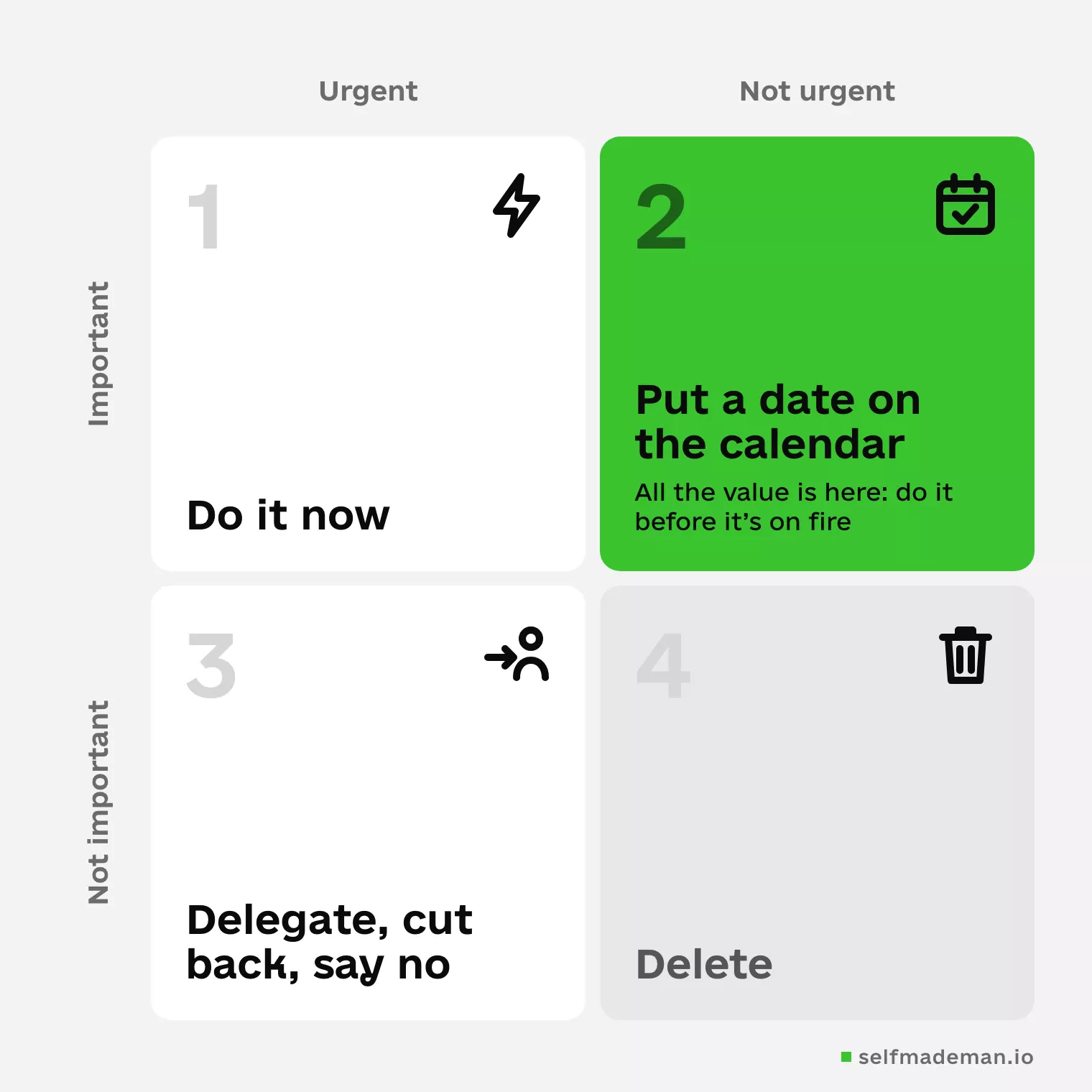
The Eisenhower Matrix is a 2×2 grid where every task gets two answers: is it important, and is it urgent? That gives you four quadrants: do what’s important and urgent now, schedule what’s important but not urgent, delegate or cut back what’s urgent but not important, and delete the rest. All the value of the matrix sits in the second quadrant: important but not urgent. That’s exactly what urgent stuff eats every single day.
- Important is what moves your goals forward, with consequences you’ll feel months from now. Urgent is what demands a reaction right now.
- Quadrant 1 — do it. Quadrant 2 — give it a date on your calendar. Quadrant 3 — delegate, cut back or say no. Quadrant 4 — delete it.
- People are drawn to urgent tasks even when the urgency is fake. Experiments have tested this.
- The matrix isn’t a one-time to-do list cleanup. It’s a question you ask yourself every morning.
Table of contents
- Where the Eisenhower Matrix came from
- My experience
- Urgent vs. important: how to tell them apart
- How to use the Eisenhower Matrix: 6 steps
- Eisenhower Matrix examples: the four quadrants
- Sort your own tasks
- Common mistakes and where the matrix breaks
- The minimum version
- If you fall off
- FAQ
- Your action for today
- Sources
Where the Eisenhower Matrix came from
In August 1954, U.S. President Dwight D. Eisenhower spoke to the World Council of Churches in Evanston, Illinois. That’s where he said the line every other time management article now quotes: “I have two kinds of problems, the urgent and the important. The urgent are not important, and the important are never urgent”1. The detail people usually skip: Eisenhower didn’t claim the idea as his own. He credited an unnamed “former college president”2. And there’s no matrix in the speech — just the line.
Stephen Covey turned it into a grid in “The 7 Habits of Highly Effective People” (1989). He called it the “time management matrix,” with four quadrants, and the key one is the second: important but not urgent3. The name “Eisenhower Matrix” stuck because of the quote.
An honest note on the science: nobody has properly tested the matrix itself as a method. But what it works against — the pull of urgency — has been tested, and more on that below.
My experience
I have a rule: “I don’t choose by tasks — I choose by direction.” For me, the matrix is a way to remember that direction on an ordinary Tuesday. When your list has thirty items, they all look like tasks of the same weight. The question “Is this important?” really means “Does this move me in my direction?”
My second rule: “Main things first, operations after.” Every day I pick one or two main tasks and put them above everything else. Everything else goes on the calendar or into the Backlog instead of hanging around in my head.
Quadrants 3 and 4 have their own rules on my list: “I delegate more” and “Cut extra tools, tabs, files and information sources.”
Urgent things will find you on their own. Important things you have to go looking for — and then defend.
Urgent vs. important: how to tell them apart
Urgent is what demands a reaction now: there’s a deadline, someone’s waiting, a notification is blinking. Important is what moves your goals and values forward, with consequences that play out over months and years. A task can be both, or neither.
Four questions that help you keep them straight:
- What happens if I don’t do this at all? Nothing — then it’s not important.
- What happens if I do it a week from now? Nothing bad — then it’s not urgent.
- Does it move one of my goals for the year? If yes, it’s most likely important. No goals yet? Start with three main goals.
- Is it urgent for me or for someone else? Someone else’s urgency isn’t always your priority.
Why urgent always wins
Researchers Meng Zhu, Yang Yang and Christopher Hsee called this the “mere urgency effect.” In five experiments, people more often picked a task with a smaller payoff if it had a short deadline — even when the urgency was an illusion. The effect weakened when people were reminded of the payoff at the moment of choosing4. In 2026, an independent team repeated the experiments with 2,374 participants. With extra controls the effect was weaker, but it held up in every test5.
The takeaway is simple: the pull toward urgent tasks isn’t a character flaw. It’s how your brain is wired. The urgent important matrix works as that reminder of the payoff. It makes you look at a task twice before you jump on it.
How to use the Eisenhower Matrix: 6 steps
- Dump everything. Your tasks for the week in one list, work and personal. Don’t sort yet.
- Give each task two marks. “Important — yes or no?” and “Urgent — yes or no?” No “kind of important.”
- Sort them into quadrants. Four boxes on a sheet of paper or in the tool below.
- Give each quadrant an action. Quadrant 1 — do it today or tomorrow. Quadrant 2 — a specific date and time on your calendar. Quadrant 3 — who to hand it to, how to cut it back, or who to say no to. Quadrant 4 — cross it out.
- Start your day with quadrant 2 if nothing in quadrant 1 is on fire. One task, first thing, before the urgent stuff wakes up. Pomodoros make this easier.
- Review once a week. Tasks move between quadrants: important things you didn’t do turn urgent.
Eisenhower Matrix examples: the four quadrants
| Quadrant | Work | Home and life | What to do |
|---|---|---|---|
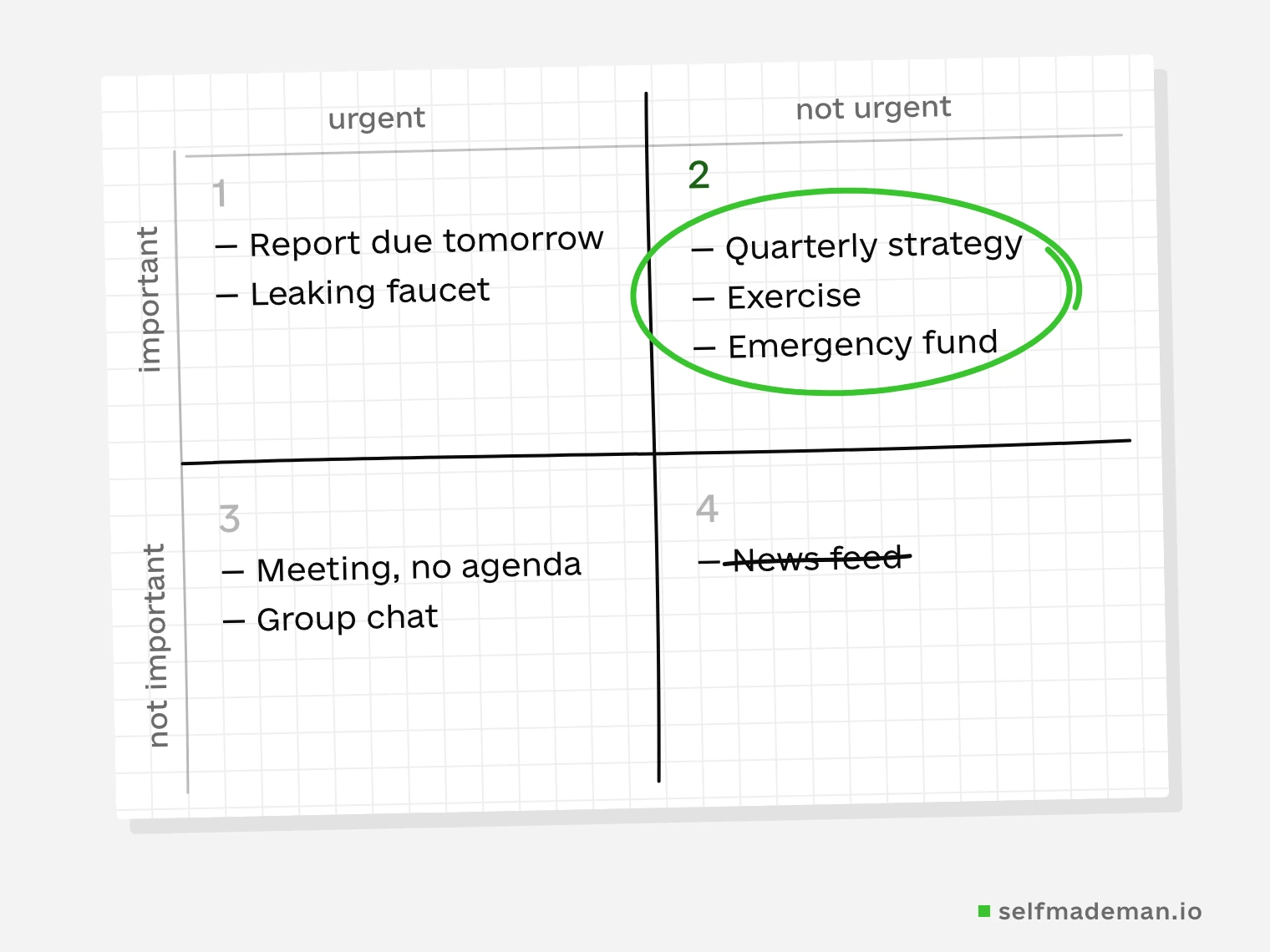
| 1. Important and urgent | A client’s website is down, a report due tomorrow | Your kid got sick, a leaking faucet | Do it now |
| 2. Important, not urgent | Quarterly strategy, learning, hiring, automation | Exercise, sleep, time with your kids, an emergency fund, a routine checkup | Put a date on the calendar |
| 3. Urgent, not important | Most notifications, other people’s “got a minute?”, meetings with no agenda | A sales call, the family group chat you “have to answer” | Delegate, cut back, say no |
| 4. Not important, not urgent | Aimlessly scrolling industry news, redoing the font for the third time | Scrolling, a show running “in the background” you don’t even want to watch | Delete |
Look at quadrant 2. Almost everything that changes your life over a year lives there: health, relationships, skills, systems. These things have no deadline — and that’s exactly why they get put off for years.
Quadrant 3 is the sneakiest. It feels like work: you’re busy, replying, solving things. If it’s packed with other people’s requests, read how to say no without making excuses.
Sort your own tasks
List your tasks and answer two questions for each: “Important?” and “Urgent?” The matrix will sort them into quadrants. Give quadrant 2 tasks a date right away: the matrix will show how many important tasks got one.
Work and personal, for the week. Don’t sort yet. Ctrl + Enter adds the list.
Four questions so you don’t mix them up
- What happens if I don’t do it at all? Nothing — then it is not important.
- What happens if I do it in a week? Nothing bad — then it is not urgent.
- Does it move one of my goals for the year? If yes, it is most likely important.
- Is it urgent for me or for someone else? Someone else’s urgency is not always my importance.
A4 landscape. In the print dialog choose “Save as PDF” to keep a file. Tasks stay only in this browser.
Prefer paper? Print a blank template or the matrix with your tasks.
Common mistakes and where the matrix breaks
- Everything is important. If 90% of your tasks land in quadrants 1 and 2, you haven’t sorted anything — you’ve just rewritten your list. Ask question 1: “What happens if I don’t do this at all?”
- Someone else’s urgency instead of your priorities. Urgent for a coworker doesn’t mean important for you. Half of quadrant 3 is other people’s priorities.
- Rest in quadrant 4. Sleep, exercise and a walk without your phone belong in quadrant 2, not in “unimportant.” Quadrant 4 is for things that neither rest you nor move you forward.
- Nobody to delegate to. If you’re a freelancer or a stay-at-home parent, “delegate” in quadrant 3 won’t help. Use other verbs instead: cut back, batch it once a day, say no. And to figure out what’s worth outsourcing, calculate what your hour is worth.
- The matrix as a one-off. Sorted on Monday, everything’s different by Wednesday. It only works as a short daily question.
- Sorting instead of doing. Neatly arranged quadrants are another way to avoid starting. Give the whole matrix 10 minutes, tops.
The minimum version
No time for quadrants? Ask one question in the morning: “What’s my one quadrant 2 task today?” Do it first. Everything else — however it goes.
If you fall off
A week of firefighting, quadrant 2 is empty. That’s normal — some weeks quadrant 1 honestly takes everything. Don’t start from scratch. Look at last week’s quadrant 3: which fire actually belonged to someone else? Next time, hand off or turn down one thing like that. And put one quadrant 2 task on your calendar for tomorrow morning.
FAQ
What is the Eisenhower Matrix in simple terms?
A 2×2 grid that sorts tasks by two questions: is it important, and is it urgent? Important and urgent — you do it. Important, not urgent — you schedule it. Urgent, not important — you delegate it or cut it back. The rest — you delete.
Who created the Eisenhower Matrix?
Eisenhower said the line about urgent and important in 1954 and credited it to a “former college president.” The four-quadrant grid was popularized by Stephen Covey in “The 7 Habits of Highly Effective People” (1989).
What is another name for the Eisenhower Matrix?
The Eisenhower box, the Eisenhower decision matrix, the Eisenhower method, the urgent-important matrix, the priority matrix, or Covey’s time management matrix.
What are the downsides of the Eisenhower Matrix?
It’s subjective: everyone defines “important” differently, and without goals the matrix turns into sorting by mood. It ignores energy and how long a task takes. And it easily becomes a ritual that replaces actual work.
How is the matrix different from a to-do list?
A list answers “what to do.” The matrix answers “what to do first, and what not to do at all.”
How often should I review my matrix?
The short question — every morning. The full sort — once a week.
Your action for today
Put tomorrow’s tasks into the matrix above. Find one from quadrant 2 — important but not urgent. Make it your first line and block 25 minutes for it on your calendar before you open your email.
Sources
- Eisenhower D. D. Address at the Second Assembly of the World Council of Churches, Evanston, Illinois. August 19, 1954. The American Presidency Project. ↩
- Quote Investigator. What Is Important Is Seldom Urgent and What Is Urgent Is Seldom Important. 2014. ↩
- Covey S. R. The 7 Habits of Highly Effective People. Free Press, 1989. Habit 3, “Put First Things First.” ↩
- Zhu M., Yang Y., Hsee C. K. The Mere Urgency Effect. Journal of Consumer Research, 2018, 45(3), 673–690. ↩
- Mills R., Cubitt R., Starmer C. Brief Commentary: An Independent Replication Study of the Mere Urgency Effect. Journal of Consumer Research, 2026. ↩