Time management is a set of techniques that help you decide what to spend your time on and then actually get it done. It’s not one system. It’s a toolbox: the Eisenhower matrix, Pomodoro, time blocking, the 80/20 rule and a dozen more. Each tool has its own job. So what works isn’t “the best method”, it’s the one that fits your problem: too many tasks, can’t get started, can’t focus, the day falls apart, everything takes longer than planned, or you’re out of energy by lunch. Below: which method fits which problem, a quiz to find yours, and an honest look at what time management can and can’t do.
- Time management isn’t one system. It’s a set of methods, and each fixes one problem.
- Name your problem in one sentence first. Then pick the method.
- One method for two weeks. Add a second only when the first one holds.
- Research links time management more strongly to well-being than to performance.
- If you have more work than hours, no method will save you. Saying no and delegating will.
Table of contents
- What is time management, in plain English?
- Does time management actually work?
- My experience
- Which time management method fits which problem
- Time management techniques: a quick look at each
- Quiz: which time management method fits you?
- How to choose a time management method: 5 steps
- Where time management breaks down
- The minimum version
- If you fall off track
- FAQ
- Your action for today
- Sources
What is time management, in plain English?
You can’t stretch time or save it for later. What you manage is your decisions: what to do, in what order, how long to give it and when to stop. Time management is the set of techniques for making those decisions.
Researchers don’t agree on one definition. In a 2007 review, Brigitte Claessens and colleagues went through 32 empirical studies from 1982 to 2004 and noted that time management has been defined and measured in very different ways1. But almost every method does one of three things:
- Choose. What to do out of everything, and what not to do: priorities, one main task, saying no.
- Place. When and how much: a day plan, blocks in the calendar, a buffer for the unexpected.
- Protect. How not to get distracted or burn out: a timer, batching routine work, working on your energy peaks.
Time management isn’t about getting everything done. It’s about getting the important things done.
Does time management actually work?
Short answer: yes, but not the way book covers promise.
In the Claessens review, time management was linked to a sense of control over time, job satisfaction, health and lower stress. Its link to work and academic performance was unclear1.
A 2021 meta-analysis pooled 158 studies and almost 54,000 participants. Time management had a moderate link to job and academic performance, a slightly stronger one to life satisfaction, and a clear link to lower distress2. These are correlations, not proof of cause.
The practical takeaway: don’t expect a method to double your output. Expect your day to get calmer and clearer. That’s a lot already: a calm head is better at deciding what matters.
My experience
My time management isn’t one system from a book. It’s a handful of rules, and behind each one, if you look closely, there’s a method.
It started with volume. My early rules said “do the maximum number of basic tasks a day” and “get through as much of the incoming flow as possible”. Later they changed: “every day, pick one or two main tasks and put them above everything else” and “main things first, operations after”. Not “more”, but “the important thing first”.
| My rule | Which method it is |
|---|---|
| “One main focus a day, and I do it first” | One most important task, eat the frog |
| “I work in honest, strict Pomodoros”, 25/5 | Pomodoro |
| “Everything else goes into the calendar or the Backlog” | Time blocking, getting things out of your head |
| “Add rest, travel, workouts and buffer time to the calendar” | A realistic day plan, a buffer for the planning fallacy |
| “Don’t plan the day as if my energy were unlimited” | Energy management |
| “Don’t keep tasks in my head if I can write them down” | Brain dump |
There are no textbook methods in my rules. There are short lines that remind me what to do when the day starts to slip.
Three things run every single day for me: a calendar with time blocks, the most important task of the day done first, and everything else dumped into a backlog. Pomodoro and batching are in my rules, but I don’t live by them daily. And the Eisenhower matrix never stuck at all — why, under “Where it breaks.”
I’ve tried every method in this article and used each of them for a while. The conclusion is simple: it’s not one method that works, it’s the combination. Cling to a single method at any cost, and it’s easy to become its hostage.
Which time management method fits which problem
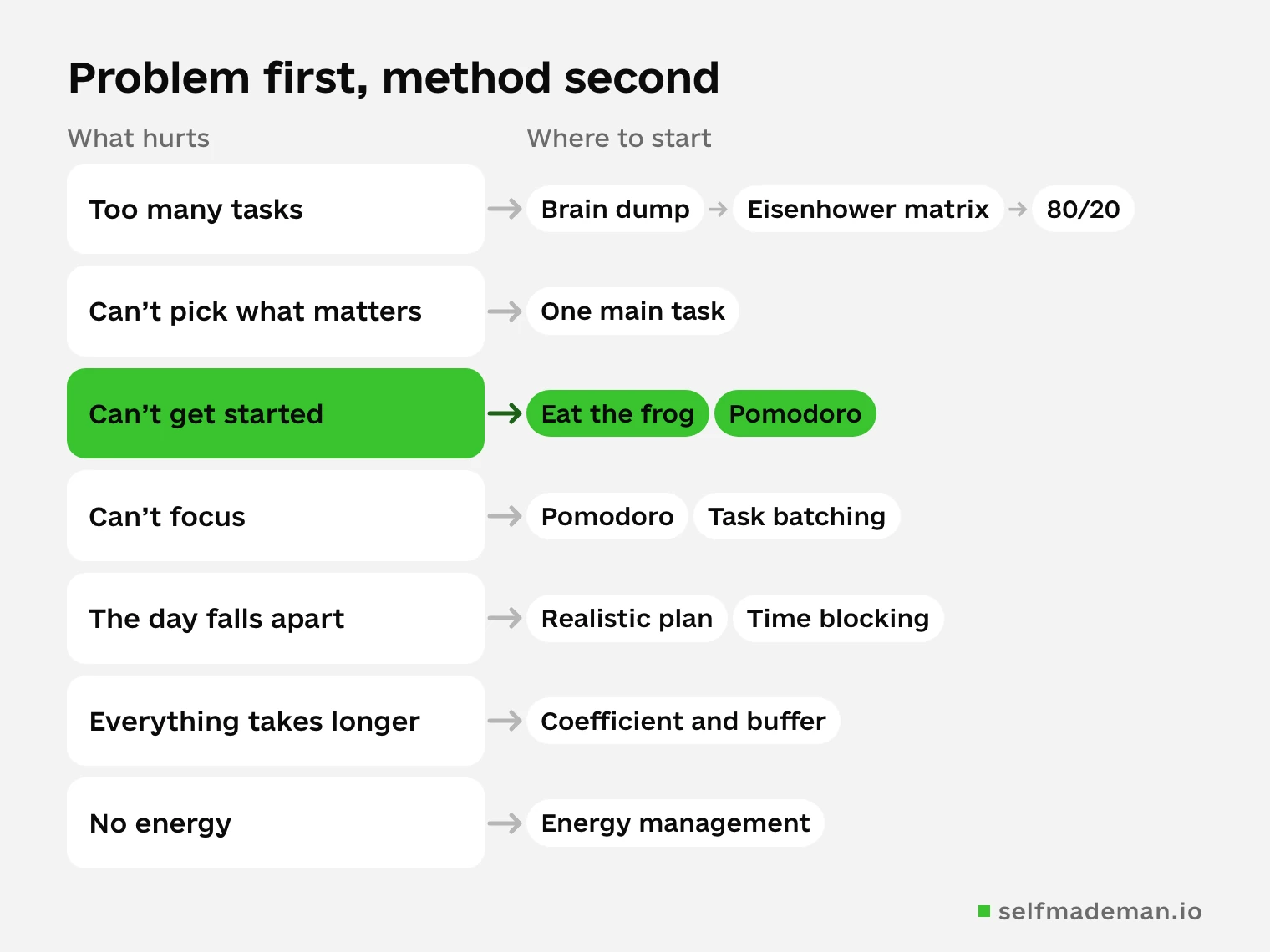
Most time management articles are a list of 15 techniques. You read it, pick nothing, close the tab. Let’s do it the other way round: problem first, method second.
| Problem | What it sounds like | Where to start |
|---|---|---|
| Too many tasks | “Everything’s on fire, the list has 40 items” | Brain dump → Eisenhower matrix → 80/20 |
| Can’t pick what matters | “Busy all day, and the main thing hasn’t moved” | One most important task |
| Can’t get started | “I sit down and open my email” | Eat the frog, Pomodoro |
| Can’t focus | “A chat or a call every 10 minutes” | Pomodoro, task batching |
| The day falls apart | “By noon the plan isn’t about today anymore” | A realistic day plan, time blocking |
| Everything takes longer | “An hour turns into three” | Planning fallacy: a coefficient and a buffer |
| Out of energy by lunch | “I put off the hard stuff because my brain won’t work” | Energy management |
Time management techniques: a quick look at each
For each one: the idea in a nutshell and when it fits. Steps, details and tools are in the dedicated articles.
Brain dump: get everything out of your head
In 10–15 minutes you write down everything spinning in your head: tasks, promises, ideas, worries. Then you sort it: do, schedule, hand off, drop. The idea comes from David Allen’s GTD system: your head is a bad place to store tasks3.
When it fits: there’s so much that you don’t know where to start, and it all lives in your memory. It’s the first step before any other method. More in how to do a brain dump, plus a brain dump template.
The Eisenhower matrix: important vs urgent
Tasks go into four boxes based on two questions: is it important, and is it urgent? Important and urgent: do it. Important, not urgent: schedule it. Urgent, not important: hand it off. The rest: drop it. It’s named after a line from Dwight Eisenhower’s 1954 speech about how the urgent is rarely important4.
When it fits: the list is long and everything feels on fire. The matrix shows that not everything has to burn. More in the Eisenhower matrix, and online as an Eisenhower matrix template.
The 80/20 rule: find what drives most of the result
A small share of actions usually brings most of the result. The 80 and 20 are a convention: real data shows 70/20 and 90/10 too. The idea goes back to Vilfredo Pareto’s observation on how wealth was distributed, and Joseph Juran turned it into a principle5.
When it fits: all your tasks seem necessary, but it’s unclear which ones move the needle. It works for a week or a project, not a single day.
One most important task
Out of your whole list you pick one, at most two, tasks that move your main goal, and you do them first. Everything else comes after or goes into the calendar.
When it fits: by evening you’ve done twenty small things and the main one hasn’t moved. More in how to prioritize tasks.
Eat the frog: the hard thing first
You do the most unpleasant important task at the start of the day, before everything else buries it. Brian Tracy popularized “eat the frog” in his 2001 book of the same name6.
When it fits: one task has been hanging over you for weeks and spoils every day. It doesn’t fit if your energy peak isn’t in the morning: then the frog goes on your peak.
Pomodoro: work in short cycles
25 minutes on one task with no distractions, a 5-minute break, and a longer break after four cycles. Francesco Cirillo came up with it as a student7.
When it fits: you struggle to start or to stay focused. The timer settles “how much longer”: only until it rings. More in the Pomodoro Technique, and online as a Pomodoro timer.
Task batching: routine in batches
Similar small tasks go into one block: email two or three times a day, calls back to back, payments once a week. Every switch leaves a trace of attention on the previous task, and the next one suffers8.
When it fits: notifications, chats and small stuff tear your day apart, and there’s never a whole hour left for deep work.
Time blocking: every task gets its time
Tasks move from the list into the calendar: each gets a block with a start and an end. Cal Newport is the best-known advocate: he plans his entire workday in blocks9.
When it fits: you have a list but no idea when to do what, and the day goes to reacting. Online: a time blocking planner.
A realistic day plan
A plan that includes travel, meals, breaks and a buffer for the unexpected, not just tasks. As many tasks as actually fit, not as many as you’d like.
When it fits: every evening half your list moves to tomorrow.
The planning fallacy: a coefficient and a buffer
People consistently underestimate how long their own tasks will take. Daniel Kahneman and Amos Tversky coined the term “planning fallacy”10, and Roger Buehler, Dale Griffin and Michael Ross showed that remembering past tasks doesn’t fix it11. Trying harder to be accurate doesn’t help. Numbers do: compare plan and actual, then multiply your estimates by your own coefficient.
When it fits: “one hour” keeps turning into three, and deadlines slip for reasons that have nothing to do with laziness.
Energy management
Everyone has the same hours, but the hours when your brain actually works are your own. The hardest work goes on your energy peak, routine on the dip, rest into the plan. Tony Schwartz and Catherine McCarthy made the approach popular12.
When it fits: there’s time for the task, but no energy at that time.
If you want a complete system rather than a couple of techniques, from inbox to weekly review, look at Getting Things Done. It’s a hard place to start, though: it’s a dozen habits at once.
Quiz: which time management method fits you?
Seven questions about where your time leaks. The result: one method for the next two weeks, a backup, and links to the full article and the tool.
One method for two weeks. Add the next one only when the first one holds.
I’m not looking for the perfect system. I close one problem at a time.
One method, not a full system: that’s on purpose. Your answers stay in this browser.
How to choose a time management method: 5 steps
- Name your problem in one sentence. Not “I’m bad at time management”, but “by noon every day the plan isn’t about today anymore”. The more specific, the easier the choice.
- Pick one method from the table. The simplest one that fits. If you have several problems, start with the one highest in the table: without getting things out of your head and setting priorities, nothing else holds.
- Give it two weeks. For the first week a method feels awkward and annoying. Judging it on day three means judging it by the annoyance.
- Check it against the problem. After two weeks, reread your sentence from step 1. Has it got easier? The method stays. If not, change the method, not yourself.
- Add the next one, one at a time. For example, after one main task, add a Pomodoro on it, then a block in the calendar. That’s how methods add up to your own system instead of a collection.
I’m not looking for the perfect system. I fix one problem at a time.
Where time management breaks down
- Collecting methods. Reading about ten methods is easier than sticking with one for two weeks. If you’re on your fifth article in a row, close the tab and do step 1.
- Setting up instead of working. A pretty calendar, colors, tags, a new app. A week later maintaining the system takes longer than the tasks.
- Treating the plan as a contract. A schedule is a plan, not a promise. I have a rule for this: “Don’t break the whole plan if something goes wrong. Adjust and keep going.”
- More tasks than hours. If there’s honestly 12 hours of work a day, no method will compress it. Only saying no and delegating help. Here time management tells you the truth: it won’t fit.
- Someone else’s schedule. Kids, shifts, a manager who books meetings over your mornings. Protect at least one block a week for the important stuff and don’t demand a perfect schedule from yourself.
- Time management instead of rest. If all the optimization goes into squeezing in one more task, you’re heading for burnout, not productivity.
My example is the Eisenhower matrix. I tried it, but when you work in services — websites, client projects — a huge amount of effort goes into deciding what’s important and what’s urgent. Some tasks are hidden or tied to others, and you can’t honestly drop them into one quadrant. It never really worked for me.
The minimum version
A bad day, low energy, everything on fire. Then just two things:
- One main task for today, in one line.
- One Pomodoro on it: 25 minutes without your phone.
Everything else, as it comes. One moved piece of the important thing beats a perfect plan that never started.
If you fall off track
A week with no system, the plan abandoned, tasks back in your head. That’s normal: time management isn’t an exam you have to retake. Don’t try to bring everything back at once. Do a 10-minute brain dump, pick one main task for tomorrow from it and put it first. The system comes back on its own, one method at a time.
FAQ
What is time management in simple words?
It’s a set of techniques for deciding what to spend your time on, in what order and for how long. Not one system but a toolbox: each method solves its own problem, from a long to-do list to losing focus.
What are the main time management techniques?
The best known: brain dump, the Eisenhower matrix, the 80/20 rule, one most important task, eat the frog, Pomodoro, task batching, time blocking, a realistic day plan, a coefficient for the planning fallacy, and energy management. A complete system is GTD.
What is the most effective time management method?
There isn’t one. Pomodoro is useless if your problem is a 40-item list, and the matrix won’t help if you can’t get started. The effective method is the one that fits your problem. The quiz above helps you name it.
Does time management really work?
A 2021 meta-analysis of 158 studies found a moderate link between time management and job and academic performance, and a stronger one with life satisfaction and lower distress. These are correlations. Honestly: its biggest effect is on how calm you feel.
How do I start with time management?
With one problem and one method. If you don’t know where to begin, do a 10-minute brain dump and pick one main task for tomorrow.
What’s the difference between time management and energy management?
Time management answers when and what to do. Energy management answers at what time you’ll have the energy for it. It’s not a replacement but a second layer on top of your calendar.
Your action for today
Finish this sentence: “Most of my time leaks because…”. One line. Find that problem in the table above, or take the quiz, and put one method in your calendar for two weeks, with a check-in date. Five minutes.
Sources
- Claessens B. J. C., van Eerde W., Rutte C. G., Roe R. A. A review of the time management literature. Personnel Review, 2007, 36(2), 255–276. ↩
- Aeon B., Faber A., Panaccio A. Does time management work? A meta-analysis. PLOS ONE, 2021, 16(1), e0245066. ↩
- Allen D. Getting Things Done: The Art of Stress-Free Productivity. Viking, 2001. ↩
- Eisenhower D. D. Address at the Second Assembly of the World Council of Churches, Evanston, Illinois. August 19, 1954. The American Presidency Project. ↩
- Juran J. M. The Non-Pareto Principle; Mea Culpa. 1974–1975, Juran Institute archive. ↩
- Tracy B. Eat That Frog! 21 Great Ways to Stop Procrastinating and Get More Done in Less Time. Berrett-Koehler, 2001. ↩
- Cirillo F. The Pomodoro Technique: The Acclaimed Time-Management System That Has Transformed How We Work. Currency, 2018. First self-published in 2006. ↩
- Leroy S. Why is it so hard to do my work? The challenge of attention residue when switching between work tasks. Organizational Behavior and Human Decision Processes, 2009, 109(2), 168–181. ↩
- Newport C. Deep Habits: The Importance of Planning Every Minute of Your Work Day. Study Hacks Blog, December 21, 2013. ↩
- Kahneman D., Tversky A. Intuitive prediction: Biases and corrective procedures. TIMS Studies in Management Science, 1979, 12, 313–327. ↩
- Buehler R., Griffin D., Ross M. Exploring the “planning fallacy”: Why people underestimate their task completion times. Journal of Personality and Social Psychology, 1994, 67(3), 366–381. ↩
- Schwartz T., McCarthy C. Manage Your Energy, Not Your Time. Harvard Business Review, 2007, 85(10), 63–73. ↩