The way to teach kids about money is practice and example, not talks. Start a regular allowance as soon as your child understands that coins can be traded for things. Let them make the decisions about that money, so mistakes happen with small amounts. Help them save toward a goal they have to wait for. Their first earnings should come from extra work, not from what they already do as part of the family. And most important: kids learn from how you handle money, not from what you say about it.
- Explaining money to young kids barely works. Your example and hands-on practice do.
- Allowance: regular, same day every time, no haggling.
- Their money, their decisions. A $3 mistake is cheaper than a $3,000 mistake at twenty.
- A savings jar with a goal teaches waiting. The goal should be visible and close.
- Being careful with money is a choice, not a fear of spending.
I’m not a child psychologist or a financial advisor. This is my experience and what I found in the research. Every family has its own rules and its own budget.
Table of contents
My experience
I started earning my own money as a kid. From the age of seven, I helped my parents in the fields. In my free time I collected bottles, hunted for scrap metal and sold it, and bought and resold small things.
Today I’m a father of sons. In the description of my role as a father, I wrote: teach kindness, responsibility, and thrift, and lead by example.
What research says: the “by age seven” myth
You’ll often read that money habits are formed by age seven. The claim usually traces back to the UK’s Money Advice Service: in 2013 it published a research review by Cambridge academics David Whitebread and Sue Bingham1 and presented it that way to the press. The report itself is more careful, and more useful:
- By age seven, kids typically have the basic concepts that later money behavior builds on: counting, understanding that one coin can be worth the same as a handful of small change, that money is exchanged for things, and that you get change when you pay more than the price.
- Teaching young kids financial knowledge directly is likely to be ineffective. What works are the approaches and skills that parents and other adults model, discuss, and demonstrate.
- What helps is anything that teaches delaying gratification, makes “the future” concrete, and lets the child talk through what they’ve understood.
- Young kids often see an allowance as a sign of their parents’ approval or kindness. They understand it as “income” closer to their teens.
In 2016, the US Consumer Financial Protection Bureau (CFPB) broke financial capability down into three building blocks by age2:
| Age | What develops |
|---|---|
| 3–5 | Executive function: the ability to wait, plan, and focus. First ideas about values around money and about numbers |
| 6–12 | Habits and norms: kids watch how money is handled at home and among friends |
| 13–21 | Financial knowledge and decision-making skills |
One takeaway: kids don’t learn from lectures. They learn from you.
Allowance for kids by age
There’s no universal amount. It depends on your family budget, your country, and what the allowance is meant to cover. A practical way to set it: look at the small things you already buy for your child in a week (candy, stickers, small toys) and hand part of that money to them. You spend the same. They make the call.
| Age | How often | What to do |
|---|---|---|
| 3–5 | Optional | Play store, a clear piggy bank, practice waiting a day or two for a purchase |
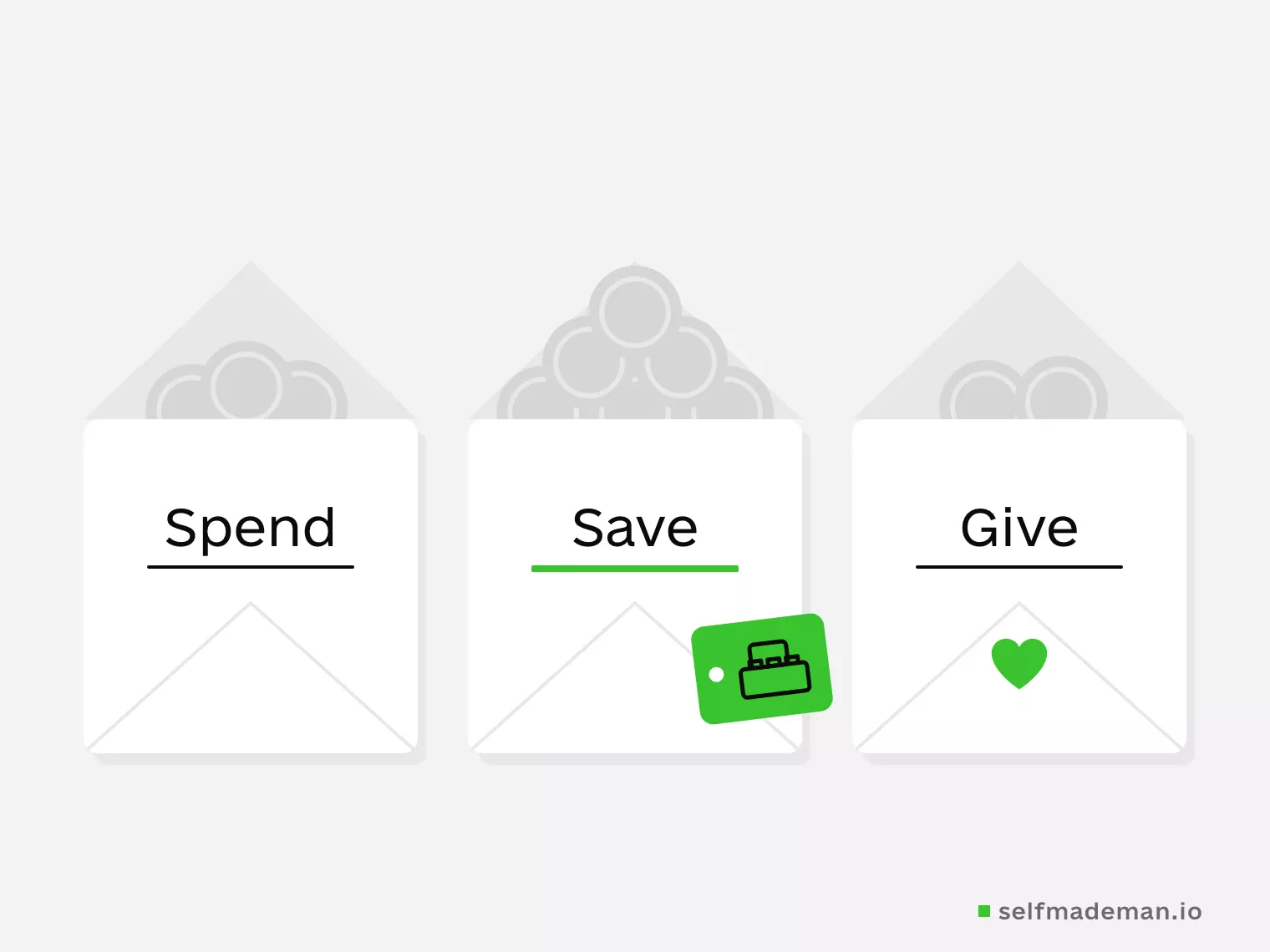
| 6–9 | Weekly | A fixed amount, two envelopes: “spend” and “save.” A goal 2–4 weeks out |
| 10–13 | Every two weeks or monthly | The amount covers small regular expenses. A kids’ debit card under parental control is an option. First paid extra jobs |
| 14+ | Monthly | A budget for part of their expenses: transport, fun, gifts for friends. First job outside the home, within your local laws on teen work |
How to teach kids about money: 7 steps
- Talk about money out loud. At the store: “I’m taking this one because the other costs more and there’s no difference.” At home: “This month we’re saving for our vacation.” Your child sees there’s a reason behind each decision.
- Pay it regularly. Same day, same amount. No haggling and no “you earned it, you didn’t”: an allowance is not a grade for behavior.
- Don’t decide for them. Want to blow it all on junk? Let them. If they’re upset afterward, talk about what they’d do differently. Step in only when safety is at stake.
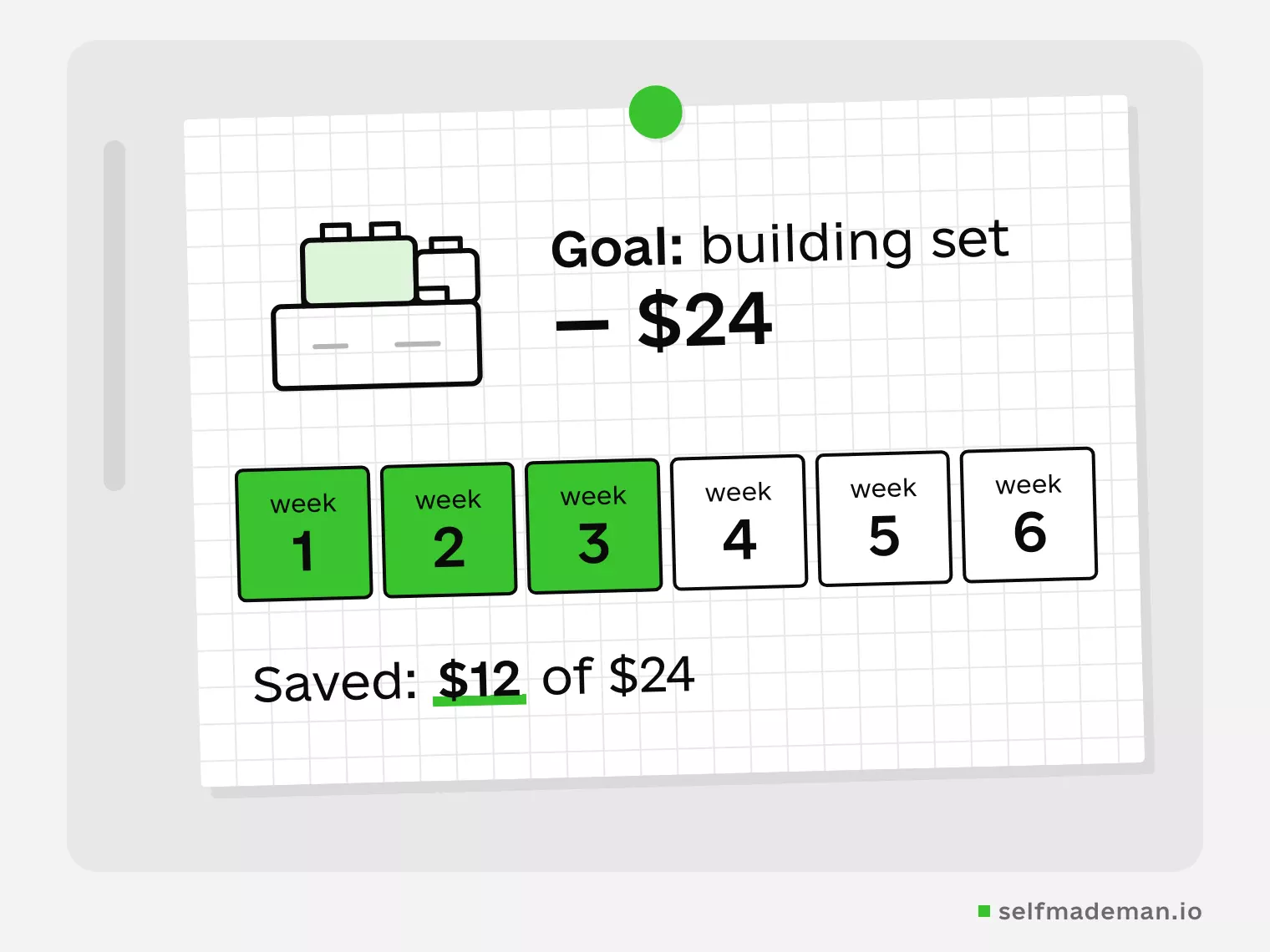
- A savings jar with a goal. A picture of the goal on the jar, its price, and how many weeks are left. The younger the child, the closer the goal: a week or two, not six months. This is how you teach kids to save money.
- Don’t bail them out before payday. Spent it all on Monday? No more money until the next allowance day. No lectures. That’s the lesson.
- Earnings come from extra work. Some chores everyone in the family does for free. Then there’s extra work they can earn from: washing the car, clearing out the storage closet. That’s how a kid sees the link between time, effort, and money.
- A third envelope: “give.” A little for gifts for loved ones or for helping others. Thrift without generosity easily turns into greed.
Allowance calculator
There is no universal amount. Take the small spending on your child you already do each week and hand part of that money to them.
Pick an age to see what the table in the article suggests.
Enter how much a week goes on your child’s small wants.
- The same day, the same amount, no bargaining. Pocket money is not a mark for behaviour.
- The child’s money, the child’s decisions. Step in only when safety is at stake.
- Spent it all on Monday? No money until the next payday. No lectures: that is the lesson.
Money box with a goal
Enter the goal and its price.
Extra earnings
Chores everyone in the family does are not paid. Extra work is: washing the car, sorting out the storeroom. That is how the child sees the link between time, effort and money.
Everyday chores are a separate thing from money. Share them out by age in the chore chart
Count how much went on your child’s small wants last week. 5 minutes.
A guide for your own calculation, not financial advice. Numbers stay in this browser.
First earnings
As a kid, I made money from bottles and scrap metal. Today kids have simpler and safer ways to make money:
- sell things they’ve outgrown (books, toys, clothes) together with a parent;
- help neighbors or relatives: walk a dog, water plants while they’re away;
- make something by hand for a school fair;
- for teens, a part-time job allowed by local law, with age and hour limits and, usually, parental consent.
For a teen, a first paycheck is a good moment to talk about what time is worth. How many hours of work does that phone they want cost? Adults use the same question to decide what to delegate: here’s how to calculate what your hour is worth.
Teens get recruited for “easy work”: lend out their bank card or account to “just pass some money along.” That’s money laundering, and the account holder is the one on the hook. According to Europol and Eurojust, criminals increasingly target young people and students for this and find them through social media3. The rule for your child is simple: never give your card, codes, or passwords to anyone, for any amount of money.
Where it breaks
- Paying for grades and good behavior. Kids learn that love and approval can be bought, and that school is paid work. Grades and behavior are a separate conversation.
- Saying one thing, doing another. You teach saving while buying on impulse and complaining there’s never enough money. Your child will remember the second part.
- Total control. If every purchase needs your approval, it isn’t an allowance, it’s your wallet at arm’s length. Nothing to learn.
- Thrift turns into fear. “We can’t afford it” and “that’s expensive” in answer to everything doesn’t teach saving. It teaches anxiety. Talk about what you’re saving for, not only about what you can’t afford.
- Parents aren’t on the same page. One gives, the other tops up. There should be one set of rules.
The minimum version
No energy for a whole system? One conversation a week at the checkout: “What do you think we actually need here?” Let your child pick one of two items and explain why. Five minutes, no lecture.
When things slip
The allowance didn’t come on time. You gave more because it was a good day. You bailed them out despite your own rule. That’s normal: the system doesn’t need to be perfect, it needs to be easy to get back to. Tell your child honestly: “I forgot. Here’s last week’s money, and we’re back on schedule.” They’ll see the main thing: the rules work even when someone slips up.
FAQ
How can I teach my kids the concept of money?
Through practice, not explanations. Play store with little ones, use a clear piggy bank, and talk through your own choices out loud at the store. Once they can count small amounts, give a regular allowance and let them make their own decisions with it.
At what age should kids get an allowance?
When they understand that money is exchanged for things and can count a small amount. That’s usually around the start of school. Before then, playing store and a piggy bank are enough.
How much allowance should a kid get?
There’s no standard amount. Look at the small things you already buy your child in a week and hand them part of that money. It should be enough to spend some and save toward a small goal.
How much allowance for a 10 year old?
Same principle: it depends on your budget and what the allowance covers. Around 10–13, many families switch to every two weeks or monthly, and the amount covers small regular expenses the child now manages on their own.
Should kids get paid for chores?
Not for the chores everyone in the family does. Extra work, yes: that’s how kids see the link between effort and money.
Should you pay kids for grades?
Better not. Grades and behavior aren’t paid work, and an allowance isn’t a reward for obedience.
Does my child need a debit card?
Not before they can handle cash. A kids’ card under parental control works well from about 10–12. Explain the rule right away: never give the card, codes, or passwords to anyone.
Your move today
Add up what you spent on your child’s small wants last week. Pick an allowance day, grab three envelopes (“spend,” “save,” “give”), and tonight, together with your child, write one goal and its price on the “save” envelope. 15 minutes.
Sources
- Whitebread D., Bingham S. Habit Formation and Learning in Young Children. University of Cambridge for the Money Advice Service, May 2013. ↩
- Consumer Financial Protection Bureau. Building blocks to help youth achieve financial capability: A new model and recommendations. CFPB, September 2016. Age stages on the CFPB page Learn about the building blocks of financial capability. ↩
- Eurojust, Europol. Over 1 500 money mules identified in worldwide money laundering sting. Press release, December 4, 2018. ↩