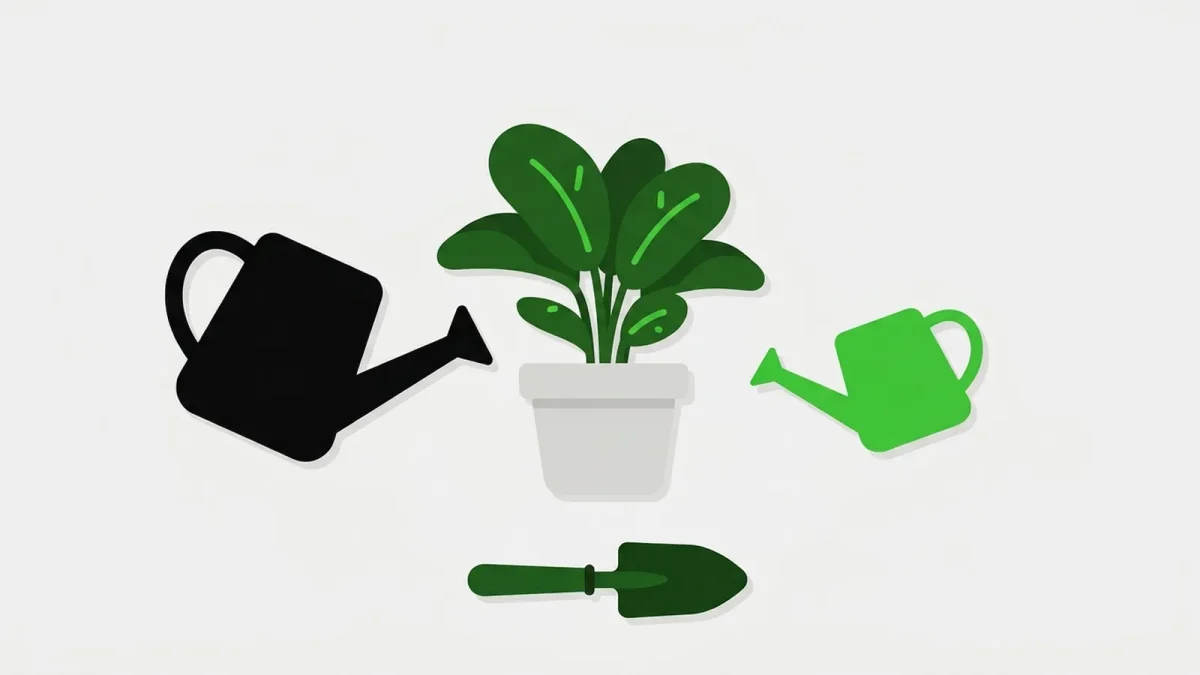
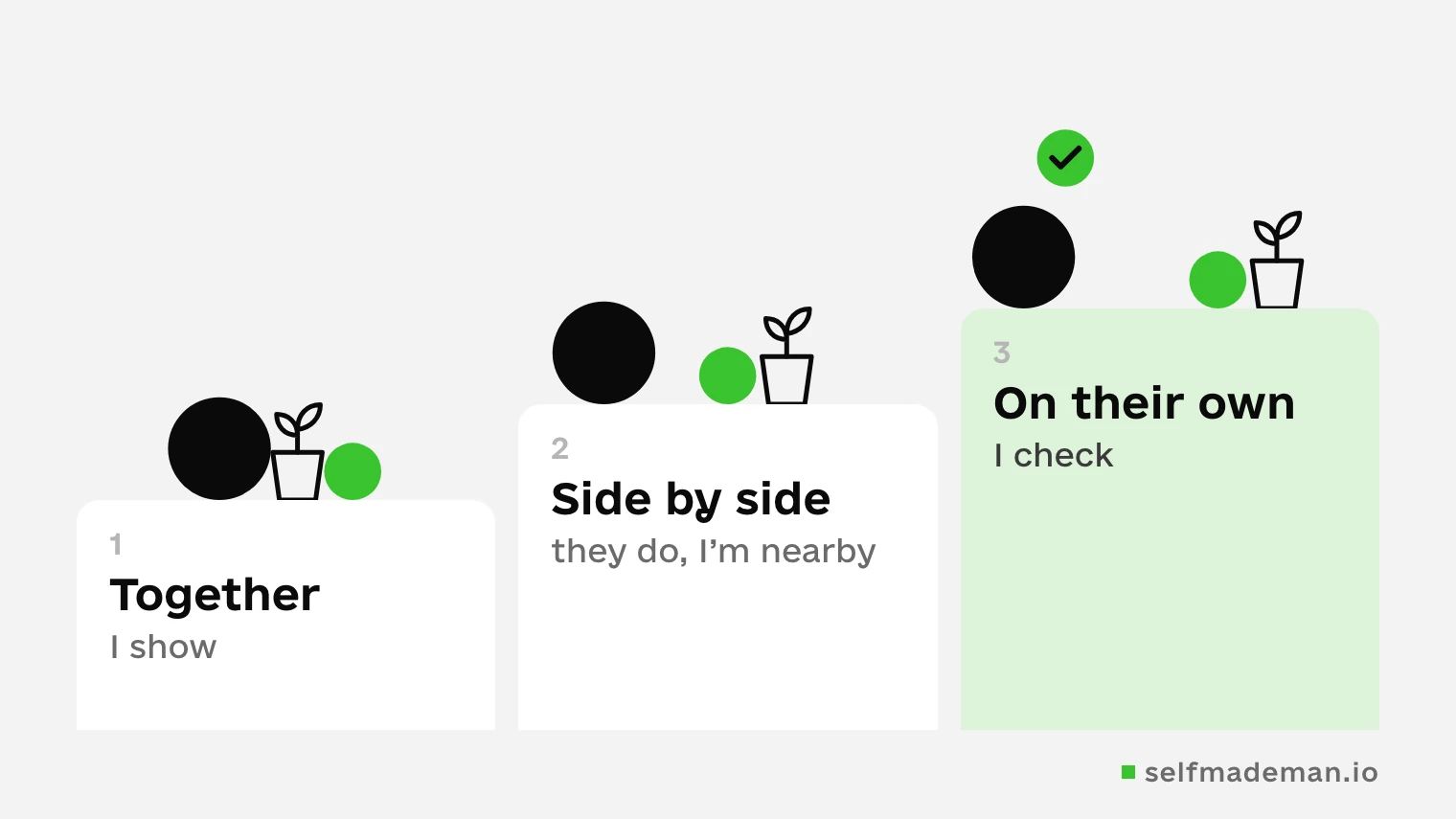
How to teach kids responsibility: give your child one or two real, age-appropriate chores they do regularly, not “when asked.” First you do them together, then side by side, then on their own. Leave them a choice about how and when within the day. Talk about chores as the family taking care of each other, not as a favor to Mom or Dad. Instead of yelling, use calm consequences and a pause. And above all: kids learn responsibility by watching you keep your word.
- Responsibility is a skill, not a personality trait. You build it with small, regular tasks.
- Start with one chore. Not a 20-item chart.
- “You’re a helper” works better than “help me.”
- Basic household chores are part of family life, not paid work.
- Yelling gets you fast results today and bad ones a year from now.
I’m not a child psychologist. This is my experience as a dad and what I found in the research. Every child and every family is different. If you’re worried about your child’s behavior, it’s best to talk it through with a professional.
Table of contents
My experience
I’m a father of sons. And I have a written description of my role as a father, of the kind of dad I want to be. It says: teach kindness, responsibility, and thrift, lead by example, and show as much restraint and patience as I can. Those last two words aren’t there by accident. I can’t “switch on” my kids’ responsibility with an order. All I can do is show it myself and not lose it when things go wrong.
There’s another line in there: come up with games and contests for the kids. And among my more recent affirmations: “I show my children an example of strength, kindness, and responsibility.” It sounds solemn, but in practice it’s everyday stuff: said “I’ll do it,” did it; promised to come, came; cleaned up after myself without being reminded.
One thing that actually worked: we had a checklist of tasks with photos hanging on the door, and the kids would walk up and tick off what they’d done themselves. As for special games and contests, honestly, I can’t remember any right now. The line is in the role. The example isn’t there yet.
What research says
Chores are linked to self-confidence. Researchers at the University of Virginia analyzed data on 9,971 American children1. The more often a child did chores in kindergarten, the higher they rated their own abilities in third grade: in school, with peers, and in life satisfaction. Kids who did almost no chores were more likely to land in the bottom 20% on these ratings. This is an observational study, not an experiment: it can’t prove the chores built the confidence. But the link holds after accounting for parents’ income and education.
What you call the task matters. In an experiment by Christopher Bryan and colleagues, kids aged 3–6 were told either “some kids choose to help” or “some kids choose to be helpers“2. In the second case, kids more often dropped their game to help an adult: pick up spilled crayons, put toys away. The verb version worked no better than not mentioning helping at all. The word “helper” tells a child: this is about who you are, not one action.
Rewards can undercut the urge to help. In 2008, Felix Warneken and Michael Tomasello gave 20-month-olds a toy for helping an adult3. Then the reward was removed. The rewarded kids went on to help less than those who were only praised or got nothing. These were very young children in a lab setting. But the cautious takeaway is useful: if you pay for every “help me,” the motive to help may shift to “what do I get?”
What it takes to do things willingly. Richard Ryan and Edward Deci’s self-determination theory describes three basic needs: autonomy (I choose), competence (I can do this), and relatedness (I belong)4. In chore terms, that’s three questions. Does your child have a choice within the task? Can they actually manage it? Do they feel they’re doing it for the family, not just to check a box?
Yelling doesn’t work long term. Ming-Te Wang and Sarah Kenny followed 976 families with teenagers over two years5. Harsh verbal discipline (yelling, cursing, insults) at 13 predicted more behavior problems and depressive symptoms by 14. Parental warmth the rest of the time didn’t soften the effect. And it ran both ways: a teen’s bad behavior provoked more yelling. A vicious circle.
Psychologist Richard Rende, reviewing research on chores, suggests talking about them not as boring work, but as the way family members take care of each other6. “We” instead of “you have to.”
Chores for kids by age
This is a guide, not a standard. The 5–7, 8–10, and 11–12 rows are based on the American Academy of Pediatrics list of age-appropriate chores7. The 2–4 and 13+ rows are general guidance outside that list. Each stage includes the ones before it.
| Age | What they can do | How to introduce it |
|---|---|---|
| 2–4 | Put toys in a bin, carry their plate to the counter, put clothes in the laundry basket | Only together with you, as a game |
| 5–7 | Make their bed, set and clear the table, feed a pet, water plants, sort laundry by color | Together → side by side. One chore a day, at the same time |
| 8–10 | Vacuum, help with dinner, make themselves a snack, put away their clean clothes and the groceries, walk the dog | On their own, you check. They can choose chores from a list |
| 11–12 | Clean the kitchen, change their sheets, load and unload the dishwasher, wash and fold clothes, cook a simple dish with supervision | On their own. Responsible for the result, not for “I tried” |
| 13+ | Their own laundry, cooking dinner once a week, grocery shopping from a list, their own schedule | Full responsibility. You’re a consultant |
The American Academy of Pediatrics recommends adding new chores one at a time, especially if there were no chores before, and doing them at the same time each day7.
How to teach kids responsibility: 7 steps
- Start with yourself. Look at your week through your child’s eyes: do you keep your promises to them? Do you clean up after yourself? Kids copy what they see, not what they hear.
- Pick one or two chores. Doable for their age, and real: things your family actually needs done. Kids see through “busywork” instantly.
- Together → side by side → on their own. First you do it together, you show how. Then your child does it while you’re nearby. Then on their own, and you check. Move to the next stage when they can do it without prompts.
- Give a choice within the task. Not “clean your room right now,” but “your room needs to be clean before dinner. Want to start with the toys or the books?” Choice is autonomy.
- Name a role. “You’re our kitchen helper,” “you’re in charge of the cat.” A role is part of who you are, not one task.
- Consequences: calm and agreed in advance. Not punishment out of anger, but a logical follow-through: toys not put away before bed, so tomorrow they “rest” on the shelf. Agree on the rule ahead of time, not in the middle of a conflict.
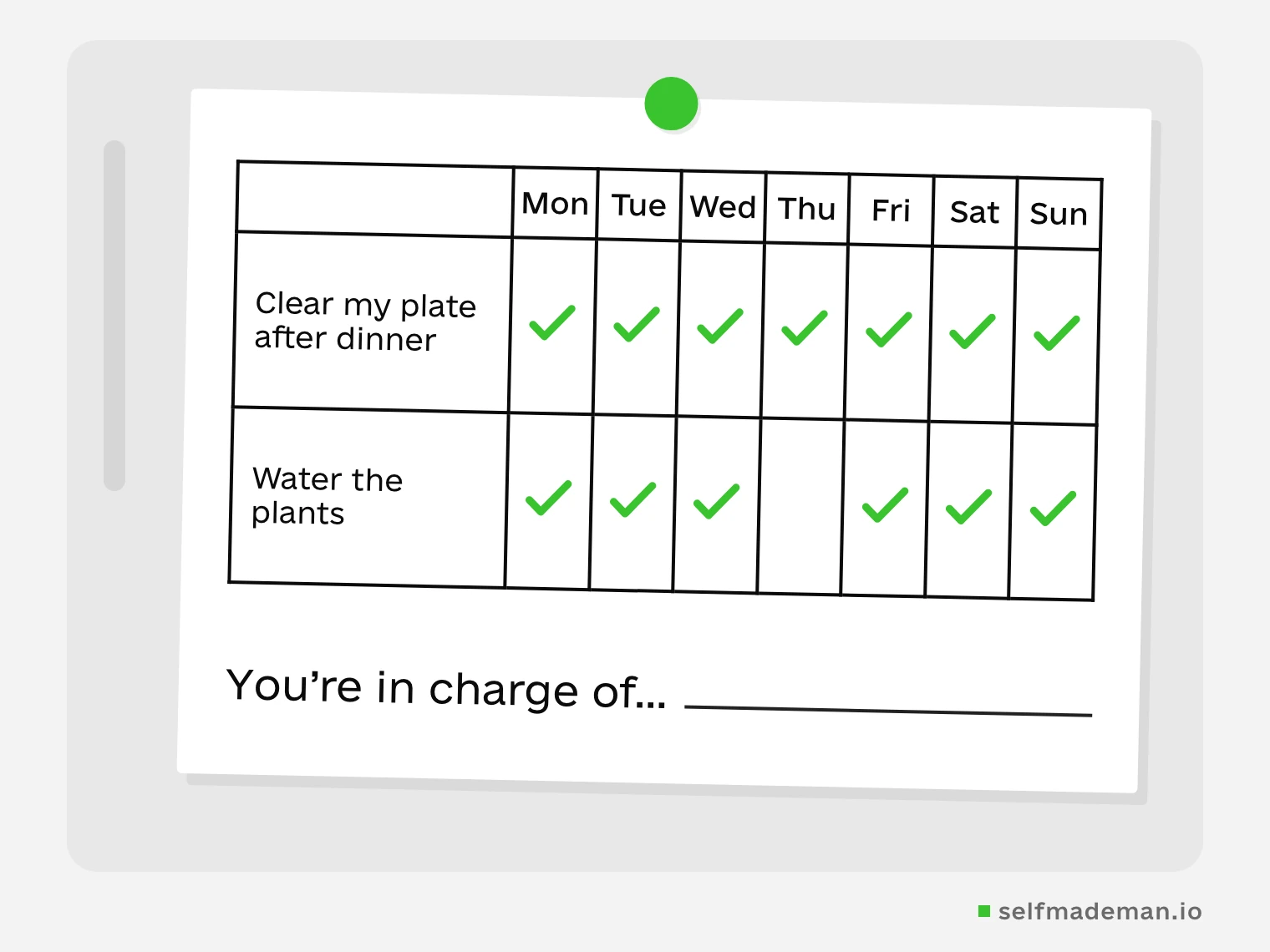
- Track progress. A chart on the fridge, a mark for each day. Praise effort specifically: “You remembered the plants on your own, no reminders.” Not “good job,” but what exactly.
No nagging, no yelling: what to do instead
Yelling almost always happens when the adult has run out of energy, not arguments. So the work is on yourself.
- Pause before you speak. I have a rule: speak from calm, not from anxiety or exhaustion. With kids it’s the hardest one. If you feel you’re about to snap, step out of the room for a minute. The chore can wait.
- One short request. “Shoes on the rack” beats a lecture about how tired you are of tripping in the hallway.
- “When… then.” “When the toys are in the bin, then we’ll put on a cartoon.” Not a threat, just the order of things.
- Don’t redo it for them. Bed made crooked? It’s their bed and their “crooked.” Redo it and they’ll learn trying is pointless.
- Be fully present. Another rule of mine: “With my kids, I’m fully here.” A boring chore is easier for a child when the adult is next to them, not on their phone.
A week of chores on the fridge
Pick an age, one or two chores from the list or your own, a stage, and a time of day. At the end of the day, your child makes the mark: ✓ for done, ★ for remembered without a reminder. When a chore runs steadily without prompts, the chart suggests the next stage.
The chart needs JavaScript. A sheet of A4 works too: days of the week on top, one or two chores on the left.
Each child has a separate chart: no comparing. Tap a cell at the end of the day: ✓ done → ★ on their own → empty. Let the child put the mark.
Praise something specific: “You remembered the plants on your own, without reminders.”
One A4 page per child, big cells for marks. Names stay only in this browser; a nickname works too.
Prefer paper? Print the week: one letter-size or A4 sheet per child, with big boxes. Same principles as an adult habit tracker: mark only what’s done, and a missed day isn’t a disaster.
Should kids get paid for chores?
It’s a debated question. The American Academy of Pediatrics allows for allowance money and stickers tied to completed chores7. On the other hand, the Warneken and Tomasello experiment suggests material rewards can crowd out the desire to help3.
A workable compromise is the same one as in the article on teaching kids about money. There are basic chores everyone in the family does for free, because we live here. And there’s extra work kids can earn from: washing the car, clearing out the storage closet. That way a child doesn’t learn that helping family is for sale, but still sees the link between effort and money.
Where it breaks
- Too much at once. A ten-chore chart is blank within a week. One chore, then a second.
- The perfectionist parent. Redo things for your child and they stop trying. Accept “good enough” for their age.
- Inconsistency. Strict today, shrugging it off tomorrow. Kids quickly figure out the rule is optional.
- Chores as punishment. “You were rude, so you’re on dishes for a week.” After that, dishes are linked to punishment forever, not to caring for the home.
- Comparison. “Your brother was already doing this at your age…” is a sure way to put both of them off.
- Parents aren’t on the same page. One insists, the other does it for the child. There should be one set of rules.
The minimum version
One daily chore at the same time. For example, after dinner your child carries their plate to the sink. No charts, no rewards. A month later it’s normal, and you can add a second one.
When things slip
The yelling already happened. It happens to every parent, not just you. The good news: a blowup is also a lesson in responsibility, if you own it.
“I’m sorry I yelled, that wasn’t okay. I was worn out, but yelling still isn’t okay. Let’s start over: toys in the bin, I’ll help with the cars.”
Your child sees an adult admit a mistake and fix it. That’s responsibility, shown rather than explained.
FAQ
At what age should kids start doing chores?
Simple tasks together with a parent from 2–3: putting toys away, carrying their plate. Regular chores of their own from roughly 5–7. The American Academy of Pediatrics recommends starting early and adding one chore at a time.
What are age-appropriate chores for kids?
At 5–7: making the bed, setting the table, feeding a pet. At 8–10: vacuuming, helping with dinner, putting away clean clothes. At 11–12: loading the dishwasher, doing laundry, cooking a simple dish with supervision. The full table is above.
Should kids get paid for chores?
Opinions differ. A workable compromise: basic chores everyone in the family does are unpaid, extra work can be paid. That way helping family doesn’t turn into a service for money.
What do I do if my child refuses to help?
Check three things: do they have a choice within the task, is it doable for them, and do you do anything together. Offer a choice (“now or after the cartoon?”), agree on a calm consequence in advance, and follow through without yelling.
How do I get my child to keep their room clean?
Fewer things, clear places for them (bins, shelves at their height), and one short daily task, like five minutes of tidying before bed. Do it together until they can manage on their own.
What can I do instead of yelling?
A pause, one short request, “when… then,” and consequences agreed on in advance. After a blowup, apologize and start over. That’s an example of responsibility too.
Your move today
Pick one household chore your child can do every day, and one time for it. Tonight, don’t say “you have to.” Say “starting today, you’re in charge of…” Set up the chart above together, or print it for the week. 15 minutes.
Sources
- White E. M., DeBoer M. D., Scharf R. J. Associations Between Household Chores and Childhood Self-Competency. Journal of Developmental & Behavioral Pediatrics, 2019, 40(3), 176–182. ↩
- Bryan C. J., Master A., Walton G. M. “Helping” versus “being a helper”: Invoking the self to increase helping in young children. Child Development, 2014, 85(5), 1836–1842. ↩
- Warneken F., Tomasello M. Extrinsic rewards undermine altruistic tendencies in 20-month-olds. Developmental Psychology, 2008, 44(6), 1785–1788. ↩
- Ryan R. M., Deci E. L. Self-determination theory and the facilitation of intrinsic motivation, social development, and well-being. American Psychologist, 2000, 55(1), 68–78. ↩
- Wang M.-T., Kenny S. Longitudinal links between fathers’ and mothers’ harsh verbal discipline and adolescents’ conduct problems and depressive symptoms. Child Development, 2014, 85(3), 908–923. ↩
- Rende R. The developmental significance of chores: Then and now. The Brown University Child and Adolescent Behavior Letter, 2015, 31(1), 1–7. The advice to talk about chores as caring for each other comes from a Whirlpool press release on a joint review by Rende, 2014. ↩
- American Academy of Pediatrics. Age-Appropriate Chores for Children. HealthyChildren.org, updated February 9, 2024. Based on Caring for Your School-Age Child: Ages 5 to 12, 3rd ed., 2018. ↩