
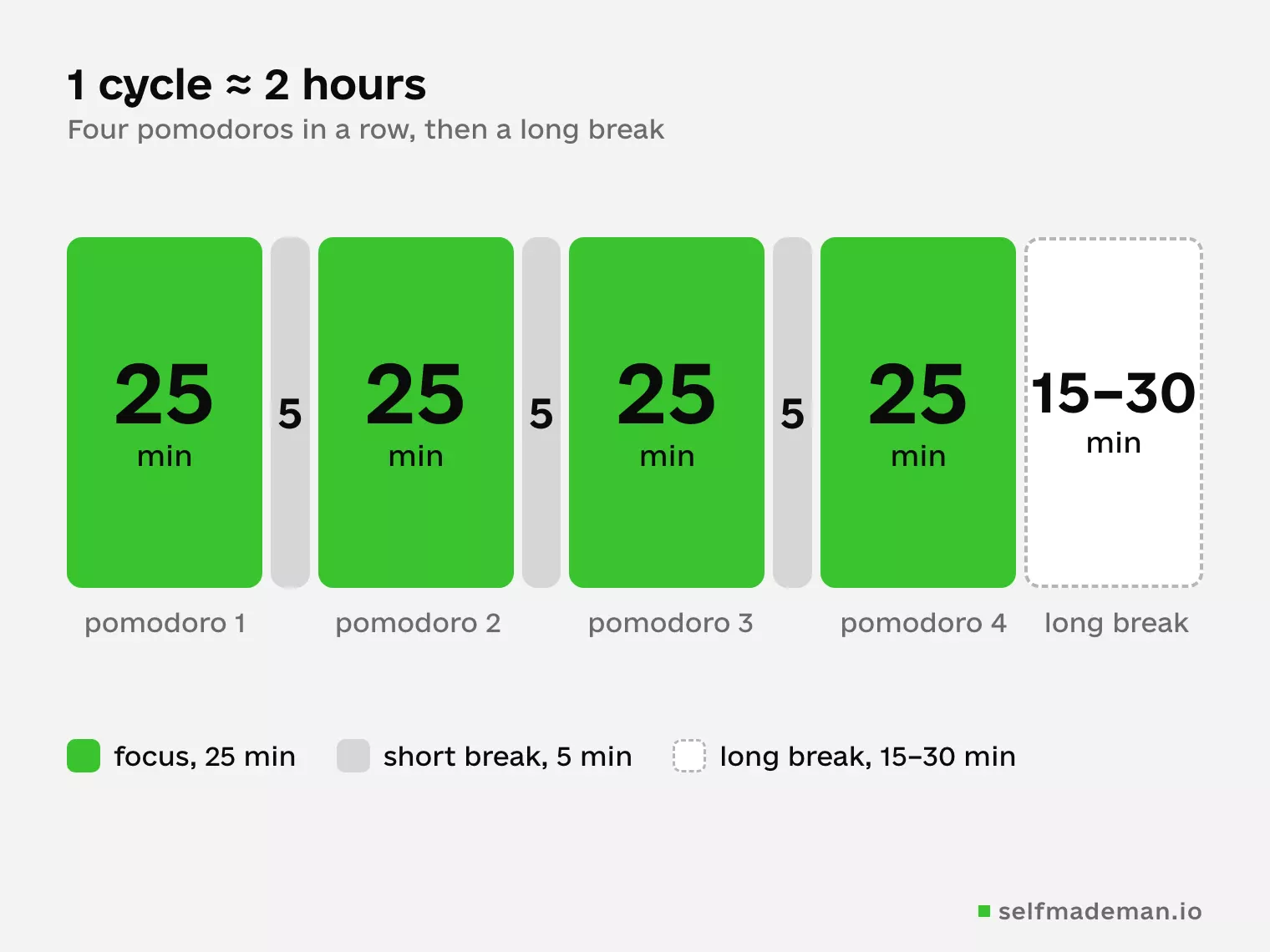
The Pomodoro Technique is a way to work in short cycles: 25 minutes on one task with no distractions, then about 5 minutes of rest, and after four cycles a longer break of 15–30 minutes. Francesco Cirillo, an Italian, came up with it as a university student1. It sounds too simple to work. But the simplicity is the point: the timer decides for you when to start and when to stop. Below is how I work in pomodoros, which interval to pick, and what we actually know about breaks.
- One pomodoro, one task. Switch to something else and the pomodoro doesn’t count.
- 25/5 is for getting started, studying and routine work. 50/10 is for tasks that take a while to get into. 90/20 is for one or two deep sessions a day.
- Short breaks boost energy and reduce fatigue, but they barely move the needle on hard cognitive work.
- In one study, timed breaks worked better than “I’ll rest when I’m tired.” In another, there was almost no difference.
- A break means rest, not scrolling your phone.
Table of contents
- My experience
- What is the Pomodoro Technique: 6 steps
- Pomodoro method intervals: 25/5, 50/10 or 90/20
- Does the Pomodoro Technique work? What research says about breaks
- Start your first pomodoro
- Pomodoro study method, office work, creative work, routine
- Where it breaks
- The minimum version
- If you fall off
- FAQ
- Your action for today
- Sources
My experience
One of my personal rules reads: “I work in honest, clean Pomodoros.” The key word is “honest.” A pomodoro where I opened a messenger twice isn’t a pomodoro. It’s 25 minutes with a timer running in the background.
It’s the same honesty as another rule of mine: don’t mark a task done if it isn’t really finished. Small self-deceptions quickly turn any system into stage decoration.
The timer doesn’t do the work for me — it keeps the work from sprawling.
My setup is the classic 25/5. No clever tweaks: 25 minutes on one task, 5 minutes off. And right next to it on my list is another rule: “I take a lunch break.”
What is the Pomodoro Technique: 6 steps
- Pick one task. Not “work on the project,” but “outline the article” or “clear 20 emails.”
- Set a timer for 25 minutes. Cirillo used a tomato-shaped kitchen timer — pomodoro is Italian for tomato, hence the name1. Any timer works, including ours below.
- Work until it rings. Only on that task. If a thought about something else pops up, jot it down and get back to work.
- Mark the pomodoro. A cross on paper or in a tracker. This shows how many pomodoros a task really took.
- Take a short break — about 5 minutes. Stand up, walk around, drink some water. Don’t open your inbox.
- After four pomodoros, take a long break of 15–30 minutes. Then start the cycle again.
A pomodoro is indivisible. If you get interrupted and have to switch, the pomodoro doesn’t count, and you start a new one1. For calls and requests you can’t ignore, Cirillo has a simple move: tell the person you can’t step away right now, agree on when you’ll get back to them, and follow up after the timer rings.
Pomodoro method intervals: 25/5, 50/10 or 90/20
25 minutes isn’t a law of nature. Cirillo picked that length for himself, and plenty of people stretch it. Three popular setups:
| Setup | Best for | Risk |
|---|---|---|
| 25/5 | Getting started with the method, studying, routine work, tasks you dread | On a hard task, the timer cuts you off just as you hit your stride |
| 50/10 | Writing, code, analysis — anything that takes 10–15 minutes to get into | Easier to drift mid-session, takes discipline |
| 90/20 | One or two deep sessions a day: strategy, a long piece of writing, a hard problem | Without the habit, it turns into 90 minutes of procrastination |
How to choose. Start with 25/5 for a week. If the timer keeps cutting you off at the best part, move to 50/10. Save 90/20 for the one main task of the day — the one you do first.
An honest note on 90 minutes. This setup is usually explained by the “ultradian rhythm.” Physiologist Nathaniel Kleitman proposed that the 90-minute rest-activity cycle that’s clearly visible in sleep continues during the day2. I couldn’t find solid evidence that daytime attention moves in strict 90-minute waves. So 90/20 is a convenient length, not a biologically precise schedule.
Does the Pomodoro Technique work? What research says about breaks
Short breaks help how you feel, but not always how you work. A 2022 meta-analysis pooled 22 samples, 2,335 people, on micro-breaks of up to 10 minutes. Breaks slightly increased vigor and reduced fatigue. But the overall effect on performance was small and not statistically significant. It showed up on simple tasks, not on cognitively demanding ones. And the longer the break, the bigger the effect on performance3.
What this means in practice: 5 minutes is enough to refresh during routine work. After heavy mental work, you need a longer break — hence 50/10 and 90/20.
Timed breaks vs. “I’ll rest when I’m tired.” In a Maastricht University study, 87 students studied on their own during a regular study day. One group took breaks whenever they wanted; two others followed a schedule, for example 24 minutes of work and 6 minutes of rest. The amount of work done didn’t differ. But the self-paced group worked longer stretches without rest, took longer breaks, and more often felt tired and distracted, less often focused and motivated. The authors’ conclusion: scheduled breaks delivered the same results in less time and with a better mood4.
But it’s not a law. In a 2025 study, the same research group gave 94 students a two-hour session. They compared self-regulated breaks, the classic 25/5 pomodoro, and Flowtime — you work as long as it flows, and the break length depends on how long you worked. With pomodoros, fatigue rose faster and motivation dropped faster than with free breaks, though by the end of the session no overall difference had built up. There was no difference in productivity, amount of work done, or flow5.
Both studies were on students and covered a single day. For office work over months, there’s almost no data on the Pomodoro Technique itself.
The honest verdict: the Pomodoro Technique isn’t a magic pill. Its power isn’t in the number 25. The timer removes the question of when to start and when to stop, and the no-switching rule protects the task. If the timer annoys you more than distractions do, lengthen the cycle or try breaks based on how you feel — but log how long you actually rest.
Start your first pomodoro
The timer is below: 25/5, 50/10, 90/20 or your own setup. Type in your task, hit “Start,” and don’t switch until it rings. Got distracted? Hit “Pomodoro interrupted”: an honest count beats a pretty one.
No pomodoros yet today. The first one is the hardest.
Space starts and pauses. The timer keeps going in a background tab and after a page reload.
The timer keeps running in a background tab, but put your phone face down anyway — or better, in another room.
Pomodoro study method, office work, creative work, routine
| Situation | Setup | How |
|---|---|---|
| Studying | 25/5 | One pomodoro, one section or set of problems. During the break, don’t review the material — rest |
| Office with meetings | 25/5 or 50/10 in the gaps between meetings | Email and messages get their own pomodoro 2–3 times a day, not a background hum all day |
| Creative work | 50/10 or 90/20 | The first pomodoro has no quality bar: a draft, sketches, an outline |
| Routine and unpleasant tasks | 25/5 | “Just one pomodoro” is the easiest way to start what you’ve been putting off for a week |
If you want to know which tasks deserve your pomodoros, figure out what your hour is worth. A task worth $20 an hour and a task that moves your main project shouldn’t get the same time.
Where it breaks
- Working on someone else’s rhythm. Support, sales, on-call shifts: people interrupt you for good reasons, and that’s part of the job. Here pomodoros only work for the blocks you control.
- Flow. The work finally gets going — and the timer rings. You can finish up to a natural stopping point, but no more than 10 minutes. If that happens every time, you need a longer cycle.
- A break spent on your phone. Five minutes of scrolling isn’t rest. It’s one more serving of information for your brain. Stand up and step away from the screen.
- Pomodoros for the sake of pomodoros. Twelve pomodoros on email and calls isn’t productivity — it’s bookkeeping for busywork. First decide what matters, then start the timer. How to tell important from urgent — in the Eisenhower Matrix. What matters for the year — in three main goals.
- Overload. The method helps you hold focus, but it doesn’t add energy. Sixteen pomodoros in a row is the same old “grind yourself down with tasks,” just with a timer. My rule: don’t plan the day as if I had unlimited energy.
The minimum version
Bad day? One pomodoro on your main task. 25 minutes, phone in another room. That’s it. One honest pomodoro beats four for show.
If you fall off
Don’t wait for Monday. A broken pomodoro isn’t a failure — it’s data: what pulled you out? Write the reason down in one word. In a week you’ll see a pattern: messenger, coworker, hunger, boring task. Remove the main cause and start the timer again.
Another of my rules fits here best: don’t scrap the whole plan when something goes wrong — adjust and keep going.
FAQ
What is the Pomodoro Technique in simple terms?
Working in cycles: 25 minutes on one task with no distractions, about 5 minutes of rest, and after four cycles a long break of 15–30 minutes.
Why is it called the Pomodoro Technique?
Pomodoro is Italian for “tomato.” Francesco Cirillo timed his work with a tomato-shaped kitchen timer.
Which is better, 25/5 or 50/10?
For getting started, routine work and studying — 25/5. For tasks that take a while to get into, like writing, code or analysis — 50/10. Try each for at least a week and compare how many honest pomodoros you get done per day.
What is the 90/20 rule?
90 minutes of deep work and 20 minutes of rest. It suits one or two hard tasks a day. It’s often tied to a 90-minute activity rhythm, but for daytime that’s a hypothesis, not a proven fact.
Does the Pomodoro Technique work?
Depends on what you count as a result. In one study, timed breaks gave students the same amount of work as free breaks, with less fatigue and in less time. In another, there was almost no difference. Test the main thing it’s worth trying for: is it easier to start, and do you switch tasks less?
Is the Pomodoro Technique good for ADHD?
I haven’t found solid research on the method specifically for ADHD, so I won’t promise anything. If you have a diagnosis, it’s best to discuss your work routine with a specialist and try the timer as an experiment.
Your action for today
Pick one task you’ve been putting off. Type it into the timer above and run 25 minutes with your phone in another room. The timer will count the pomodoro for you; after it rings, write down how many times you felt the urge to get distracted. That’s enough for today.
Sources
- Cirillo F. The Pomodoro Technique: The Acclaimed Time-Management System That Has Transformed How We Work. Currency, 2018. First self-published edition, 2006. Method website: pomodorotechnique.com. ↩
- Kleitman N. Basic Rest-Activity Cycle — 22 Years Later. Sleep, 1982, 5(4), 311–317. ↩
- Albulescu P., Macsinga I., Rusu A. et al. “Give me a break!” A systematic review and meta-analysis on the efficacy of micro-breaks for increasing well-being and performance. PLOS ONE, 2022, 17(8), e0272460. ↩
- Biwer F., Wiradhany W., oude Egbrink M., de Bruin A. Understanding effort regulation: Comparing ‘Pomodoro’ breaks and self-regulated breaks. British Journal of Educational Psychology, 2023, 93(S2), 353–367. ↩
- Smits E. J. C., Wenzel N., de Bruin A. Investigating the Effectiveness of Self-Regulated, Pomodoro, and Flowtime Break-Taking Techniques Among Students. Behavioral Sciences, 2025, 15(7), 861. ↩