
How to delegate in one sentence: hand someone a result along with the right to decide how to get there. Not “do this,” but “here’s the result we need, here’s how we’ll know it’s done, here’s how much freedom you have, and here’s when we check in.” You end up redoing everyone’s work when one of those four things falls out of the handoff. Start with tasks that repeat, are cheap to get wrong, and that someone already knows how to do. And accept up front: the first few times, handing a task off takes longer than doing it yourself. That’s an investment, not a loss.
- Hand off the result, not the steps. Describe what “done” looks like before you hand it over.
- Start with low risk: recurring tasks someone already knows how to do.
- Agree on the level of freedom, from “do it exactly as described” to “decide yourself.”
- Set check-ins in advance, not “so, how’s it going?” every hour.
- Send work back for fixes instead of redoing it. Otherwise the task is yours forever.
Table of contents
My experience
One line in my personal rules reads: “I delegate more.” The word “more” is there for a reason: delegating was hard for me. That’s why one of my later affirmations reads: “I know how to delegate, and I don’t have to carry everything myself.” That’s a reminder to myself, not a statement of fact.
In the description of my role as a leader, I wrote down who I want to be: someone who has set up a transparent system of reporting, finances, delegation and control. On my personal site the wording is simpler: I trust my team and delegate, because people grow when someone believes in them. The gap between those words and an actual week is exactly what this article is about.
Two of my rules turned out to be the key ones for delegation, even though I didn’t write them about it. “I always define the result I want to get.” And: “Don’t mark a task done if it isn’t really finished.” The first is half of a good brief. The second is your acceptance criteria.
Why you struggle to delegate
The reasons sound sensible: “it’s faster if I do it myself,” “nobody will do it like I do,” “I don’t want to overload people,” “explaining takes longer.” Each one has some truth in it. And each one has a cost.
Few people have a talent for delegating, and it makes a real difference. In 2015, Gallup studied 1,446 US entrepreneurs who employ people: 75% of them had limited or low talent for delegating. And among 143 CEOs of fast-growing companies on the Inc. 500 list, those with high delegator talent averaged 33% more revenue in 2013: $8 million versus $6 million1. That’s a correlation, not proof. But the direction is clear: if you don’t hand things off, you hit the ceiling of your own hours.
We rate our own work higher. Jeffrey Pfeffer, Robert Cialdini and colleagues (1998) showed two biases. People judged the same piece of work as better when it had more supervision from a manager. And better still the more the evaluator had been involved in it themselves2. That explains part of the redoing: the work isn’t bad, it just isn’t yours.
The monkey jumps back. A 1974 Harvard Business Review article by William Oncken Jr. and Donald Wass has a metaphor people still remember: every problem is a monkey on someone’s back. An employee comes to you with “we have a problem,” you say “let me think about it,” and now the monkey is sitting on you3. A week later, the manager is carrying the whole team, and the team is waiting.
Delegation isn’t a personality trait. It’s a skill, and you can train it like any other.
What to delegate: a delegation matrix
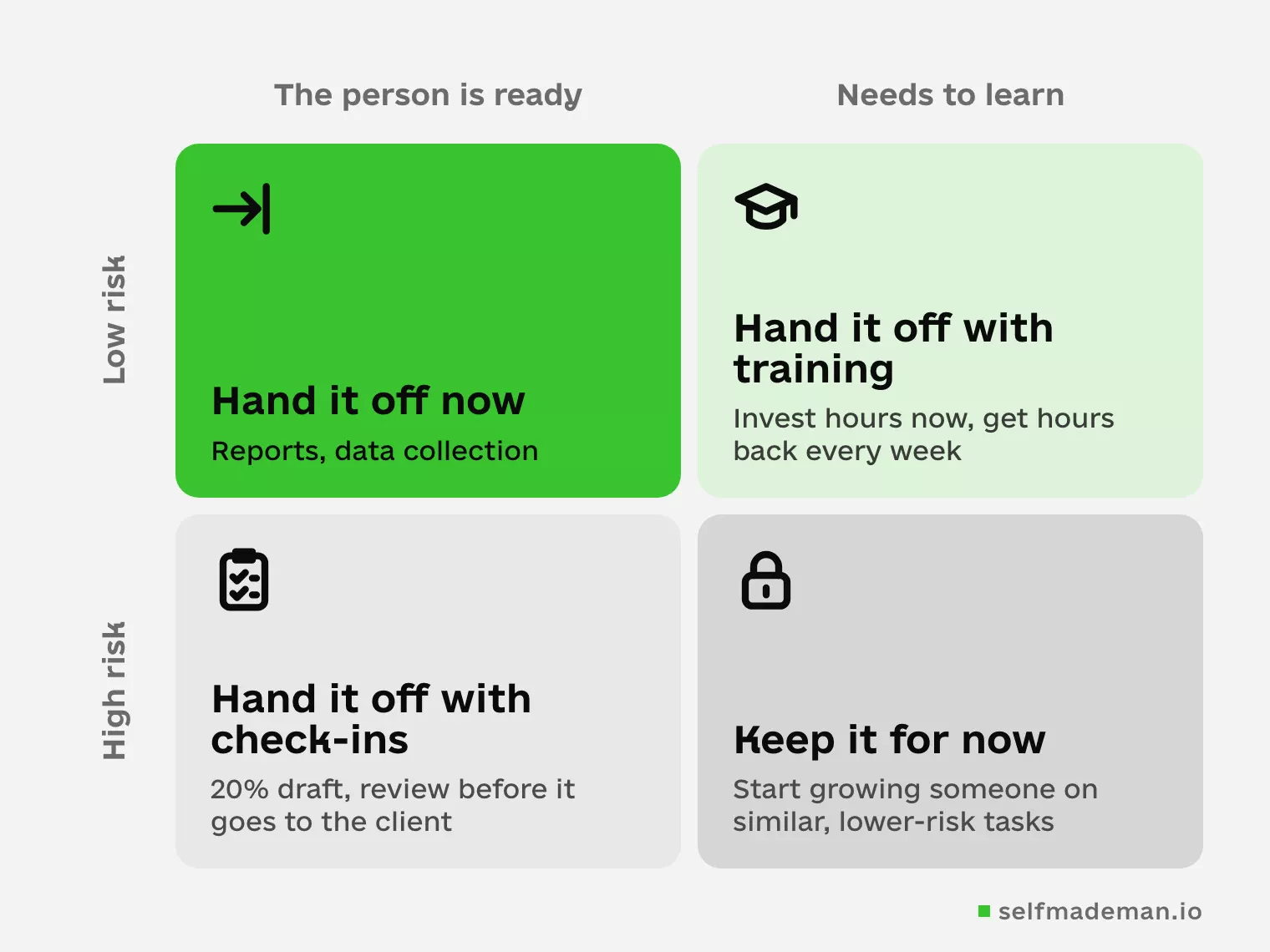
Judge each task by two questions. What happens if it’s done badly? Is there someone who knows how to do it or can learn?
| The person is ready | The person needs to learn | |
|---|---|---|
| Low risk | Hand it off now. Reports, data collection, routine emails, formatting | Hand it off with training. Invest hours now, get hours back every week |
| High risk | Hand it off with check-ins. A 20% draft, a review before it goes to the client | Keep it for now. And start growing someone on similar, lower-risk tasks |
Two more filters:
- Does the task repeat? A one-off complex task is the most expensive to hand off: the explaining won’t pay for itself. A recurring task is the best deal.
- What’s your hour worth on it? If the task can be done well enough for less than your hourly value, it’s a candidate. How to work that out — in the article on how much your time is worth. And in the Eisenhower Matrix, delegation candidates live in the “urgent but not important” quadrant.
What you don’t delegate: direction and priorities, hiring key people, feedback to your direct reports, and decisions you’re personally accountable for to a client or your family.
How to delegate tasks: 7 steps
- Describe the result. Not “take care of the website,” but “by Friday, three new service pages on the site, one for each line of business.”
- Set the criteria for done. What will you check before you accept the work: scope, format, quality, what’s been tested. If they’re not in the brief, they’ll live in your head, and the other person won’t guess them.
- Agree on the level of freedom. How many decisions the person makes on their own (see the scale below).
- Give context and resources. Why it matters, who it’s for, access, budget, a good example from the past.
- Set check-ins in advance. For example: a plan tomorrow, a 20% draft on Wednesday, the final on Friday. That’s not distrust. It’s a way to catch a mistake while it’s still cheap.
- Don’t take the monkey. When someone comes to you with a problem, ask: “What do you suggest?” They make the call; you agree or adjust.
- Accept against the criteria, not your taste. Check against step 2. Say what worked and what to fix.
5 levels of delegation
A handy working scale. The idea is similar to the seven levels of delegation in the Management 3.0 approach4. The point is the same: set the level of freedom explicitly, not by default.
| Level | What you say | When it fits |
|---|---|---|
| 1 | “Do it exactly as described” | New person, high risk |
| 2 | “Look into it and bring me options; I’ll choose” | The person is learning, the decision is costly |
| 3 | “Recommend a solution; I’ll approve it” | The person knows the topic, medium risk |
| 4 | “Decide and let me know what you chose” | Experienced person, familiar task |
| 5 | “Decide yourself; no need to report” | The task is fully theirs now |
The goal is to raise the level over time. A task that has sat at level 1 for two years isn’t delegated. It’s just done by someone else’s hands.
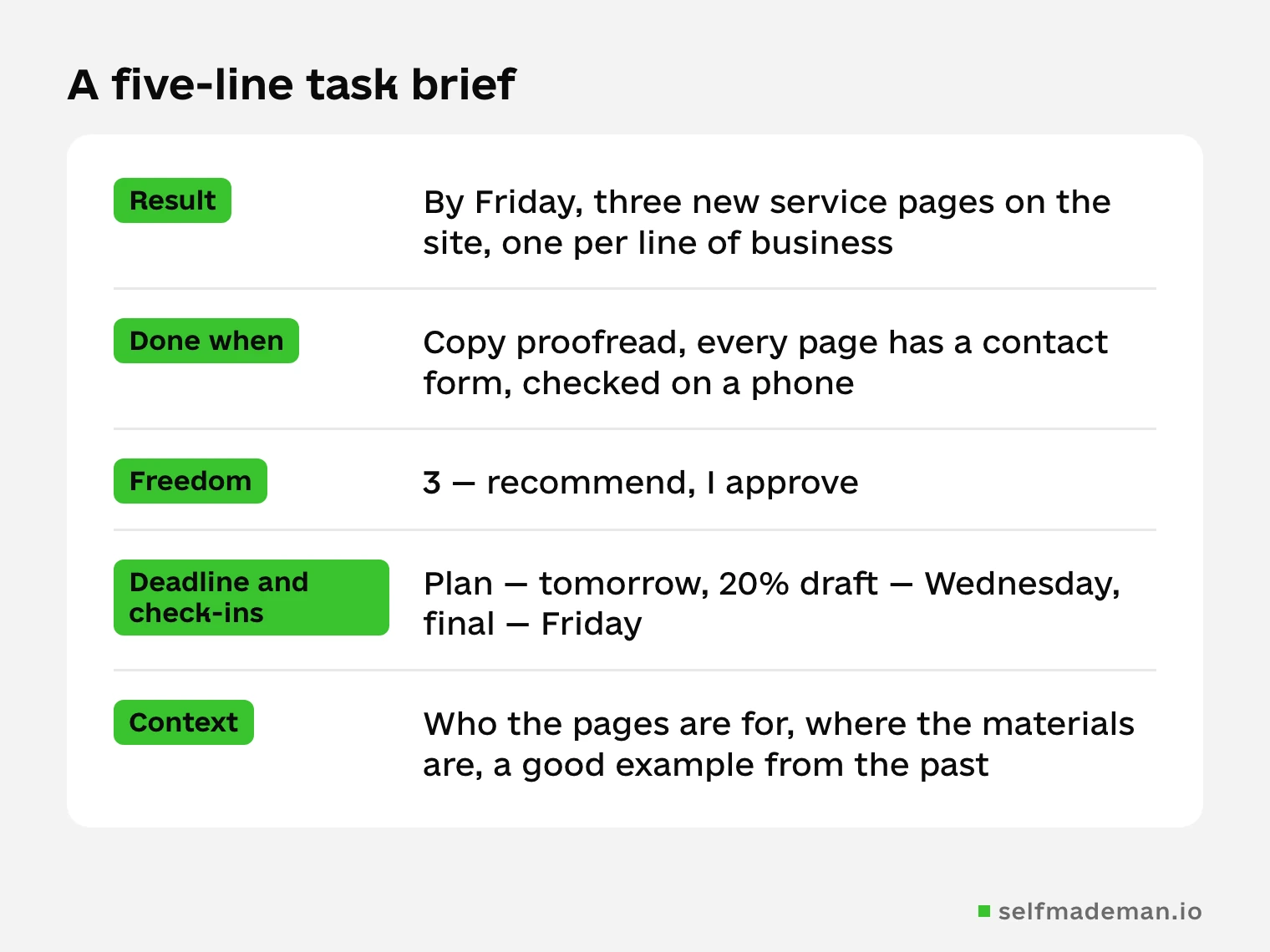
A 5-line task brief
Five lines that prevent most of the redoing:
- Result: what should exist at the end.
- Done when: 2–4 checkable criteria.
- Freedom: level 1 to 5.
- Deadline and check-ins: the final date and one or two checkpoints.
- Context: why, for whom, where to find materials.
How to stop redoing everyone’s work
- Tell a mistake from “not how I’d do it.” If the result meets the criteria but you don’t like the style, that’s a reason to sharpen the criteria next time, not to rewrite it now.
- Send it back, don’t redo it. Write what to fix and hand it back. Redo it for someone once, and you’ve taught them that’s an option.
- Find the broken step. A redo almost always points to one of these: the result wasn’t described, there were no criteria, the freedom level was higher than the person was ready for, or there was no check-in.
- Count the investment. A task takes you 2 hours a week. Training takes 6 hours, plus an hour of review a week for the first two weeks. After a month you’re ahead, and from then on it’s almost 9 free hours every month.
The “what to delegate” matrix
Add your tasks for the week and answer two questions about each.
Write down ten of your tasks from last week. Mark the ones that repeat and are not scary if done wrong. Pick one, write a five-line brief and send it today. 15 minutes.
For each task: how many hours it takes you, what happens if it is done badly, and whether someone can do it or learn it. Ctrl + Enter adds the list.
What is not delegated
Only yours: direction and priorities, hiring key people, feedback to your direct reports, decisions you answer for personally. Mark such a task “Not delegated”: it stays with you whatever the risk.
Two more filters. A one-off complex task is the most expensive to hand over; a repeating one pays back best. And if the task can be handed over cheaper than your hour and done well enough, it is a candidate.
Tasks from the three “give it away” zones will appear here.
A4. In the print dialog choose “Save as PDF” to keep a file. Everything stays in this browser.
Where it breaks
- Responsibility without authority. “You own the result, but run every decision by me” isn’t delegation. It’s a trap for the other person. The level of freedom has to match what you’ll hold them accountable for.
- Dumping instead of delegating. If you only hand off what you find unpleasant, with no context and no growth for the person, the team will notice fast.
- Micromanagement. Once check-ins are agreed, don’t poke between them. Otherwise people wait for your decisions instead of making their own.
- No one to delegate to. A freelancer or a small business without a team. Then you delegate to services and contractors, or you automate. My rule for any recurring work: “Can this be automated?”
- Delegating everything at once. Hand off ten tasks in a week and you’ll get ten failures and the conclusion “you can’t trust anyone.” One or two tasks at a time.
The minimum version
One task a week. Recurring, low risk. A five-line brief from the template. No systems, just one handed-off task. In a quarter, that’s twelve tasks that aren’t yours anymore.
If the task came back to you
It happens. Deadlines were burning, the client was waiting, and the task landed back on your desk. That doesn’t mean delegation “isn’t for you.” Find which of the seven steps fell out and hand the task back with a fix: drop the freedom level by one, add a check-in, write out the criteria. Handing it off again with less freedom beats keeping it forever.
FAQ
Why do I struggle to delegate?
It feels faster to do it yourself, the result isn’t clearly described, and it’s awkward to load people up. There’s also a perception bias: research shows we rate work we were involved in higher, even when it’s identical.
What are the steps of delegation?
Describe the result, set the criteria for done, agree on the level of freedom, give context and resources, set check-ins in advance, don’t take the problem back, and accept against the criteria. Different authors count five or seven steps; the substance is the same.
What are the levels of delegation?
It’s handy to think in five: “do it as described,” “bring me options,” “recommend, I’ll approve,” “decide and tell me,” “decide yourself.” The Management 3.0 approach uses seven. The key is to agree on the level explicitly.
What should you not delegate?
Direction and priorities, hiring key people, feedback to your direct reports, and decisions you’re personally accountable for. Everything else can be handed off; it’s only a question of the freedom level and check-ins.
What’s the difference between delegating tasks and delegating authority?
You can hand off a task at the “do it as described” level. Authority is the right to decide: spend a budget, pick a contractor, answer the client. Real delegation starts when the task comes with the authority it needs.
What if my employee does it worse than I would?
First check whether the result meets the criteria. If it does, it’s “different,” not “worse.” If it doesn’t, send it back with specific fixes instead of redoing it yourself.
Your action for today
Write down ten of your tasks from last week. Mark the ones that repeat and aren’t scary to get wrong. Pick one, write a five-line brief from the template, and send it to someone today. 15 minutes.
Sources
- Badal S. B., Ott B. Delegating: A Huge Management Challenge for Entrepreneurs. Gallup Business Journal, April 14, 2015. ↩
- Pfeffer J., Cialdini R. B., Hanna B., Knopoff K. Faith in Supervision and the Self-Enhancement Bias: Two Psychological Reasons Why Managers Don’t Empower Workers. Basic and Applied Social Psychology, 1998, 20(4), 313–321. ↩
- Oncken W. Jr., Wass D. L. Management Time: Who’s Got the Monkey? Harvard Business Review, 1974; reprinted November–December 1999. ↩
- Management 3.0. Delegation Poker. Seven levels of delegation: tell, sell, consult, agree, advise, inquire, delegate. ↩