How do you start a business with no money? You can, but it isn’t free: instead of cash, you invest your skills, time, contacts and reputation. Here’s the path that works. Sell what you already know how to do, starting as a service. Land your first paying client before you spend anything. Decide in advance how much time and money you can afford to lose. And don’t drop your main income until the business replaces it. There’s no fast money here. About half of new US business establishments close within five years1, and that’s normal statistics, not a verdict.
- Skills, time, contacts and reputation replace money. Start with what you already have.
- A service before a product: the client pays before you buy anything.
- First sale before any spending. No buyer, no business — just a hobby.
- Decide up front how much you can afford to lose. Don’t borrow for an idea nobody has bought.
- Keep your main income until the business replaces it.
Table of contents
- My experience
- What percentage of businesses fail? The honest numbers
- What “starting a business with no money” really means
- How to start a business with no money: 7 steps
- How to validate a business idea: 10 questions
- What not to do
- Where it breaks
- The minimum version
- If your first attempt doesn’t work
- FAQ
- Do this today
- Sources
My experience
I didn’t grow up with money. From the age of seven, I helped my parents in the fields. In my free time I collected and returned bottles, turned in scrap metal I found at dumps, and bought and resold small things.
Then came SEO. From 2007 to 2015 I worked at Promodo and rose to SEO Team Lead. Then I founded my own agency, UpMotion. Alongside it, I built a portfolio of my own websites: today they get more than 100,000 users a month.
If I had to boil the path down to one idea, it’s already in my rules: “Every day, one small action toward a long-term asset.” Money shows up when you do something someone is willing to pay for. Not when you come up with an idea.
What percentage of businesses fail? The honest numbers
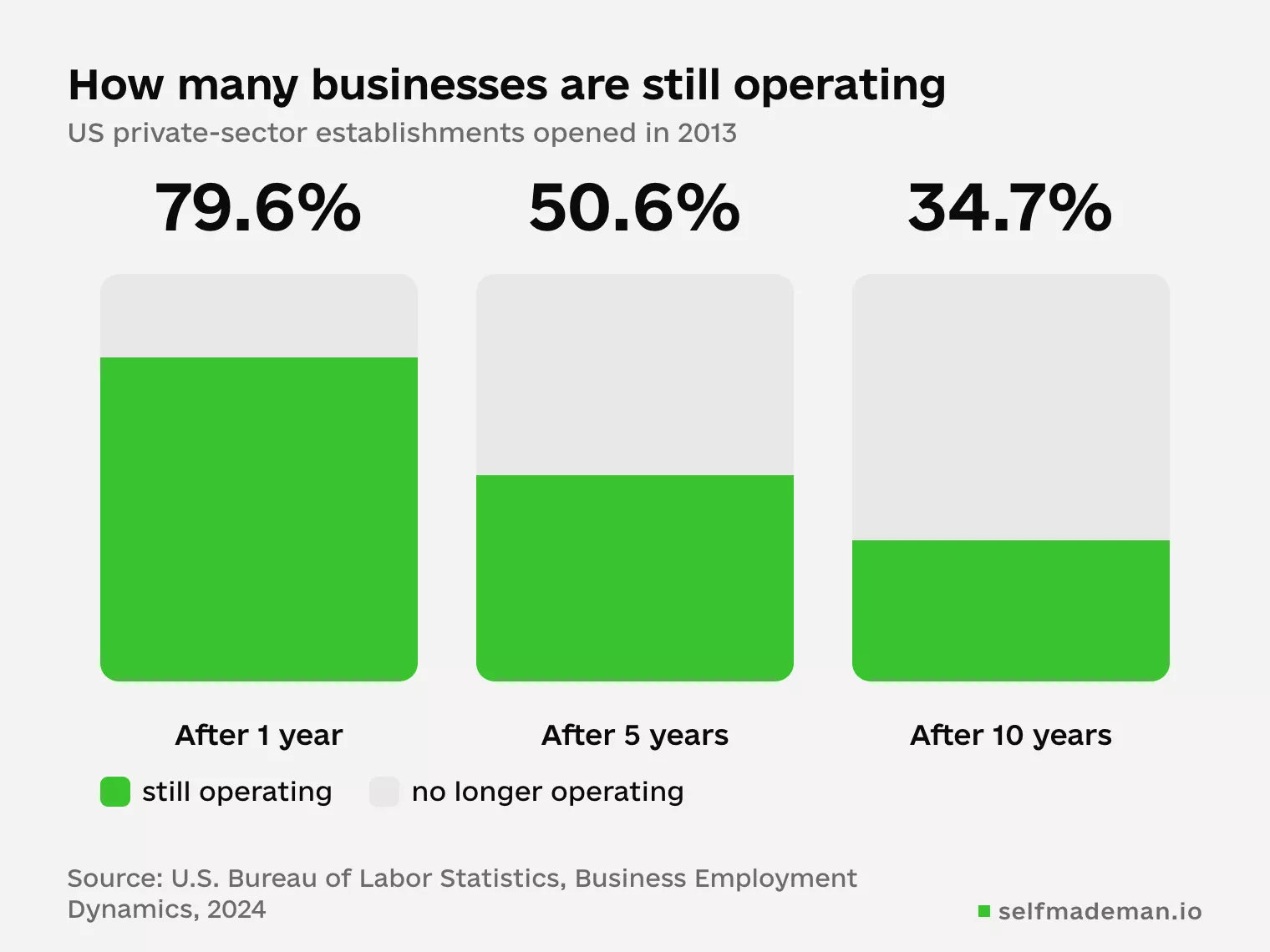
According to the U.S. Bureau of Labor Statistics (Business Employment Dynamics program), of private-sector establishments that opened in 2013, 79.6% were still operating after one year, 50.6% after five years, and 34.7% after ten1.
Two caveats, so you don’t panic for no reason:
- These are numbers for establishments (business locations), not people. Closing isn’t always failure: some owners sold, some closed one business and opened another.
- This is US data. But the order of magnitude is useful anywhere: not everyone survives year one, and about half make it to year five.
The takeaway isn’t “don’t start.” It’s “start in a way that closing won’t ruin you.” That’s exactly what the no-capital path is for: a small bet, a fast test, and your client’s money instead of your own.
What “starting a business with no money” really means
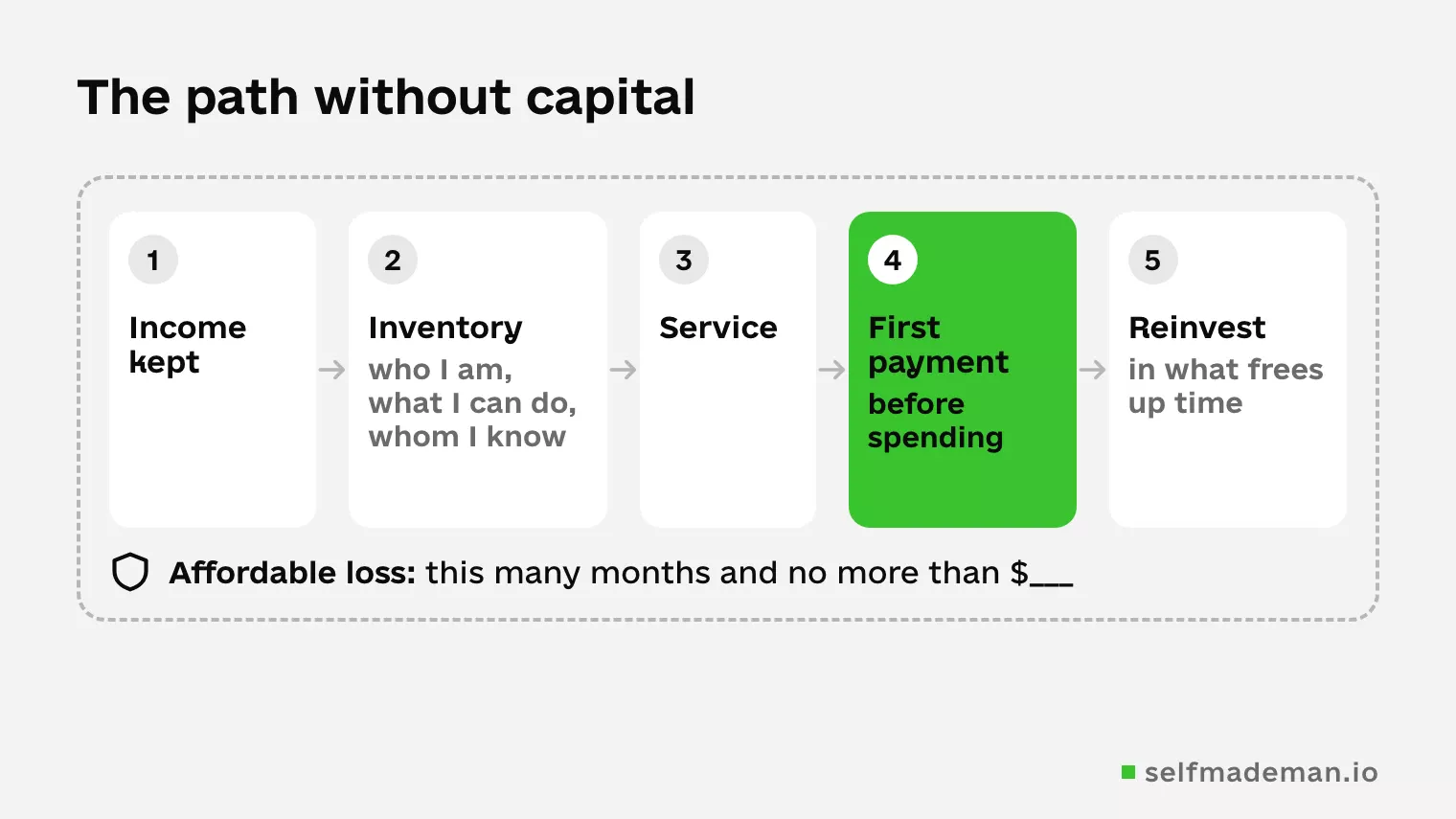
There’s no such thing as a business with zero investment. There’s a business where you invest something other than money. Entrepreneurship researcher Saras Sarasvathy described how experienced entrepreneurs actually operate: they don’t start with a goal and a business plan, but with what’s at hand — who I am, what I know and whom I know — and they decide how much they’re willing to lose, not how much they hope to earn2.
| Instead of money | What it looks like in practice |
|---|---|
| Skills | What people have already paid you for: your job, freelancing, helping friends |
| Time | Evenings and weekends. A finite resource: sleep and family aren’t a reserve |
| Contacts | Former coworkers, your employer’s clients, people in your field |
| Reputation | People take your word because they remember your good work |
| Cushion | Living expenses, so you don’t sell in a panic |
How to start a business with no money: 7 steps
- Keep your income. Don’t quit on day one. Evenings and weekends plus a cushion for a few months of living expenses — that is your starting capital.
- Take inventory. Three columns: who I am, what I can do, whom I know. Your idea grows from here, not from a list of “50 business ideas with no money.”
- Start with a service. A product needs money before the first sale. A service doesn’t: the client pays, you do the work. Websites, repairs, bookkeeping, translation, tutoring, design — something you already know how to do.
- Sell before you invest. Talk to ten people who have the problem you solve. Offer a pilot, a pre-order, a discounted first project in exchange for a review. The first payment is the real test of your idea.
- Decide how much you can afford to lose. In advance: this many months of evenings and no more than this many dollars. Sarasvathy calls this the affordable loss principle2. Taking out a loan for an idea nobody has bought isn’t courage. It’s betting your family.
- Figure out your hourly rate. A freelancer’s hourly rate isn’t “salary ÷ 160.” Taxes, expenses, unpaid hours — it all goes into the price. How to calculate it: how much your time is worth.
- Reinvest and build systems. Your first earnings go into whatever frees up your time: tools, an assistant, automation. In the description of my role as an entrepreneur, I wrote: invest more than 20% of monthly profit in growing the company.
I don’t wait for money to get started — I start with what I already have.
How to validate a business idea: 10 questions
Before the verdict, honestly: does any of this apply to your idea?
One A4 page; in the print dialog choose “Save as PDF”. Everything stays in this browser.
A self-check of the idea against the criteria from the article, not a business plan and not a forecast of income. Registration and tax rules depend on the law of your country.
What not to do
- Don’t pay for a “turnkey business, no investment needed.” Courses and mentors who promise income within a month with no experience make money off you, not with you.
- Don’t join schemes where the money comes from recruits. If your income depends on how many people you bring in rather than on what you sell to customers, it’s a pyramid scheme, however it’s packaged.
- Don’t take out a loan or max out a credit card to get started. Until you have paying clients, debt turns testing an idea into a risk for your family.
- Don’t register a company or order a logo before your first sale. The paperwork matters, but after you have a client. Registration and tax rules depend on where you live.
Where it breaks
- The hourly ceiling. A service started with no money means selling your own time. At some point you run out of hours. Next comes delegation, a team, a product. That’s the next stage, not failure.
- Not everything can start without capital. Manufacturing, food service, a store with inventory all need money before the first sale. For those, the path is different: save up, find a partner, start with a micro version (a farmers market stall instead of a café).
- No money means slower. You grow at the speed of your evenings. That’s the price of not risking your savings or anyone else’s.
- Burnout. A day job plus a business at night. If sleep and family have become “resources,” you’re headed the wrong way. My rule: “Don’t plan the day as if I had unlimited energy.”
The minimum version
No energy for seven steps? One action a week: a conversation with someone who could become a client. Not a sales pitch, a question: “How do you handle this right now, and what does it cost you?” Ten conversations like that will tell you more about your idea than a month of planning.
If your first attempt doesn’t work
An idea that didn’t sell doesn’t mean you’re “not an entrepreneur.” You lost exactly what you set aside for risk, and in return you got skills, contacts and a feel for the market. That’s the whole point of affordable loss: you get more than one shot. Look at what broke: the wrong problem, the wrong buyer, the wrong price. Change one thing and try again.
FAQ
Can you start a business with no money?
You can start without capital, but not without investing. You pay with time, skills and reputation. The easiest way in is a service, where the client pays before you buy anything.
What is the easiest business to start with no money?
The one where you already have the skill and know people who need it. Lists of “businesses to start with no money” are useless if you can’t do what’s on them and don’t know who to sell it to.
Is $1,000 enough to start a business?
For a service, it’s often enough: a laptop, a phone plan, a simple website. What matters more is a cushion to live on while clients are few. It’s smarter to keep that $1,000 as a reserve than to spend it before your first sale.
How do you start a side business without quitting your job?
Evenings and weekends, plus your first clients from your own network. Check your employment contract for any ban on working with your employer’s clients or competitors. Quit when the business reliably brings in close to your salary.
What percentage of new businesses fail?
According to the BLS, of US establishments opened in 2013, 79.6% were still operating after one year, 50.6% after five years and 34.7% after ten1.
Do this today
Take a sheet of paper and split it into three columns: who I am, what I can do, whom I know. Circle one skill people have already paid you for. Under it, list five people who might need it, and message the first one before the day is over. 15 minutes.
Sources
- U.S. Bureau of Labor Statistics. 34.7 percent of business establishments born in 2013 were still operating in 2023. The Economics Daily, January 12, 2024. Business Employment Dynamics data, private sector. ↩
- Sarasvathy S. D. Causation and effectuation: Toward a theoretical shift from economic inevitability to entrepreneurial contingency. Academy of Management Review, 2001, 26(2), 243–263. ↩