How to prioritize tasks for the day comes down to one decision: which one or two tasks matter more today than everything else. You pick them the night before and do them first, in the best hours of your day. Everything else, from routine work to email to small stuff, comes after, and if some of it doesn’t get done, that’s fine. A 15-item list doesn’t help you prioritize. It hides your priorities. Below: how to pick your most important task with three questions, where the method comes from, and where it breaks.
- One or two most important tasks a day. Not three “top priorities,” not five.
- Pick them the night before with three questions: direction, leverage, reality.
- The important thing first, routine work after.
- Everything else doesn’t disappear: it goes on your calendar or a “later” list, and your head is clear.
- Didn’t finish the main task? Move it to tomorrow. Don’t stack another one on top of it.
Table of contents
- Why a 15-item to-do list doesn’t work
- Where the most important task method comes from
- My experience
- How to choose your most important task: three questions
- How to prioritize work, step by step
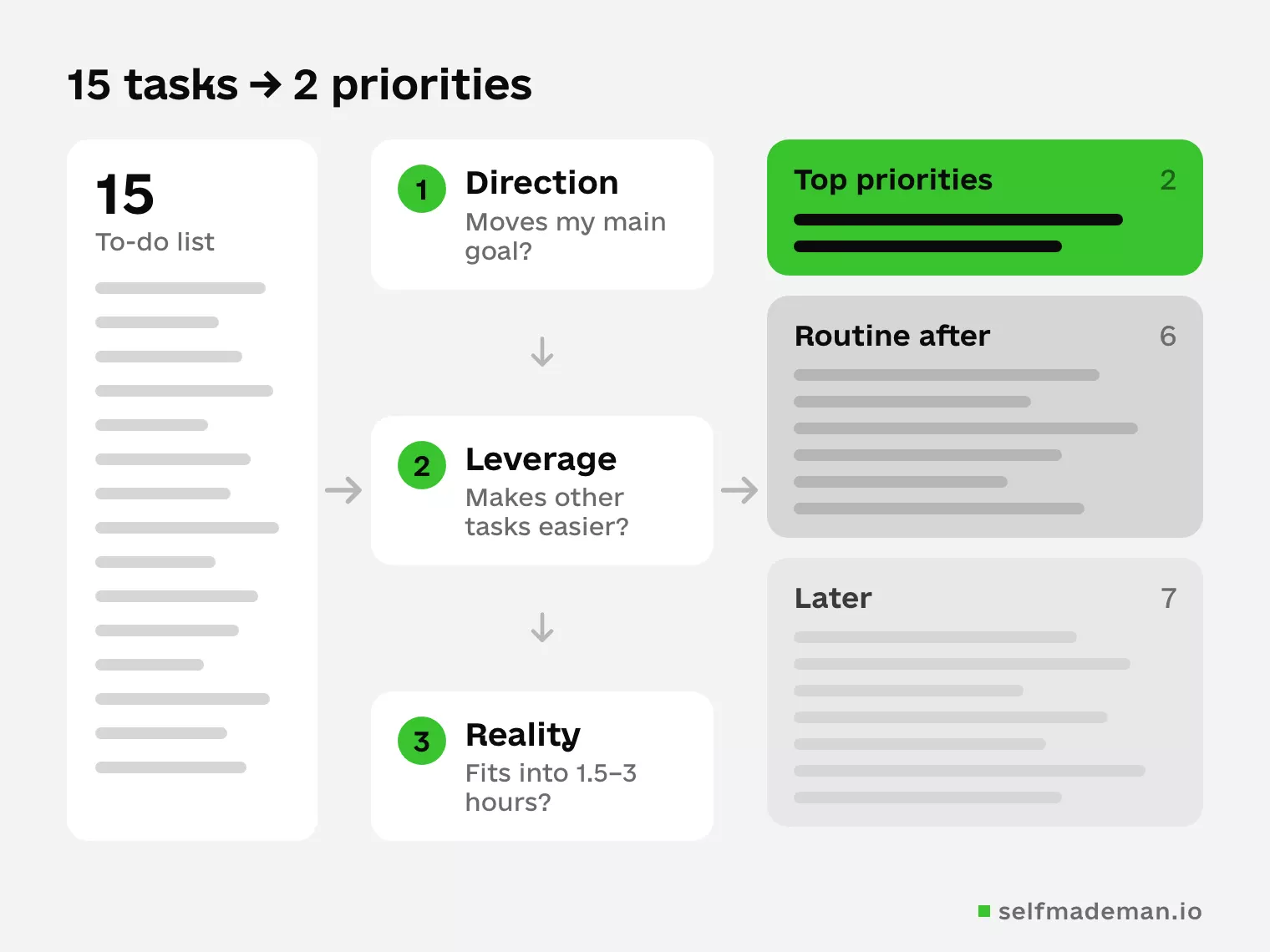
- Example: from 15 tasks to 2 daily priorities
- Most important task builder
- Most important task vs. eat the frog vs. the Eisenhower Matrix
- Where it breaks
- The minimum version
- If you fall off
- FAQ
- Your action for today
- Sources
Why a 15-item to-do list doesn’t work
Urgent beats important even when that’s a bad deal. In 2018, Meng Zhu, Yang Yang and Christopher Hsee published a series of five experiments. People chose the task with a short deadline even when another task paid more and took the same effort. The effect was stronger in people who saw themselves as very busy1. A long list is the perfect habitat for this: there’s always something “on fire” and quick in it.
The more goals at once, the worse each one goes. Even a specific “when, where, what” plan helps a single goal, but loses its power when there are many such goals2. Fifteen items are fifteen small goals fighting over one morning.
A list creates the illusion of work. Crossing off small things feels good. By lunch, nine items are done, the day feels productive, and the thing that actually moves the project hasn’t been started.
Where the most important task method comes from
The idea is old, and it comes in several versions.
- The Ivy Lee method. The famous story: in 1918, consultant Ivy Lee advised Charles Schwab, president of Bethlehem Steel, to write down the six most important things for tomorrow every evening, in order of importance, and in the morning work only on the first one until it’s done. Supposedly, three months later Schwab sent him a check for $25,000. That Lee worked with Bethlehem Steel is confirmed. The check story is a popular retelling with no document from the time to back it up3.
- The MIT method: Most Important Task. Leo Babauta, the author of the Zen Habits blog, suggested in 2007 starting each day with one to three most important tasks and doing them first4.
- The 1-3-5 rule. Alex Cavoulacos of The Muse: one big thing, three medium things and five small ones per day5. A softer version for days when you can’t avoid small stuff.
- The ONE Thing. Gary Keller boiled it all down to one question in his 2013 book “The ONE Thing”: what’s the one thing I can do such that by doing it everything else will be easier or unnecessary?6
The method isn’t about how many tasks — it’s about the order. First what moves things forward. Then what keeps things running.
My experience
My rules about tasks show pretty clearly how my approach changed. The early ones said “I try to complete as many basic tasks as possible each day” and “I complete as many tasks from the flow as I can.” The later ones say something else: “every day, pick 1–2 main tasks and put them above everything else” and “do the important thing first, then the routine work.” And one more, the shortest of all: “one main focus for the day, and I do it first.”
One more line from my rules explains how to choose: “I don’t choose by tasks — I choose by direction.” The main task of the day isn’t the most urgent or the most pleasant one. It’s the one that leads where I’m going this year.
That really was the order: first “get as much done as possible,” then “one or two main tasks above everything else.” Not more — the main thing first.
How to choose your most important task: three questions
Take your list for tomorrow and run the candidates through three questions.
| Question | What it checks | Red flag |
|---|---|---|
| Direction. Does this move my main goal for the quarter or the year? | Importance, not urgency | “Well, this needs doing too” |
| Leverage. Will some of my other tasks get easier or become unnecessary after this? | Payoff | The task changes nothing but itself |
| Reality. Does it fit into my best block tomorrow, 1.5–3 hours? | Size | “Build the website,” “sort out my finances” |
Your most important task is the one with three yeses. If several get three yeses, pick by leverage. If none do, it’s one of two things: either there’s nothing important on the list (that’s an answer too), or the important thing is too big and needs to be broken into steps.
The yearly goals you check the first question against are in the piece on goals for the year.
How to prioritize work, step by step
- In the evening, get it all out. Every task for tomorrow goes on paper or into your task manager. Keep nothing in your head.
- Run the list through the three questions. Mark the candidates with three yeses.
- Pick one, two at most. The second one only if the first takes less than half of your best block.
- Define the result. Not “work on the presentation” but “10 slides with numbers, done.” Without a result, the task goes fuzzy.
- Put it first on your calendar. In the best hours of your day, before email and messengers. Everything else goes on the calendar after it, or on the “later” list.
- In the morning, go straight to the main task. Email and calls come after the first block.
Step 1 does more than make a list. When unfinished work is written down with a clear plan, it intrudes less on your mind while you do other things: in experiments by Masicampo and Baumeister, making a plan alone was enough to stop intrusive thoughts about an unfinished goal7. So the other 13 items don’t need to get done today. They need to get written down.
Example: from 15 tasks to 2 daily priorities
A typical day for someone running their own small project. There are 15 items on the list; the table shows seven typical ones. The rest are small and get sorted the same way as the emails and bills.
| Task | Direction | Leverage | Reality | Where it goes |
|---|---|---|---|---|
| Finish a proposal for a big client | yes | yes | yes | priority #1 |
| Set up an automatic report that’s now built by hand | yes | yes | yes | priority #2 |
| Answer 30 emails | no | no | yes | routine, after lunch |
| Team call | partly | partly | yes | calendar, 3:00 p.m. |
| Pay the bills | no | no | yes | routine, 10 minutes |
| Redo the website | yes | yes | no | break into steps, first one on the “later” list |
| Read articles on the topic | partly | no | yes | evening or weekend |
The two main tasks took the morning. The emails didn’t go anywhere. They just didn’t steal the best hours.
Most important task builder
-
1Unload everything. All your tasks, one per line. You can paste a list from your task app. Keep nothing in your head.Plan for
-
2Three questions for each task. The main one has three “yes”.
- Direction
- Does it move my main goal for the quarter or year?
- Leverage
- Will part of the other tasks become easier or unnecessary after it?
- Reality
- Does it fit into my best block tomorrow, 1.5–3 hours?
-
3Choose one, two at most. The rest doesn’t disappear: it gets its place.
-
4Result, time and first step. Without a result, a task blurs. Put it in the calendar first, before email and messengers.
An empty card prints with lines: the same method on paper.
Everything stays in this browser.
Most important task vs. eat the frog vs. the Eisenhower Matrix
These three methods often get mixed up, but they answer different questions.
- Most important task: what matters most today, and how many such tasks there are (one or two).
- Eat the frog: what to do first when the important thing is also unpleasant.
- The Eisenhower Matrix: how to sort your whole stream of tasks by importance and urgency, what to delegate and what to drop.
They work well together: the matrix cleans up the list, the three questions pick the priority, and the frog puts it first.
Where it breaks
- Your job is all other people’s emergencies. Support, on-call shifts, operations management. Then your main task is 60–90 minutes blocked off on your calendar. If you don’t even have that, it’s not the method failing. It’s a reason to talk about your workload.
- Two become five. “This one’s important too.” No: if you have five top priorities, you have none. The rule is strict: two at most.
- The main task is vague. You can’t finish “work on marketing” in a morning. Without a one-sentence result, the method doesn’t work.
- Your inbox eats the morning. Five minutes of “just a quick look at email,” and the important thing slides to after lunch again. Email and messengers go after the first block.
- The main task is the same every day and doesn’t budge. That means it’s too big, or you’re avoiding it. Break it down or look at why you’re putting it off.
- Overload. The method doesn’t add hours to the day. My rule: don’t plan the day as if I had unlimited energy.
The minimum version
Bad day? One main task and 25 minutes on it before the first email. Even if all you did was the first step, the important thing moved. The rest depends on the day.
If you fall off
Didn’t get the main task done? Don’t add a second one for tomorrow “to catch up.” Move the same task, shrink it to what will really fit in your best block, and put it first. My rule here is simple: don’t scrap the whole plan when something goes wrong. Adjust and keep going.
A whole week without main tasks? Look at where your mornings went. Sometimes the answer is in a time audit: you’ll see that the same thing keeps eating your best hours.
FAQ
What is the MIT method?
MIT stands for Most Important Task. Every day you pick one to three most important tasks and do them first, before email and small stuff. Leo Babauta popularized the method on his Zen Habits blog in 2007.
How many priorities should you have in a day?
One or two main tasks. More than that, and they start competing for the same morning. Nobody cancels the rest of your tasks, but they come after.
What is the Ivy Lee method?
In the evening, you write down the six most important things for tomorrow in order of importance. In the morning, you work on the first one until it’s done, then the second. Whatever’s left moves to the next day’s list. The method is tied to a 1918 story about consultant Ivy Lee and Bethlehem Steel; the details of the story aren’t backed by documents.
What is the 1-3-5 rule?
A daily plan with one big thing, three medium things and five small ones. Alex Cavoulacos of The Muse proposed it. It fits days full of small stuff, but the main thing is still just one.
Is Warren Buffett’s 5/25 rule real?
The story of Buffett telling someone to write down 25 goals and cross out all but five has been circulating online for years. At the 2013 Berkshire Hathaway shareholder meeting, Buffett said he couldn’t recall ever making such a list8. The idea is useful. It’s just not his.
What should I do with the rest of my tasks?
Write them down: on your calendar if they have a time, or on a “later” list. Things written down with a plan weigh on your mind less than things you keep in your head.
Your action for today
This evening, write down everything for tomorrow. Run it through the three questions (direction, leverage, reality) and circle one, two at most. Write the result in one sentence and put it first on your calendar. That’s it.
Sources
- Zhu M., Yang Y., Hsee C. K. The Mere Urgency Effect. Journal of Consumer Research, 2018, 45(3), 673–690. ↩
- Dalton A. N., Spiller S. A. Too Much of a Good Thing: The Benefits of Implementation Intentions Depend on the Number of Goals. Journal of Consumer Research, 2012. ↩
- The method’s history and fact-check: Clear J. The Ivy Lee Method; Edwards J. The dark history of the executive to-do list. Fortune, September 1, 2022. ↩
- Babauta L. Purpose Your Day: Most Important Task (MIT). Zen Habits, February 6, 2007. ↩
- Cavoulacos A. A Better To-Do List: The 1-3-5 Rule. The Muse. Also in the book: Cavoulacos A., Minshew K. The New Rules of Work. Crown Business, 2017. ↩
- Keller G., Papasan J. The ONE Thing: The Surprisingly Simple Truth Behind Extraordinary Results. Bard Press, 2013. ↩
- Masicampo E. J., Baumeister R. F. Consider it done! Plan making can eliminate the cognitive effects of unfulfilled goals. Journal of Personality and Social Psychology, 2011, 101(4), 667–683. ↩
- Schwantes M. Warren Buffett’s 25/5 Rule Has Been Debunked. Inc. Buffett’s answer: Berkshire Hathaway shareholder meeting, 2013. ↩