
Here’s the Atomic Habits summary in one breath: James Clear argues that results come not from big goals but from a system of small daily actions. To make a habit stick, make it obvious, attractive, easy and satisfying. To break a bad one, do the reverse. It’s the most practical of the popular habit books: almost every chapter turns into something you can do. Its weak spot is that it sometimes oversimplifies the science and promises more than the data shows. Below: the main ideas in my own words, what research supports, the critique, and a one-week experiment.
- Four laws: make it obvious, attractive, easy, satisfying. For bad habits, the inverse.
- Systems beat goals: a goal sets the direction, a system gets the results.
- Identity-based habits: every action is a vote for the person you want to be.
- The two-minute rule: a new habit starts with a version that takes two minutes.
- Science backs linking habits to cues and the role of environment. “1% a day” is a nice metaphor, not a model.
Table of contents
- What is Atomic Habits about
- My experience
- The main points of Atomic Habits, in my own words
- What the science supports
- Atomic Habits review: where the book oversimplifies
- How to apply Atomic Habits: a one-week experiment
- Atomic Habits worksheet
- Who the book is for, and who it isn’t
- Minimum version
- If you slip
- FAQ
- Today’s action
- Sources
What is Atomic Habits about
The book came out in 2018 from the US publisher Avery1. According to the author’s website, it has sold more than 30 million copies and been translated into more than 60 languages2.
James Clear isn’t a scientist. He’s a writer who spent years blogging about habits on his site. The book isn’t new research. It’s an assembly: the habit loop from Charles Duhigg’s The Power of Habit, BJ Fogg’s trick of anchoring a new habit to an old one, the two-minute rule from David Allen’s Getting Things Done, plus findings from behavioral psychology. Clear credits some of these himself, Fogg and Allen for example34. His contribution isn’t discovery. It’s packaging: he put it all into one clear system.
My experience
A lot of the book matches what’s written in my own rules. “I build a system, not one-off tasks.” “Build a system instead of living in sprints.” That’s Clear’s main point about systems and goals. And one of my affirmations is that I grow 1% every day.
I’ve read the book. But I won’t claim these rules came from it. They overlap, and to me that’s more a sign the idea works.
The main points of Atomic Habits, in my own words
1. One percent a day
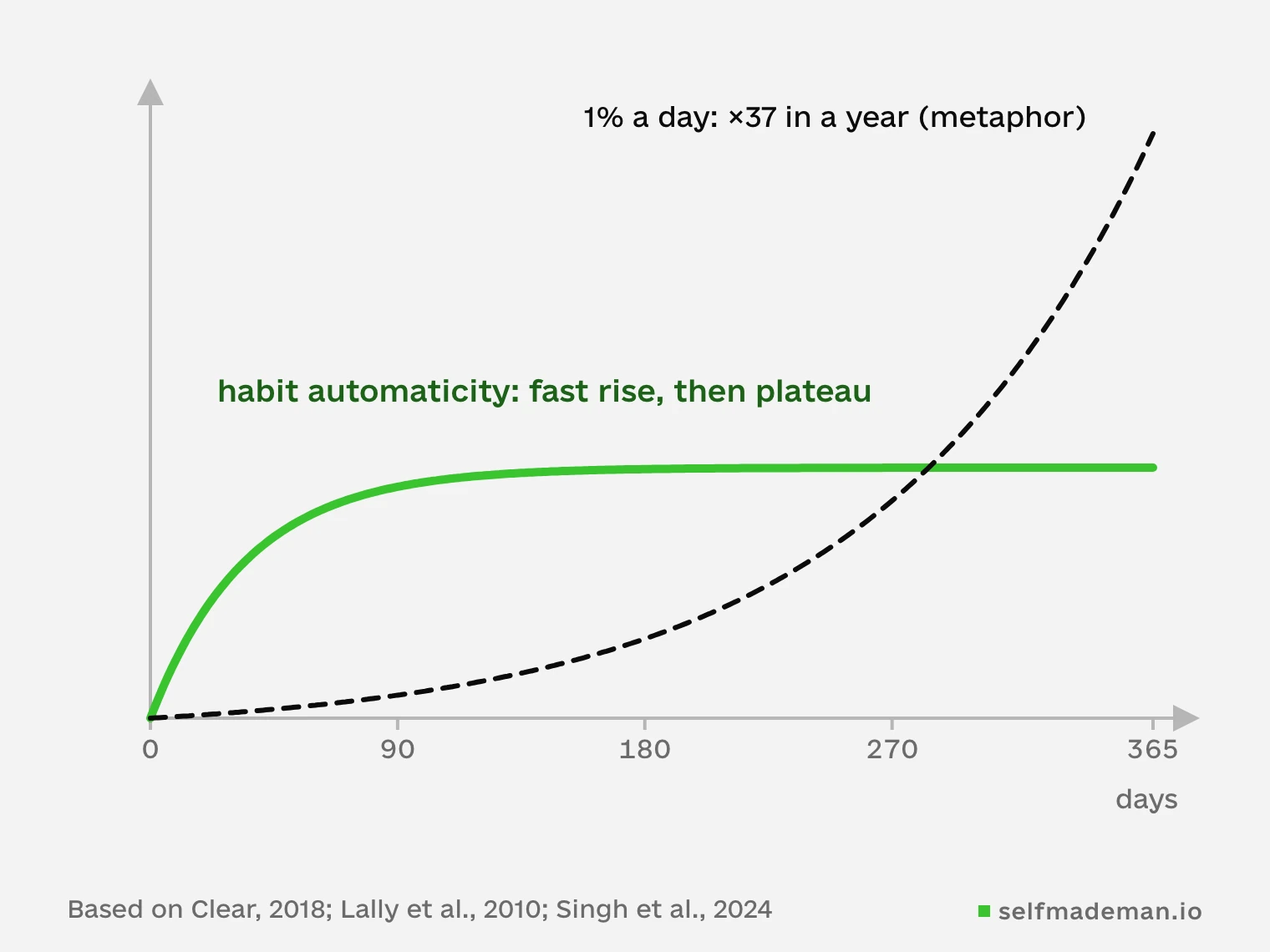
Small improvements are invisible in the moment, but they add up. Clear does the math like compound interest: get 1% better every day and after a year you’re about 37 times better (1.01 to the power of 365 is 37.8). Get 1% worse and you’re down to about 3% of where you started (0.99 to the power of 365)5. The point: don’t underestimate small things — they accumulate.
2. Systems over goals
A goal is the result you want. A system is the process that gets you there. Winners and losers often have the same goals; the difference is in their systems1. A goal answers “where to,” a system answers “what do I do every day.”
3. Identity-based habits
You can change outcomes (“lose weight”), processes (“go to the gym”) or identity (“I’m someone who works out”). Clear suggests starting with identity: decide who you want to be and prove it with small actions. Every action is a vote for that person5.
4. The four-step habit loop
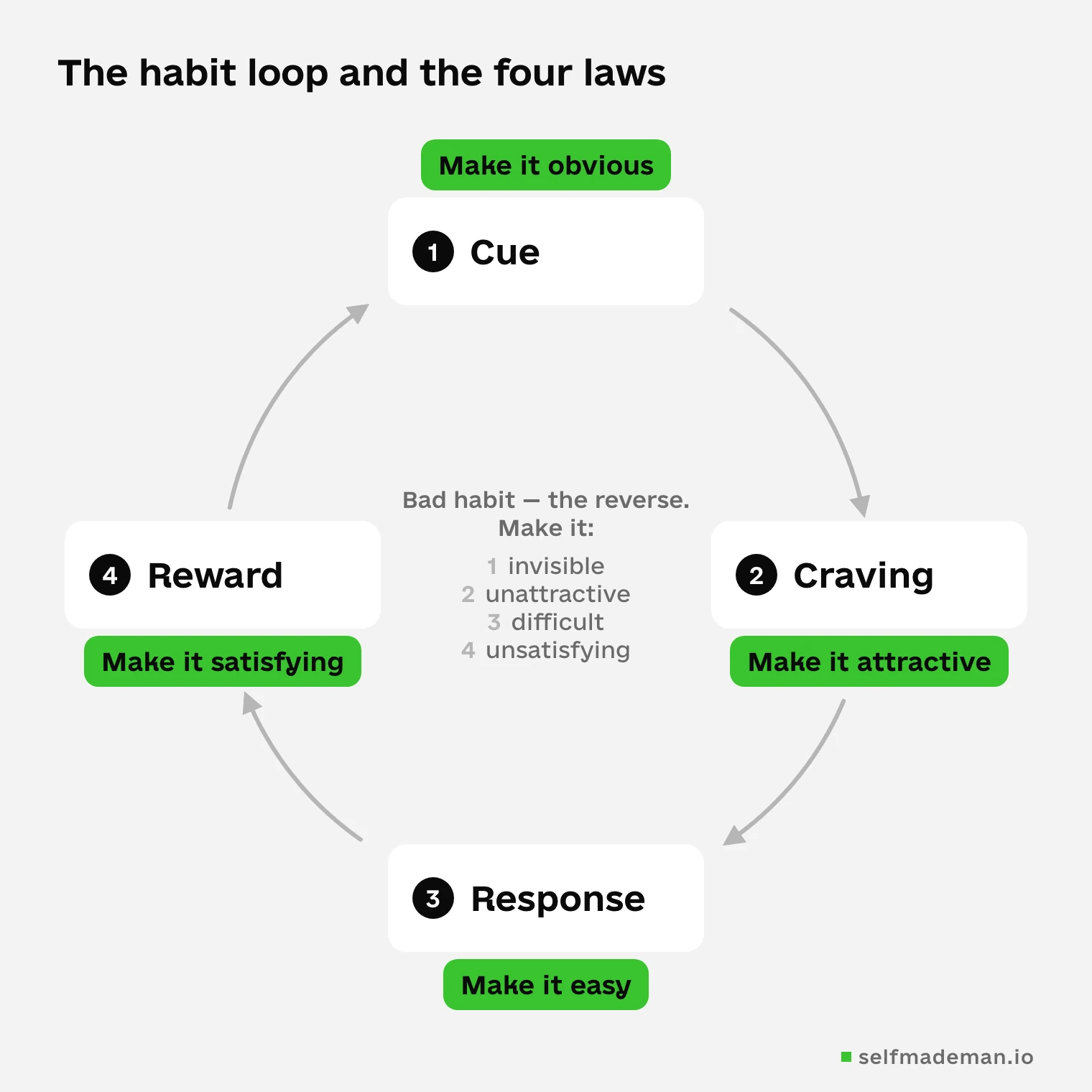
Cue → craving → response → reward. Duhigg has three steps; Clear added craving: what pulls you isn’t the cue itself but what you expect when you see it5.
5. The four laws of behavior change
Each law handles one step of the loop. Think of this table as your Atomic Habits cheat sheet.
| Law | Loop step | How to apply it | Inverse law for a bad habit |
|---|---|---|---|
| Make it obvious | Cue | Tie it to something you already do; put the book on your pillow | Make it invisible: keep your phone out of the bedroom |
| Make it attractive | Craving | Pair it with something you love | Make it unattractive: add up what it costs you |
| Make it easy | Response | A two-minute version, fewer steps to start | Make it difficult: more steps, log out of the account |
| Make it satisfying | Reward | An immediate reward, a check mark in a tracker | Make it unsatisfying: a deal with a friend, a penalty |
6. Habit stacking
The formula: “After I [something I already do], I will [new habit].” Clear calls it habit stacking and says outright that BJ Fogg came up with it3. It’s basically a special case of an if-then plan, which has solid evidence behind it (more below).
7. The two-minute rule
A new habit should take less than two minutes. “Read before bed” becomes “read one page.” “Go running” becomes “put on my running shoes”4. The point isn’t the two minutes. It’s learning to show up first. You can only improve a habit that already exists.
8. The tracker and “never miss twice”
Checking off a habit is one way to make it satisfying: the check mark is a reward right now. Everyone misses a day, but missing twice in a row is the start of a new habit — a bad one6. How to keep a tracker that doesn’t stress you out — in a separate article.
What the science supports
Linking a habit to a cue — yes. Plans of the form “if situation, then action” noticeably raise the odds of following through: a meta-analysis of 94 experiments found a medium-to-large effect7. Habit stacking is exactly that kind of plan.
Stable context and environment — yes. A habit is a learned “context → action” link, and the biggest factor is how consistently the context repeats8. “Make it obvious” is about precisely that.
Pairing with something enjoyable — yes, but more modestly than it seems. Katy Milkman came up with and tested temptation bundling: people got audiobooks they could only listen to at the gym. At first they went to the gym 51% more often than the control group, but the effect faded over time9. In a large follow-up experiment with nearly 6,800 people, advice to bundle added only a modest boost on top of simply handing out audiobooks10.
Tracking — yes. Monitoring progress raises the odds of reaching a goal, especially when you write the result down11.
Atomic Habits review: where the book oversimplifies
“1% a day” is a metaphor, not a model
The arithmetic is right, but people don’t grow like a bank deposit. Habit formation research shows a different curve: automaticity rises fast in the first weeks and then plateaus12. In a 2024 review, early repetitions gave the biggest gains, and returns dropped after that13. Skills work similarly: the first improvements come easily, each next one is harder. The metaphor is useful as motivation to keep doing small things. As a forecast of “37 times better in a year” — no.
What becomes a habit is starting, not the whole action
The book talks about habits as if an entire workout or an entire writing session can become automatic. Researchers distinguish between the habit of starting and the habit of doing. It was the habit of starting that better predicted how often people actually did the behavior14. A workout won’t become as automatic as brushing your teeth. Walking out the door in running shoes will. The two-minute rule, by the way, intuitively hits this exact point — that’s a real strength of the book.
Rewards matter at the start, not forever
In Clear’s model, craving and reward hold a habit in place for life. Research shows that an established habit barely responds to reward: people with a strong habit of eating popcorn at the movies kept eating it even when it was stale815. The practical takeaway differs from the book: with a bad habit, it’s more useful to change your environment and triggers than to fight the craving.
Stories picked to fit the conclusion
The first chapter opens with British cycling: coach Dave Brailsford arrived in 2003, hunted for 1% improvements in everything, and the British started winning the Olympics and the Tour de France16. A few years later, a scandal broke around Brailsford’s team. In 2018, a UK parliamentary committee report on doping said that Team Sky, which he ran, had used permitted medication not only out of medical need, and called that crossing an ethical line. According to the committee, the team broke no rules, and the team itself rejected the findings17. This doesn’t disprove the idea of small improvements. But it’s a reminder: a success story rarely has one neat cause.
More broadly, most habit research is correlational and relies on self-reports18. The book presents its conclusions with more confidence than the evidence allows. That’s normal for popular science — just read it as a collection of working techniques, not a textbook.
Clear gives you great tools — and overconfident promises. Take the first, discount the second.
How to apply Atomic Habits: a one-week experiment
You don’t need to implement the whole book. Take one habit and test the four laws over seven days.
- Pick one habit. Small and important. Write down who you’ll become if you do it: “I’m someone who reads.”
- Make it obvious. Tie it to something you do every day: “After my morning coffee, I open my book.” Put the book next to the coffee maker.
- Make it attractive. Pair it with something you love: read a book you enjoy, not “the useful one I’m supposed to.”
- Make it easy. The two-minute version is one page. More is fine, less isn’t.
- Make it satisfying. Right after, a check mark in your tracker. That’s the reward.
- Track it for a week. Missed a day? Don’t miss the second.
- At the end of the week, answer three questions. Which law worked best? Where did things break down? What will you change next week?
Atomic Habits worksheet
-
1One habit. Small and important. Ten techniques at once leave none in a week.
Start with identity, not with a result. Every repetition is a vote for this person.
-
2 Make it obvious. Make it invisible. Tie it to what you already do every day, and put the thing you need where the cue happens. What sets it off? Take that cue out of sight: the surroundings are a stronger lever than willpower.
-
3 Make it attractive. Make it unattractive. Pair it with something you enjoy. The effect is real but modest, so don’t build everything on it. Count what it costs you: time, sleep, money, mood.
-
4 Make it easy. Make it difficult. A version that takes under two minutes. More is allowed, less is not: first you learn to show up. Add steps between you and the habit: log out, put it further away.
-
5 Make it satisfying. Make it unsatisfying. A reward right after, not in a month. The simplest one is a tick in the tracker below. An agreement with a friend or a small penalty: so the habit has a cost right away.
Tick a day when you did at least the two-minute version.Tick a day when the plan worked. A missed day happens to everyone; just don’t miss twice.
The printout is an A4 sheet: empty fields become lines to fill in by hand, and the week has seven boxes to tick.
After the week, move the habit to the tracker: it opens with the habit, the cue and the two-minute version already in place.
Everything stays in this browser.
Who the book is for, and who it isn’t
- It’s for you if you know what you want to change but everything falls apart after a week. The book gives you specific levers for each step.
- It’s for you if you hate filler: the chapters are short, and each ends with a recap.
- It’s not for you if you want a scientific deep dive. Then Wendy Wood’s Good Habits, Bad Habits (2019) is a better pick — written by a researcher who studies habits herself.
- It won’t save you if the problem isn’t habits but burnout, depression or circumstances. Two minutes of reading won’t fix what needs rest or a professional.
- The trap: read it, get inspired and try ten techniques at once. A week later, none of them are left.
If you liked it, here are two books like Atomic Habits to read next: Charles Duhigg’s The Power of Habit (2012) — on the habit loop and company case studies — and BJ Fogg’s Tiny Habits (2019) — on tiny actions and anchoring them to existing habits.
Minimum version
Not going to read the book? Remember two things. The four laws: obvious, attractive, easy, satisfying. And the two-minute rule: start with a version you can’t fail to do.
If you slip
Clear is right about one of his simplest pieces of advice: never miss twice6. Research backs it: a single missed day doesn’t noticeably hurt habit formation12. Come back at the next cue with the two-minute version. No need to start over on Monday with a brand-new system.
FAQ
What are the main points of Atomic Habits?
Small daily actions compound into big results; systems matter more than goals; habits stick best when they’re tied to who you want to be; and you build good habits and break bad ones with four laws: make it obvious, attractive, easy and satisfying.
What are the four laws of Atomic Habits?
Make it obvious, make it attractive, make it easy, make it satisfying. For bad habits, the inverse: invisible, unattractive, difficult, unsatisfying.
What is the 1% rule in Atomic Habits?
The idea that small daily improvements compound like interest: 1% a day for a year comes out to roughly 37 times better. It’s a metaphor for the power of small steps, not an accurate forecast.
What is the 2-minute rule?
A new habit should take less than two minutes: one page instead of an hour of reading, putting on your running shoes instead of a run. First you learn to show up, then you scale up.
Is Atomic Habits worth reading?
Yes, if you want specific techniques rather than theory. Read it as a toolkit, not a science textbook, and apply one technique at a time.
How is Atomic Habits different from The Power of Habit?
Duhigg explains how habits work through stories of people and companies. Clear gives you a practical system: four laws and techniques for each one.
Today’s action
Pick one habit and write one sentence: “After [something I already do every day], I will [two-minute version of the new habit].” Put whatever you need where the cue will happen. Tomorrow, do it and check it off. 5 minutes.
If you want the habit to serve a bigger goal, start with one New Year’s promise. And if you’re juggling a lot of habits, they’re easier to hold as personal rules.
Sources
- Clear J. Atomic Habits: An Easy & Proven Way to Build Good Habits & Break Bad Ones. Avery, 2018. ↩
- Atomic Habits. jamesclear.com, as of October 2026. ↩
- Clear J. Habit Stacking. jamesclear.com. ↩
- Clear J. How to Stop Procrastinating by Using the 2-Minute Rule. jamesclear.com. ↩
- Clear J. Atomic Habits Summary. jamesclear.com. ↩
- Clear J. The Ultimate Habit Tracker Guide. jamesclear.com. ↩
- Gollwitzer P. M., Sheeran P. Implementation intentions and goal achievement: A meta-analysis of effects and processes. Advances in Experimental Social Psychology, 2006, 38: 69–119. ↩
- Wood W., Rünger D. Psychology of Habit. Annual Review of Psychology, 2016, 67: 289–314. ↩
- Milkman K. L., Minson J. A., Volpp K. G. Holding the Hunger Games Hostage at the Gym: An Evaluation of Temptation Bundling. Management Science, 2014, 60(2): 283–299. ↩
- Kirgios E. L., Mandel G. H., Park Y., Milkman K. L., Gromet D. M., Kay J. S., Duckworth A. L. Teaching temptation bundling to boost exercise: A field experiment. Organizational Behavior and Human Decision Processes, 2020, 161: 20–35. ↩
- Harkin B., Webb T. L., Chang B. P. I. et al. Does monitoring goal progress promote goal attainment? A meta-analysis of the experimental evidence. Psychological Bulletin, 2016, 142(2): 198–229. ↩
- Lally P., van Jaarsveld C. H. M., Potts H. W. W., Wardle J. How are habits formed: Modelling habit formation in the real world. European Journal of Social Psychology, 2010, 40(6): 998–1009. ↩
- Singh B., Murphy A., Maher C., Smith A. E. Time to Form a Habit: A Systematic Review and Meta-Analysis of Health Behaviour Habit Formation and Its Determinants. Healthcare, 2024, 12(23): 2488. ↩
- Gardner B., Phillips L. A., Judah G. Habitual instigation and habitual execution: Definition, measurement, and effects on behaviour frequency. British Journal of Health Psychology, 2016, 21(3): 613–630. ↩
- Neal D. T., Wood W., Wu M., Kurlander D. The pull of the past: When do habits persist despite conflict with motives? Personality and Social Psychology Bulletin, 2011, 37(11): 1428–1437. ↩
- Clear J. This Coach Improved Every Tiny Thing by 1 Percent. jamesclear.com, excerpt from chapter 1. ↩
- House of Commons Digital, Culture, Media and Sport Committee. Combatting doping in sport. Fourth Report of Session 2017–19, HC 366, 2018. ↩
- Gardner B. A review and analysis of the use of ‘habit’ in understanding, predicting and influencing health-related behaviour. Health Psychology Review, 2015, 9(3): 277–295. ↩