
How much is your time worth? Not “salary divided by 160.” Your hour has two prices. Your real hourly wage is what you actually get for an hour of life you give to work: take-home pay minus work-related costs, divided by every hour work takes, including the commute, late-night email and unpaid tasks. Your target rate is what you need to charge per billable hour to cover the income you want, your costs, taxes, time off and profit. The first number tells you what to delegate and automate. The second tells you what to ask clients for.
- Real hourly wage = (take-home pay − work costs) ÷ all the hours work eats.
- Target rate = (income you want + costs + taxes + profit) ÷ billable hours only.
- You always have fewer billable hours than working hours: sales, email, learning and bookkeeping take time too.
- If a task can be bought for less than your hour, it’s a candidate for delegation.
- Don’t price every hour. Rest and time with your kids aren’t on the rate card.
Table of contents
- My experience
- Two numbers: real hourly wage and target rate
- How to calculate your real hourly wage
- How to calculate your hourly rate as a freelancer or business owner
- What to do with the number: the opportunity cost of your time
- Time value calculator: your hour in dollars
- Where it breaks
- The minimum version
- If you’re carrying everything yourself again
- FAQ
- Your action for today
- Sources
My experience
I’ve been in SEO since 2007. Today I run my own agency and a portfolio of websites. Two of my rules are directly about the price of an hour. The first one: “I delegate more.” The second is a question I ask about any repetitive manual work: “Can this be automated?”
Behind both rules is plain arithmetic. When you run a business, your hour is worth more than any task another person or a script could do. And you still do it yourself, because “it’s faster to do it than to explain it…” Every single day.
In the description of my role as an entrepreneur, I wrote that I want to work on strategy and vision, and to delegate, track and control tasks clearly. The value of my hour is how I check whether my real week matches that description.
Two numbers: real hourly wage and target rate
| Real hourly wage | Target rate | |
|---|---|---|
| The question it answers | How much do I actually get for an hour of life I give to work? | How much should I charge per hour so the business pays me? |
| Who needs it | Everyone, including employees | Freelancers, consultants, business owners |
| On top | Take-home pay minus costs you wouldn’t have without the job | Income you want + business costs + taxes + profit |
| On the bottom | All hours: work, commute, email, “just a quick reply tonight” | Billable hours only |
| What it’s for | Delegating, automating, buying time, comparing job offers | Setting prices, turning down unprofitable projects |
How to calculate your real hourly wage
The idea of a “real hourly wage” isn’t new. Joe Dominguez and Vicki Robin popularized it in their book *Your Money or Your Life* (1992): subtract everything work costs you from your income, then divide by every hour work takes1.
- Take your monthly take-home pay. What lands in your account after taxes.
- Subtract the costs you wouldn’t have without the job. Commute, eating out at lunch, work clothes, phone, courses your employer requires.
- Count every hour work takes. Working hours, the commute both ways, email in the evenings and on weekends, calls on vacation. Multiply the weekly total by 4.33 — the average number of weeks in a month.
- Divide the first number by the second. That’s your real hourly wage.
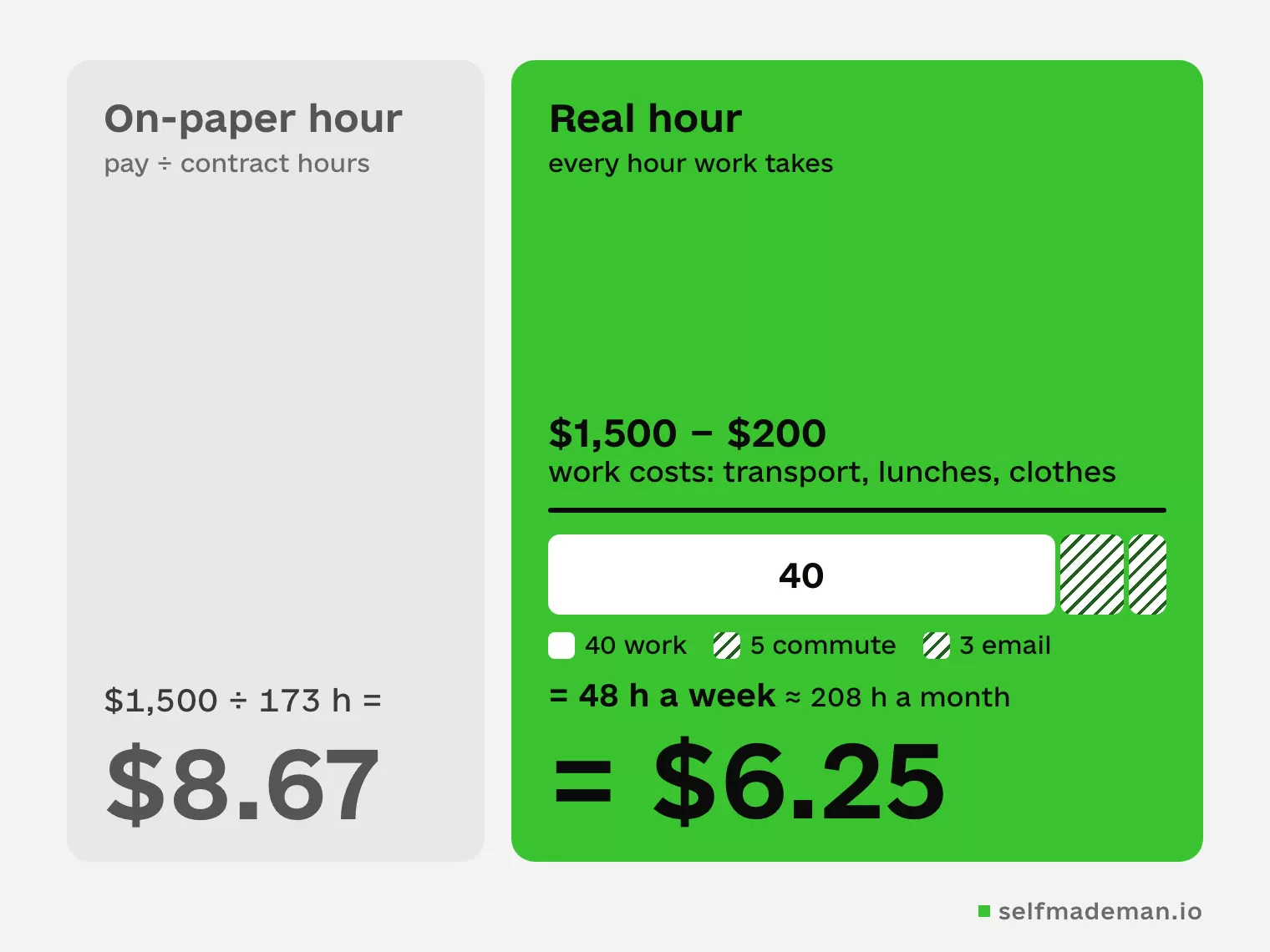
Example. Take-home pay is $1,500 a month. Officially 40 hours a week, plus 5 hours of commuting and 3 hours of evening email: 48 hours a week, about 208 a month. Work-related costs — transport, lunches, clothes — come to $200.
- Your “on paper” hour: $1,500 ÷ 173 hours ≈ $8.67.
- Your real hour: ($1,500 − $200) ÷ 208 hours ≈ $6.25.
That’s almost a third less. It’s not a reason to quit. It’s a number you can compare things against: a job closer to home, remote work, a side gig, an offer with a lower salary but without two hours in traffic.
How to calculate your hourly rate as a freelancer or business owner
The classic mistake here is dividing the income you want by 160 hours. It ignores three things: taxes and business costs, weeks you don’t work, and the hours nobody pays for.
- Monthly take-home income you want. What you want to pay yourself, like a salary.
- Monthly business costs. Software and subscriptions, equipment, an accountant, coworking, ads.
- Taxes. Based on your tax setup. The example below uses a placeholder 10% of revenue.
- Working weeks per year. 52 minus vacation, holidays and sick days. Don’t plan for 52: that way you sell your vacation in advance.
- Billable hours per week. Only the ones you invoice for. Sales, email, learning, bookkeeping and finding clients are work, but nobody pays for them.
- Profit you want. A margin on top of your pay: for growth, equipment, slow months.
- Do the math. (Income + costs) ÷ (1 − tax share) × 12 ÷ (weeks × billable hours), plus profit on top.
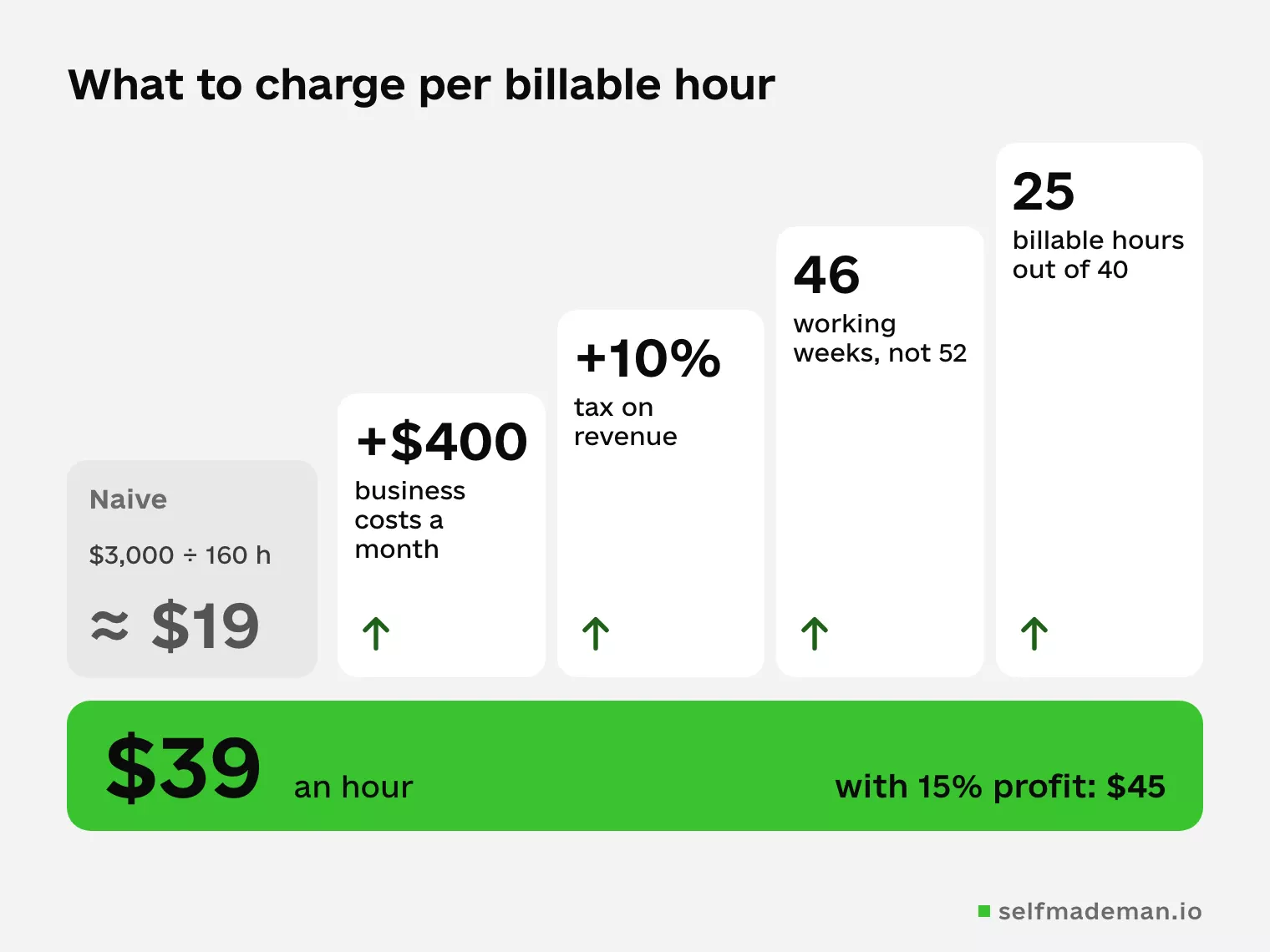
Example. You want $3,000 a month take-home. Business costs are $400. Tax is a placeholder 10%. You work 46 weeks a year. Of your 40 working hours a week, 25 are billable; the rest is sales and routine.
- Revenue you need: ($3,000 + $400) ÷ 0.9 ≈ $3,780 a month, or about $45,300 a year.
- Billable hours per year: 46 × 25 = 1,150.
- Rate without profit: $45,300 ÷ 1,150 ≈ $39 an hour.
- With 15% profit: about $45 an hour.
Now the “naive” math: $3,000 ÷ 160 hours ≈ $19. If you charge $20 an hour for the same 1,150 billable hours, after taxes and costs you take home about $1,325 a month. Not $3,000. That’s why freelancers end up working more and earning less than they planned.
Your hourly rate isn’t a measure of your self-worth. It’s math nobody bothered to do.
What to do with the number: the opportunity cost of your time
The calculation alone changes nothing. It’s there to help you make three decisions.
1. Delegate. List the tasks you do every week and ask about each one: could someone else do this cheaper than my hour, and well enough? If yes, it’s a candidate. Count the time you’ll spend explaining and checking: for the first few weeks, delegation costs more than it seems.
2. Automate. My question for any repetitive work is whether it can be automated. The math is simple. A report takes 2 hours a week, about 8.7 hours a month. At $40 an hour, that’s roughly $350. If automating it takes 10 hours of setup and a $20-a-month tool, it pays for itself in a month or a month and a half.
3. Buy time. Cleaning, delivery, repairs, bookkeeping. In a study by Ashley Whillans and colleagues (2017) of 6,271 people in the US, Canada, Denmark and the Netherlands, those who spent money on time-saving services reported greater life satisfaction. And in a field experiment, working adults felt happier after a time-saving purchase than after a material one2.
Productivity techniques are a special case. If the Pomodoro Technique or the Eisenhower Matrix frees up 3 hours a week, at $40 an hour that’s about $520 a month. It makes it easier to see whether a method is worth adopting.
I don’t sell every hour — I decide what to spend it on.
Time value calculator: your hour in dollars
How much you actually get for an hour of life given to work. For everyone, employees included: to delegate, automate, buy time and compare offers.
How much to charge per billable hour so the work pays: for freelancers, consultants and business owners.
Enter your take-home income and the hours the job takes.
Enter the desired income, working weeks and billable hours.
What I can hand over cheaper than my hour
Tasks you do every week. If another person or a script does one well enough and cheaper than your hour, it is a candidate to delegate or automate. Count your own hours to explain and check, too: the first weeks cost more than it seems.
Count the hour for work decisions. Rest and time with your kids are not priced. Recalculate every six months and whenever your job, rate or tax system changes.
A guide for your own calculation, not financial or tax advice. Taxes depend on your country and tax system. Numbers stay in this browser.
Where it breaks
- Not every hour can be sold. If you’re on a salary, a freed-up hour doesn’t automatically turn into money. It turns into rest, family, sleep, your own project. That has value too, but pricing it at your hourly rate is a stretch.
- Pricing your hour spoils your free time. In experiments by Sanford DeVoe and Julian House (2012), people asked to calculate their hourly wage enjoyed their free time and music less: they grew impatient for the “pause” to end3. So how much is your spare time worth? Use the number for work decisions only. With my kids, it’s like my rule says: “With my kids, I’m fully here.”
- The formula doesn’t know your market. The math may say $45, while clients in your niche pay $25. Then it’s not the formula you need to change, but what you sell: the skill, the niche, the packaging. More on that in setting a career goal for the year.
- Delegation isn’t free. You have to explain the task, check the result, sometimes redo it. Count not just their rate but your hours of oversight.
- Cheap doesn’t mean unnecessary. Some tasks are cheaper to hand off, but you do them for the pleasure or the skill. That’s fine. The calculator helps you decide; it doesn’t forbid anything.
The minimum version
No time for all of this? One formula, two minutes: last month’s take-home pay ÷ all the hours work took. Include the commute and email. Write the number somewhere you’ll see it. The next task you want to “just quickly do yourself” goes through that number.
If you’re carrying everything yourself again
You did the math, you decided to delegate, and a month later it’s all on you again. That’s normal: the “faster to do it myself” habit is stronger than one spreadsheet. You don’t need to rebuild everything at once. Pick one task a week and hand it off. In a month that’s four tasks and a few free hours. If delegation didn’t work, look at what broke: the explanation, the person, or whether the task was needed at all.
Recalculate your number every six months and whenever your job, rate or tax setup changes.
FAQ
How do I calculate what my time is worth?
If you’re on a salary: take-home pay minus work-related costs, divided by every hour work takes, including the commute. If you work for yourself: the income you want plus business costs, taxes and profit, divided by your billable hours.
How do I calculate my hourly rate as a freelancer?
Add up the yearly income you want, business costs and taxes, then divide by your real billable hours for the year: working weeks without vacation times the hours you actually invoice. Add a profit margin on top.
Why can’t I just divide my income by 160 hours?
Because 160 hours a month are never all billable. Part goes to sales, email and learning, and there’s vacation, sick days and taxes. An “income ÷ 160” rate almost always leaves you with noticeably less than you planned.
How much is my time worth if I’m on a salary?
Divide your take-home pay minus work costs by every hour your job takes. It usually comes out lower than “salary ÷ 173.” It’s a handy number for comparing job offers and the price of services that save you time.
How much is $1,000 a day per hour?
For an 8-hour day, $1,000 is $125 an hour. But if only 5 of those 8 hours are billable, the rate you need to charge is $200 an hour to earn the same $1,000.
Should I put a price on my free time?
For decisions, yes: is it worth paying for delivery or cleaning? For the rest itself, no. The habit of valuing every hour in money makes it harder to relax.
Your action for today
Open your notes and calculate your real hourly wage for last month: take-home pay minus work costs, divided by all hours, including the commute and email. Then list three tasks you do every week that you could buy for less than that number. Hand off one of them this week. 15 minutes.
Sources
- Dominguez J., Robin V. Your Money or Your Life. Viking, 1992; revised edition — Penguin Books, 2018. Chapter on the “real hourly wage.” ↩
- Whillans A. V., Dunn E. W., Smeets P., Bekkers R., Norton M. I. Buying time promotes happiness. Proceedings of the National Academy of Sciences, 2017, 114(32), 8523–8527. ↩
- DeVoe S. E., House J. Time, money, and happiness: How does putting a price on time affect our ability to smell the roses? Journal of Experimental Social Psychology, 2012, 48(2), 466–474. ↩